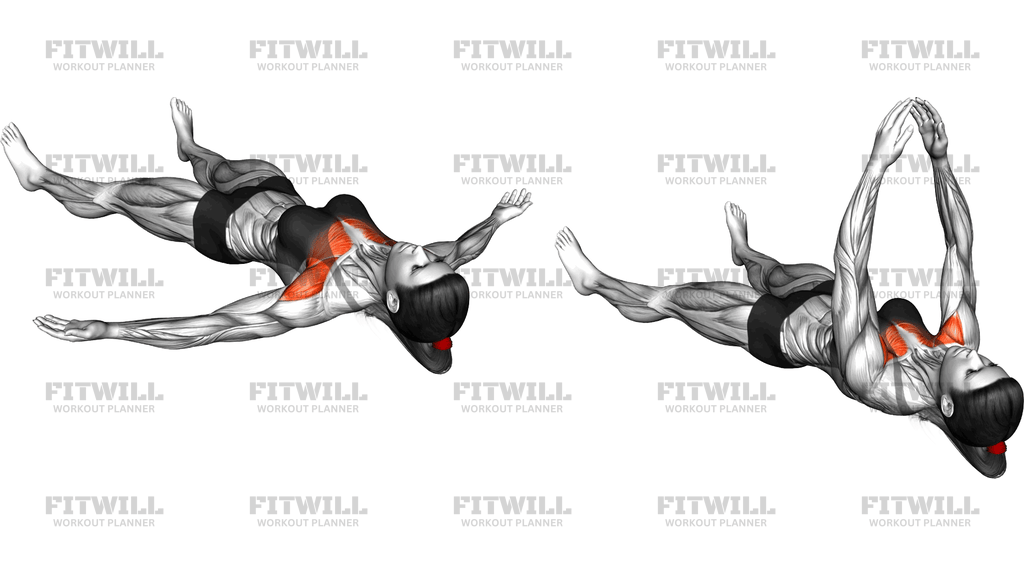
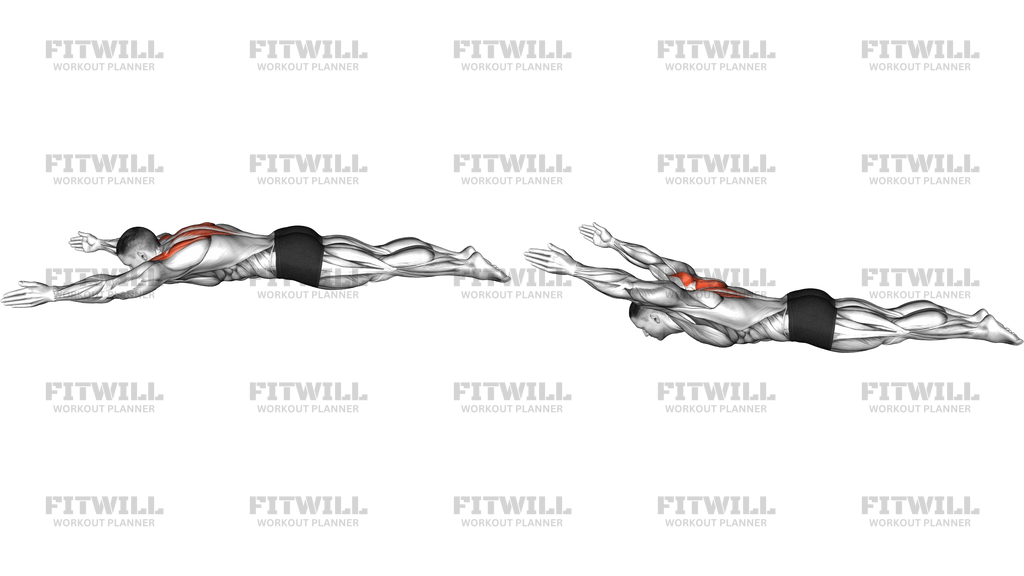
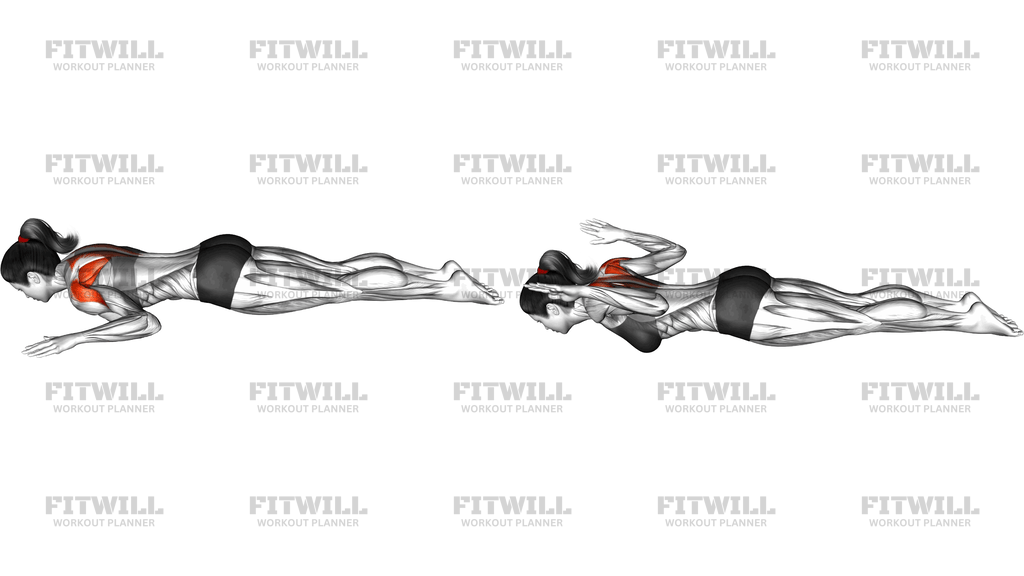
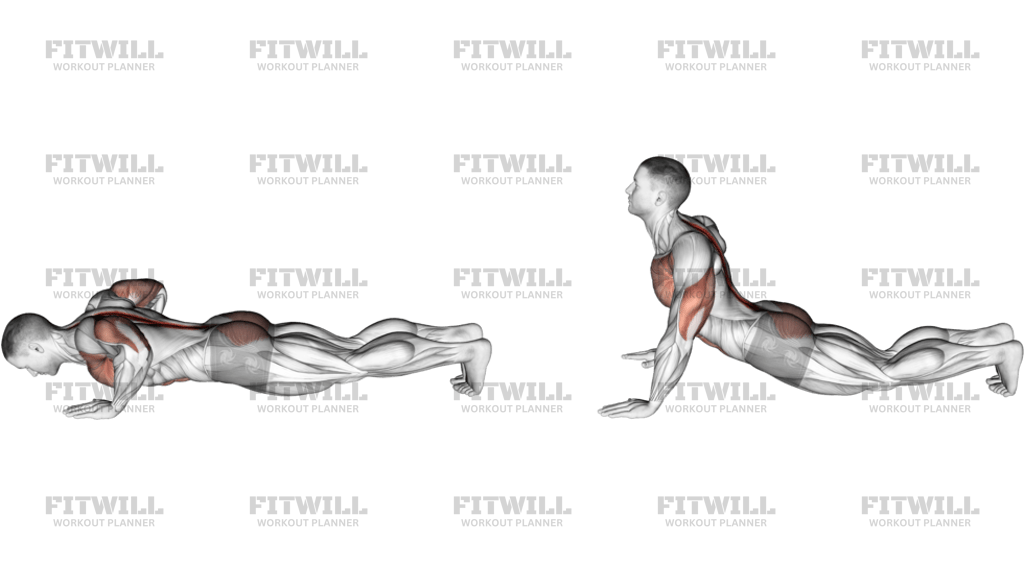
Lying Upper Body T Raise
The Lying Upper Body T Raise is a bodyweight movement performed face down on the floor, with the arms straight out to the sides so the torso and arms form a letter T. From that position, you lift both arms toward the ceiling by squeezing the shoulder blades together, letting the upper chest rise slightly off the floor as the upper back does the work. It looks simple, but the position makes it one of the most direct ways to feel the muscles between the shoulder blades without any equipment beyond a mat or a patch of floor.
This exercise primarily targets the mid-back — the middle trapezius, rhomboids, and rear deltoids — while the muscles along the spine work to hold the chest in a gentle, supported extension. Because the arms move away from the body rather than toward it, the emphasis sits squarely on scapular retraction, which is exactly what tends to be weak in people who spend long hours at a desk or in front of a screen.
The prone setup matters more than it might seem. Lying face down removes momentum from the equation and forces the upper back to lift the arms against gravity from a dead stop. It also places the shoulder in a position where the rotator cuff and scapular stabilizers have to control the arm throughout the entire range, which builds coordination along with strength. Keep the thumbs rotated toward the ceiling; this external shoulder rotation keeps the movement shoulder-friendly and biases the rear shoulder and mid-back rather than the front of the shoulder.
The Lying Upper Body T Raise fits well into warm-ups, posture-focused routines, and finishers after pulling workouts. It is a common rehabilitation-style exercise for shoulder health, and many lifters use it as an activation drill before rows, pull-ups, or presses so the mid-back is firing before heavier loading. Because it uses only bodyweight, it can be done almost anywhere and progressed simply by adding reps, holding the top position longer, or slowing the lowering phase.
The main technical points are keeping the neck in line with the spine, avoiding shrugging the shoulders toward the ears, and lifting through the arms and upper back rather than throwing the head back. The legs, hips, and lower body should stay relaxed and in contact with the floor; this is an upper body movement, and arching hard through the lower back just shifts work away from where it belongs. Small, clean reps with a brief pause at the top beat large, bouncy ones every time.
Fitwill
Log Workouts, Track Progress & Build Strength.
Achieve more with Fitwill: explore over 9600 exercises with images and videos, access built-in and custom workouts, perfect for both gym and home sessions, and see real results.
Start your journey. Download today!




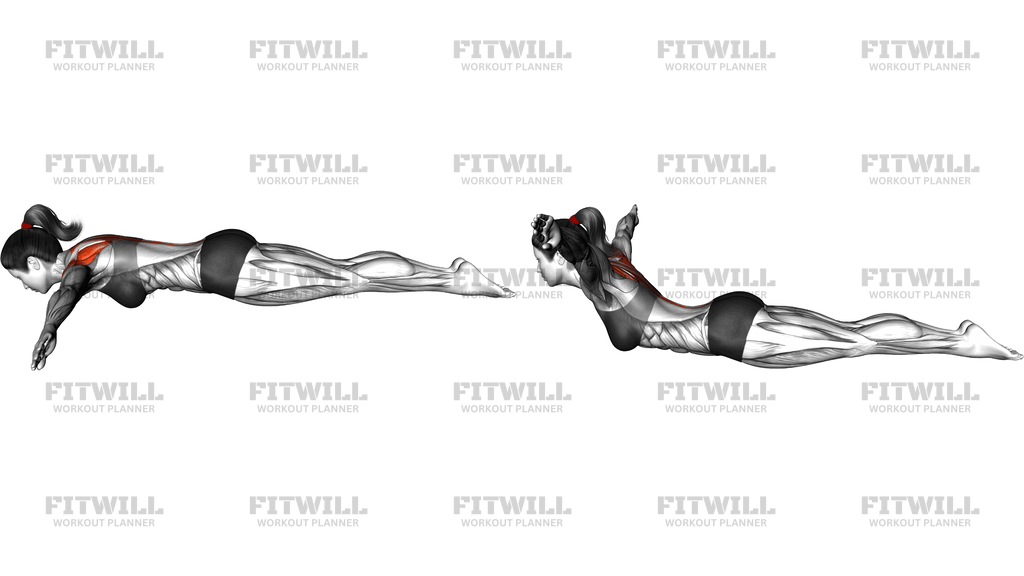
Instructions
- Lie face down on an exercise mat with your legs straight behind you, feet relaxed, and your forehead hovering just above or lightly resting on the floor.
- Extend both arms straight out to the sides at shoulder height so your body forms a T shape, with your palms facing down and your thumbs rotated up toward the ceiling.
- Draw your shoulders slightly away from your ears and brace your core gently so your lower back stays long before you move.
- Exhale and lift both arms up toward the ceiling by squeezing your shoulder blades together and down, keeping the elbows straight.
- Let your upper chest rise a few centimeters off the floor as your arms lift, but keep your neck in line with your spine — do not tilt your head back to lift higher.
- Pause at the top for one to two seconds with the arms as high as you can raise them without shrugging.
- Inhale and lower your arms slowly and under control back to the floor, resisting gravity rather than dropping them.
- Reset your shoulder position and neck briefly between reps, then repeat for your target number of repetitions.
- Keep your hips, glutes, and legs relaxed and in contact with the floor throughout the entire set.
Tips & Tricks
- If you feel the front of your shoulders or your neck doing the work, rotate your thumbs further toward the ceiling — this small change shifts the effort to the rear shoulders and mid-back.
- A common mistake is lifting the head and chin to fake a bigger range; keep your gaze down at the floor so the neck stays neutral and the upper back does the lifting.
- Watch for shrugging: if your shoulders creep toward your ears at the top, lower the arms slightly and think about pulling the shoulder blades down and together, not just up.
- Do not force the chest far off the floor. The arms are the moving parts; a modest chest lift is enough, and cranking into a big back extension steals work from the mid-back.
- Bent elbows turn this into a different, easier movement. If your elbows keep bending, reduce the range and focus on long, straight arms.
- The lowering phase is where most people rush. Take two to three seconds to return the arms to the floor to build control through the full path.
- If the floor position is uncomfortable on your ribs or hips, place a thin pad under your hips or lie with the forehead supported on a small folded towel.
- Quality matters more than volume here — 10 to 15 clean reps with a top pause beat 30 fast, sloppy ones for training the muscles between the shoulder blades.
- Use this before rowing or pressing sessions as an activation drill: two light sets where you can feel the mid-back working will improve how heavier pulling exercises feel.
Frequently Asked Questions
What muscles does the Lying Upper Body T Raise work?
It primarily targets the middle trapezius and rhomboids of the upper back, along with the rear deltoids. The lower traps, rotator cuff, and the muscles along the spine assist to hold the lifted position.
Why are the arms held out to the sides in a T shape instead of overhead?
The T position places the arms at shoulder height perpendicular to your torso, which biases scapular retraction — the shoulder blades squeezing together. Different arm angles shift emphasis, and the T is the most direct mid-back variation.
Should my palms face down or up during the Lying Upper Body T Raise?
Start with palms facing the floor and thumbs rotated up toward the ceiling. This keeps the shoulders in external rotation and makes the movement more comfortable and more effective for the rear shoulders.
Is this exercise suitable for beginners?
Yes. It uses only bodyweight and a short range of motion, so it is very approachable. Beginners should focus on slow reps with a brief pause at the top rather than chasing a large chest lift.
How high should I lift my chest off the floor?
Only a few centimeters. The arms are the primary movers; if you find yourself arching hard through the lower back or craning your neck to lift higher, the range has gone too far.
Why do I feel my neck working during this exercise?
This usually means the head is tilting back or the upper traps are shrugging. Keep your gaze down at the floor, draw the shoulders away from your ears before lifting, and reduce the height of each rep until the neck stays quiet.
How is the Lying Upper Body T Raise different from a Y Raise?
In the T Raise the arms go straight out to the sides, while a Y Raise angles them up past the head, which shifts more work toward the lower trapezius. Both are done prone and often trained together.
Can I add weight to the Lying Upper Body T Raise?
You can hold very light dumbbells once bodyweight reps feel easy, but most people get plenty of benefit from adding a top hold or slowing the descent first. Light weight matters here because the mid-back muscles are small.
How many reps and sets should I do?
Two to three sets of 10 to 15 reps with a one-to-two second pause at the top works well, whether as a warm-up or as standalone mid-back work. Stop the set when your form or arm height starts to drop.
Is it safe to do this exercise if I have shoulder discomfort?
The prone T position is generally gentle on the shoulders, but any movement should stay pain-free. Keep the range small, use the thumbs-up arm position, and stop and consult a professional if discomfort persists.