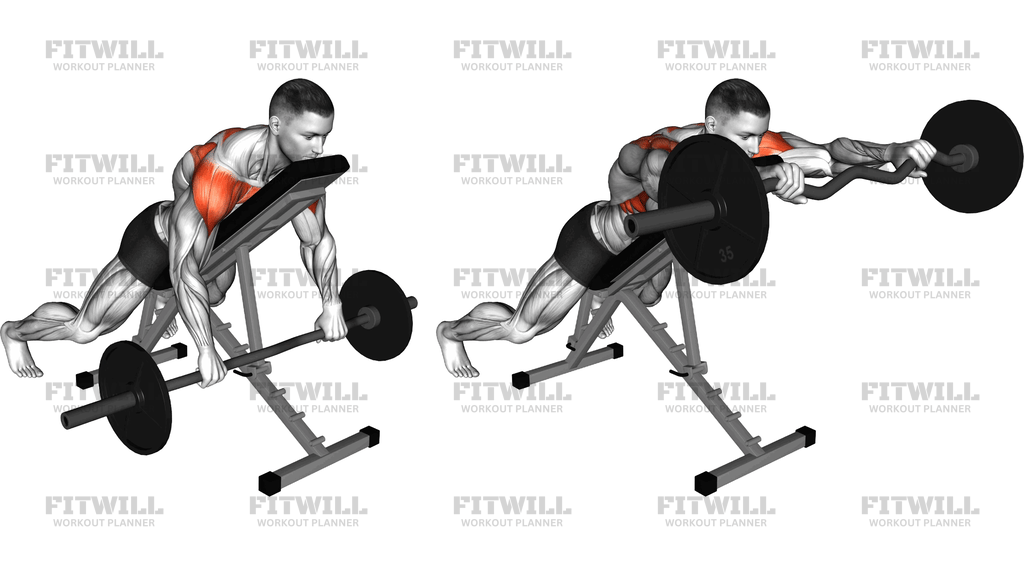
Ez Bar Incline Lying Rear Delt Raise
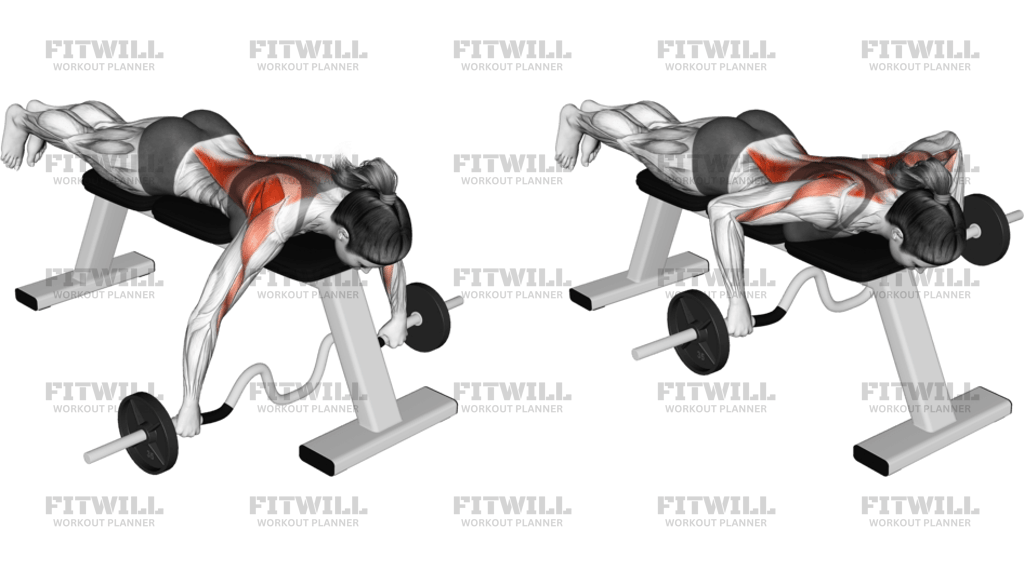
The Ez Bar Incline Lying Rear Delt Raise is a shoulder isolation exercise performed lying chest-down on an incline bench while raising an EZ bar out to the sides with straight arms. The inclined, prone position pins your torso against the bench, which removes almost all momentum from the equation and forces the rear deltoids to do the work. Because you hold a single EZ bar rather than two separate dumbbells, both arms stay locked into the same path, which makes it easier to spot and fix left-to-right imbalances.
This movement primarily targets the posterior deltoids, with strong contributions from the middle and lower traps, the rhomboids, and the small rotator cuff muscles that stabilize the shoulder as the arm travels. The wide, semi-pronated grip on the EZ bar's angled sections sits comfortably on the wrists and naturally encourages the slight external rotation that biases the rear delts over the lats. If your rear shoulder development lags behind your front and side delts from a lot of pressing work, this exercise is one of the most direct ways to close that gap.
Setup matters more here than in most raises. The bench angle is typically set between 30 and 45 degrees, high enough that your arms can hang and swing clear of the floor but low enough that your chest stays firmly supported. Your feet should be planted wide on the floor with knees slightly bent, bracing your body against the bench so your torso cannot rock as the bar moves. If your chest peels off the pad, the weight is too heavy or the angle is too steep.
Execution is simple but demanding. With the bar hanging directly beneath your shoulders, elbows slightly bent, you sweep it up and out in a wide arc until your arms reach roughly shoulder height or just below, then lower it under control. The bar travels in front of and slightly below the bench, so keep your chin tucked and your neck neutral rather than craning upward to watch the plates.
You will see this lift used as a primary rear delt builder in shoulder days, as a pre-exhaust before rows or pulls, and as a finishing movement with light weight and higher reps at the end of an upper-body session. It also suits lifters who find dumbbell rear delt raises hard to load evenly, since the bar keeps the range symmetrical.
Because the rear delts are a small muscle, ego lifting is the fastest way to ruin this exercise. Choose a load you can raise smoothly for 10 to 15 reps without shrugging, swinging, or lifting your chest off the pad. The stretch at the bottom and the squeeze at the top matter far more than the number on the plates.
[ Workout Log & Planner ]
Put your next workout in Fitwill
Keep your plan and training log ready when you are.


Instructions
- Set an incline bench to roughly 30-45 degrees and position a loaded EZ bar on the floor directly under the top edge of the bench.
- Lie chest-down on the pad so your chest and the front of your shoulders are supported, and plant your feet wide on the floor with knees softly bent to stabilize your body.
- Grip the EZ bar on the angled inner sections with an overhand grip, hands wider than shoulder width, and let your arms hang straight down toward the floor.
- Keep a slight bend in your elbows and hold it throughout the set; brace your core lightly and tuck your chin so your neck stays in line with your spine.
- Raise the bar up and out to the sides in a wide arc, leading with your elbows, until your upper arms reach shoulder height or just below.
- Pause briefly at the top and squeeze your rear shoulders and upper back without shrugging the bar toward your ears.
- Lower the bar slowly along the same arc until your arms are fully extended beneath you and you feel a mild stretch across the back of the shoulders.
- Exhale as you raise the bar and inhale as you lower it, keeping your breathing steady and your chest in contact with the pad on every rep.
- Complete the set, then stand up carefully and set the bar down with both hands rather than dropping it from the hanging position.
Tips & Tricks
- If your chest lifts off the pad as you raise the bar, the weight is too heavy or you are initiating with your lower back — drop the load and keep your torso glued to the bench.
- Shrugging at the top means the upper traps are taking over; consciously press your shoulder blades down and slightly together as you lift instead of letting them ride up.
- Bending the elbows more as the rep gets hard turns this into a row; lock in one slight elbow angle at the start and hold it for every rep.
- Raising the bar too high, past shoulder level, shifts tension into the traps and strains the shoulder capsule; stop when your upper arms are parallel to the floor.
- Letting the bar drift back toward your hips shortens the arc and reduces rear delt work; keep the bar traveling directly out to the sides from under your shoulders.
- Craning your neck to watch the plates fatigues the upper back and pulls you out of position; look straight down at the floor throughout the set.
- A thumbless or relaxed overhand grip on the EZ bar's angles often improves the rear delt feel compared with gripping hard, as long as you maintain control of the bar.
- If your grip gives out before your shoulders, use smaller plates or lift the bar from a low rack position instead of the floor to shorten the lever arm slightly.
- Because the arms hang below the bench, check that the plates will not strike the bench frame or floor at full extension before you start your set.
Frequently Asked Questions
What muscles does the Ez Bar Incline Lying Rear Delt Raise work?
It primarily targets the posterior deltoids at the back of the shoulders. The middle and lower traps, rhomboids, and rotator cuff muscles assist as the bar rises to shoulder height.
Why use an EZ bar instead of dumbbells for this rear delt raise?
The EZ bar locks both arms into one symmetrical path and its angled grip sections sit comfortably in a wide, semi-pronated hand position. That makes it easier to keep both sides working evenly than with two independent dumbbells.
What bench angle should I use for the Ez Bar Incline Lying Rear Delt Raise?
Around 30 to 45 degrees works for most people. The angle must be high enough that your arms can hang freely below you and sweep up without the bar hitting the floor or the bench frame.
Is this exercise suitable for beginners?
Yes, but start very light — the EZ bar alone is often enough for the first few sessions. The prone position removes momentum, so beginners can learn what a true rear delt contraction feels like before adding plates.
Why do I feel my traps working instead of my rear delts?
This usually means you are shrugging the bar up or raising it past shoulder height. Keep your shoulder blades pressed down, stop when your upper arms reach parallel to the floor, and reduce the weight if needed.
How many reps and sets should I do?
Because the rear delts are a small muscle and this is an isolation movement, 3 to 4 sets of 10 to 15 controlled reps works well. Lighter loads and higher reps tend to produce better quality contractions than heavy, sloppy sets.
Can I substitute the Ez Bar Incline Lying Rear Delt Raise if I do not have an EZ bar?
Yes — incline dumbbell rear delt raises, cable reverse flyes, or bent-over rear delt raises with a band train the same area. The EZ bar's main advantage is the fixed, even path for both arms.
Is it safe for my shoulders?
When performed with moderate weight and a controlled arc to about shoulder height, it is generally well tolerated and commonly used for balanced shoulder training. Stop at the top of the range rather than forcing the bar higher, and avoid jerking the weight off the floor.
Where should this exercise fit in my workout?
It works well after your main presses or rows, when the rear delts still get full attention but the load stays light. It can also serve as a pre-exhaust before heavy back work or as the final rear delt movement on a shoulder day.
Should my elbows stay bent or straight during the raise?
Keep a small, fixed bend in the elbows — around 10 to 20 degrees — from start to finish. Fully locked arms stress the elbow joint, and bending the elbows more mid-rep turns the movement into a row and shifts work away from the rear delts.