Barbell Drag Curl (Version 2)
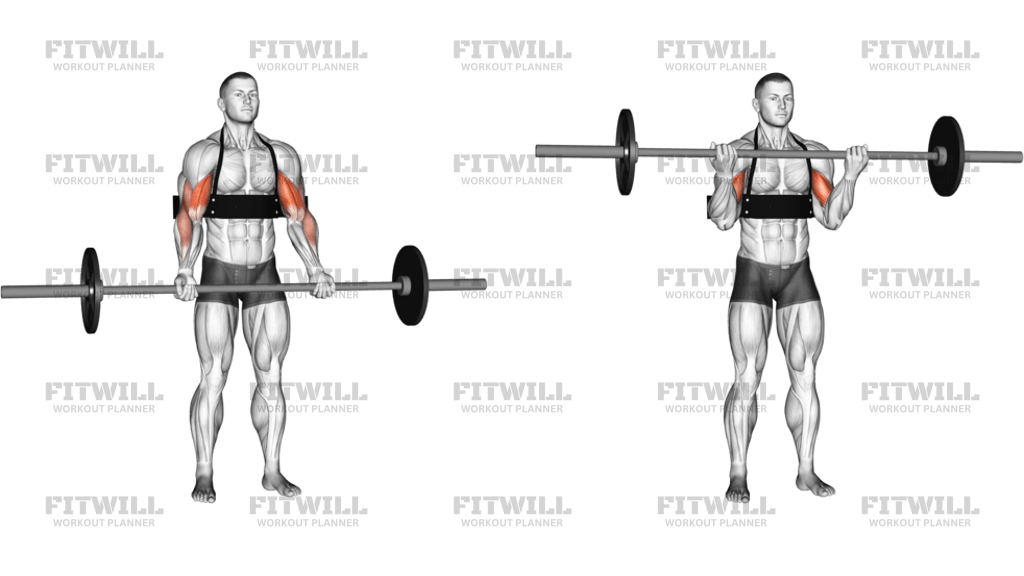
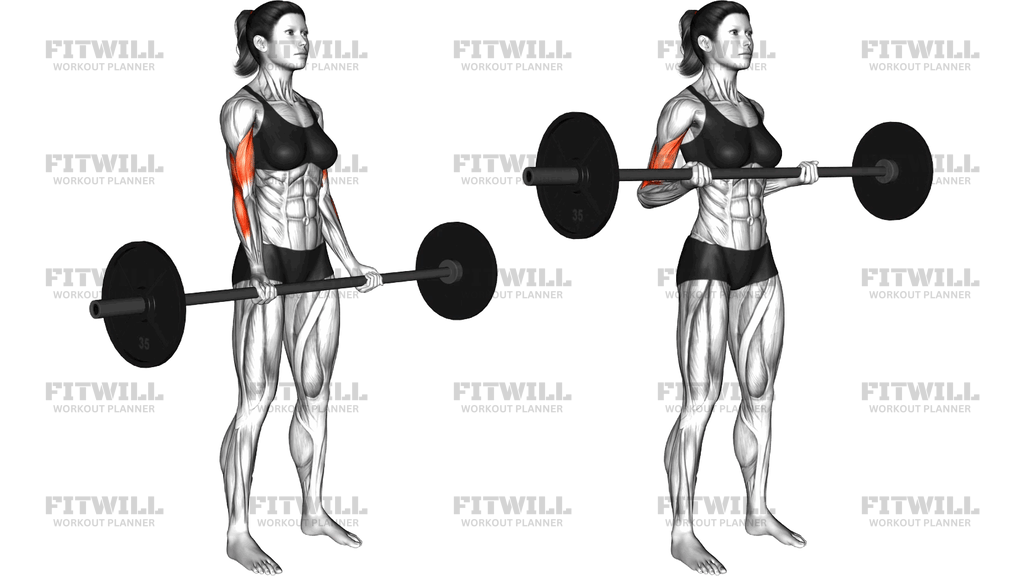
The Barbell Drag Curl is a strict biceps variation where the bar stays in contact with your body for the entire rep. Instead of curling the weight out in front of you, you pull it straight up your torso — almost dragging it along your thighs, hips, and stomach — until your elbows travel behind your ribs and the bar reaches your lower chest. That forward shoulder position is what separates it from a standard barbell curl.
Because the bar never swings away from the body, the front delts have very little chance to take over, and momentum is nearly eliminated. The biceps brachii and the brachialis underneath it do almost all of the work, which makes this a favorite for lifters whose arms feel more like a shoulder exercise when they curl. It is especially useful for people who have built up strength on heavy curls but still lack peak and detail in the upper arm.
The setup is simple: stand tall with a shoulder-width grip on a barbell, arms hanging fully extended at your sides. The key positions to hold throughout the set are retracted shoulder blades, stacked ribs over hips, and elbows that track backward rather than forward. If any of those positions slip, the bar drifts forward and the exercise turns back into an ordinary curl.
Execution is deliberately slow. You pull the bar up in a tight vertical line against your torso, squeeze hard at the top where your elbows are pulled well behind you, then lower under control along the same path. The range is shorter than a regular curl and the top portion feels compressed — that is normal, and it is exactly where the biceps are working hardest.
Use the Barbell Drag Curl as a second or third biceps movement after your heavier curls, with moderate weight and higher reps. It pairs well with incline curls or hammer curls in an arm-focused session. Because the elbow stays behind the torso under load, choose a weight you can move cleanly, and stop the set as soon as your torso starts leaning back to finish reps.
[ Workout Log & Planner ]
Put your next workout in Fitwill
Keep your plan and training log ready when you are.


Instructions
- Stand with your feet hip-width apart and hold a barbell with an underhand grip about shoulder-width apart, arms fully extended so the bar rests against the front of your thighs.
- Pull your shoulder blades back and down, brace your core, and keep your ribs stacked over your hips so your torso stays upright.
- Rotate your elbows slightly in so they point down and back, and keep your shoulders pulled forward out of a shrug before you start the rep.
- Exhale and pull the bar straight up your body, keeping the bar in light contact with your thighs, hips, and stomach the whole way.
- Let your elbows travel behind your ribs as you pull, and finish with the bar just below chest height and your biceps fully contracted.
- Pause for a beat at the top and squeeze your biceps without letting your upper arms drift forward or your torso lean back.
- Inhale and lower the bar along the same tight path down your torso until your arms are fully extended again.
- Keep your knees soft and your feet planted throughout; do not swing the bar away from your body to generate momentum.
- Complete all reps on one side of the bar path only — straight up, straight down — then set the bar down safely once the set is finished.
Tips & Tricks
- The most common mistake is turning this into a standard curl by letting the bar swing forward. If the bar loses contact with your torso, the set is over — end it or reduce the weight.
- Lean your torso back even slightly and your lats and rear delts start pulling instead of your biceps. Check your ribs: if they flare up as you pull, you are cheating the rep.
- Short range at the top is expected. If you try to curl all the way to shoulder height, your elbows will drift forward and defeat the purpose of the drag path.
- Use a lighter load than your normal barbell curl. Most lifters need roughly 60-70% of their regular curl weight to keep the bar glued to their body.
- If your wrists ache at the top, widen your grip slightly. A narrow grip forces the forearms to rotate inward and can irritate the wrist joint when the elbows pull back.
- Think of the cue "elbows back, not forward." The bar should finish near your sternum with your elbows pointing behind you, not lifted in front of your chest.
- Do these near the end of your arm workout. Starting with them makes heavy conventional curls feel awkward, but they are excellent after a heavy curl to isolate the biceps under fatigue.
- Grip the bar with your fingers rather than a death grip in the palms. Excessive squeezing recruits the forearms and steals tension from the biceps.
- If your lower back fatigues before your arms, brace harder or split the set into two shorter blocks instead of leaning back to keep pulling.
Frequently Asked Questions
What muscles does the Barbell Drag Curl work?
The biceps brachii is the primary muscle, with strong support from the brachialis and brachioradialis in the upper and lower arm. Because the bar is dragged up the torso, the front delts contribute far less than in a standard barbell curl.
How is the Barbell Drag Curl different from a regular barbell curl?
In a regular curl the bar arcs forward and away from your body, which lets the shoulders help. In the drag curl the bar stays glued to your torso and your elbows travel behind you, so the biceps do nearly all of the work through a shorter range.
Why does the range of motion feel so short at the top?
The short range is a feature, not a flaw. With your elbows pulled behind your torso, the biceps reach full contraction early, so forcing the bar higher only shifts the load to your shoulders and lower back.
Is the Barbell Drag Curl good for beginners?
It can be, provided the weight is kept light. Beginners often benefit because the bar against the body gives instant feedback — the moment form breaks down, the bar drifts forward and you feel it immediately.
How much weight should I use compared to a normal barbell curl?
Start with noticeably less, usually around 60-70% of your regular curl weight. The strict leverage and reduced body English mean your biceps are working harder at any given load.
My lower back feels strained during the Barbell Drag Curl. What should I fix?
You are most likely leaning your torso back as the bar rises to help pull the weight. Brace your core, keep your ribs over your hips, and cut the load until you can keep your torso still for every rep.
Can I use an EZ bar instead of a straight barbell?
Yes, an EZ barbell is a good substitute if the straight bar bothers your wrists or elbows. The semi-supinated grip slightly shifts emphasis toward the brachialis and brachioradialis while keeping the same dragging path.
Where in my workout should I place the Barbell Drag Curl?
It works best as a second or third biceps exercise after your heavier curl variations, using moderate weight and controlled reps in the 8-15 range to finish the arms with strict tension.
Should the bar actually touch my body during the movement?
Yes, light contact with your thighs, hips, and stomach is the defining feature of the exercise. The bar should slide up your torso in a straight vertical line rather than arc outward.
Is the Barbell Drag Curl safe for the elbows?
For most lifters it is joint-friendly because the weight is kept moderate and momentum is removed. However, if you have a history of elbow or wrist discomfort, warm up thoroughly and keep the grip width neutral to slightly wide to avoid pinching at the top.