Dumbbell Row With Chest Supported
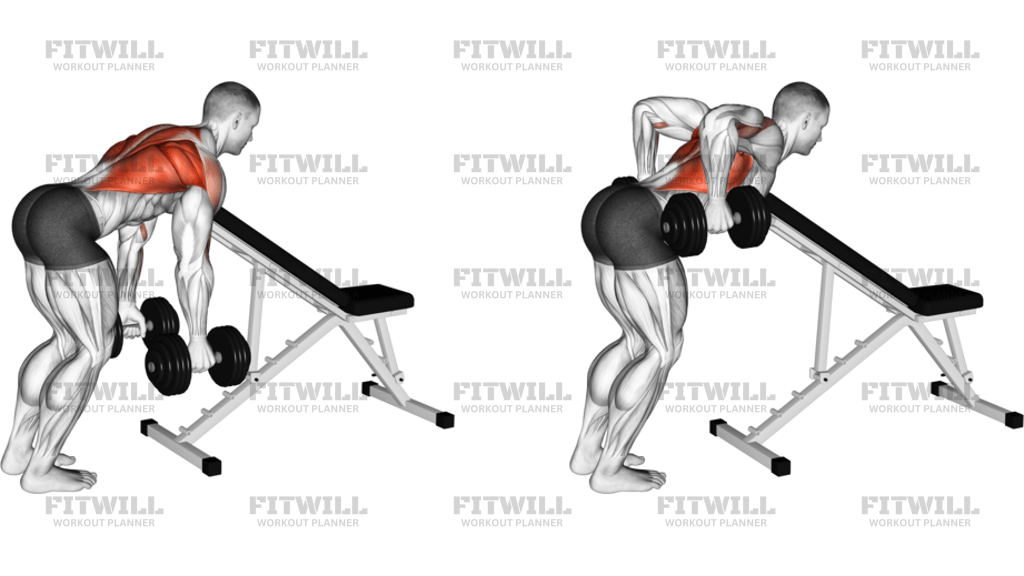
The Dumbbell Row With Chest Supported is a rowing variation performed lying chest-down on an incline bench, usually set somewhere between 30 and 45 degrees, with a dumbbell in each hand. Because your torso is fully supported by the pad, your lower back and legs are taken almost entirely out of the movement, which means the work has to come from your upper back, lats, and arms. That is the whole point of the setup: it removes the ability to cheat with body english, which is the most common fault in bent-over rowing.
This exercise is a strong choice for anyone who wants to build back thickness without loading the spine. Lifters with lower-back fatigue from heavy deadlifts or squats often use it as their main horizontal pull, and beginners benefit from it because the bench pins the torso angle in place, so there is far less to think about. It also works well as a volume builder in a pull day, where you can push close to technical failure without form breaking down the way it does in a free-standing row.
The main muscles working are the lats, rhomboids, and mid-traps, with the rear shoulders assisting on each pull and the biceps and forearms handling the elbow flexion and grip. If you row with your elbows tucked close to your ribs, the lats take the lead; if you flare your elbows slightly wider, you shift more emphasis to the rhomboids and upper back. Neither is wrong, but knowing the difference lets you aim the set where you want it.
Setup details matter more than people expect. Set the bench high enough that the dumbbells clear the floor at the bottom without you having to shrug or drop your shoulders to reach, and keep your chest glued to the pad for every rep. Straddling the bench with your feet planted on the floor gives you a stable base. If your chest lifts off the pad as you pull, the weight is simply too heavy for your back to move on its own.
To execute it well, pull the dumbbells toward your lower ribs or hip crease rather than toward your armpits, drive your elbows back and slightly down, and finish with a deliberate squeeze of the shoulder blades. Lower the weights under control until your arms are fully extended and your upper back is allowed to stretch a little at the bottom before starting the next rep. That bottom stretch and controlled lowering is where a lot of the growth stimulus lives, so resist the urge to bounce out of each rep.
In practice, you will see this movement used as a primary back builder in beginner programs, a spinal-friendly heavy row for intermediate and advanced lifters, and a strict-form accessory on pull days. Start with a weight you can control for a full second on the way down, and only progress once you can keep your chest in contact with the pad for every rep of every set.
[ Workout Log & Planner ]
Put your next workout in Fitwill
Keep your plan and training log ready when you are.


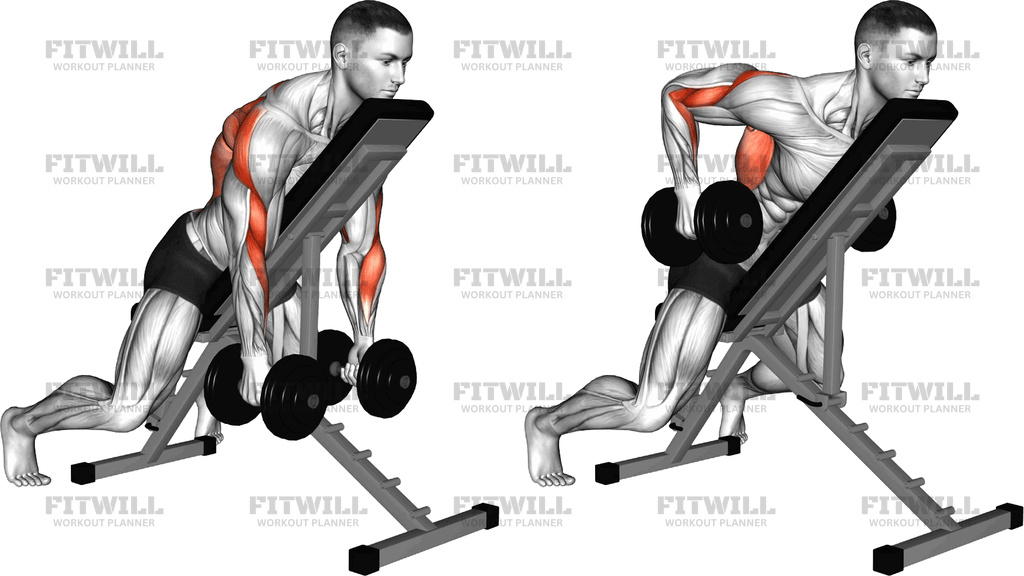
Instructions
- Set an adjustable bench to roughly 30-45 degrees and straddle it so you are lying chest-down on the pad, with your feet planted on the floor on either side for a stable base.
- Pick a dumbbell in each hand and let your arms hang straight down toward the floor, making sure the weights fully clear the ground at arm's length.
- Press your chest firmly into the pad and keep it there for the entire set; this contact is what removes momentum from the movement.
- Brace your abdominal muscles lightly and keep your neck neutral by looking at a spot on the floor a few inches in front of the bench.
- Start the pull by driving your elbows up and back toward your hips, letting the shoulder blades pull together as the dumbbells rise.
- Finish each rep with the dumbbells level with or just below your ribcage and your elbows behind your torso, then squeeze your shoulder blades for a beat.
- Lower the dumbbells slowly under control until your arms are fully extended and you feel a slight stretch across your upper back at the bottom.
- Exhale as you pull the weights up and inhale as you lower them, keeping your breathing steady rather than holding your breath.
- Complete all reps with your chest in contact with the pad, then set the dumbbells on the floor before standing up off the bench.
Tips & Tricks
- If your chest peels off the pad at the top of the pull, the load is too heavy or you are trying to lift the dumbbells too high; reduce the weight and pull only to your lower ribs.
- Pull toward your hip crease, not your armpits. Rowing toward the armpits on this bench angle tends to jam the shoulders and shifts work away from the lats.
- Keep your elbows around 45 degrees or less relative to your torso if you want the lats to lead; flare them wider only when you deliberately want more upper-back focus.
- Do not let the dumbbells clang together or touch down between reps. Staying off the floor keeps constant tension on the back muscles.
- If your grip gives out before your back does, use lifting straps rather than shortening the range or swinging, and add direct forearm work elsewhere.
- A common mistake is jerking the head up to watch the mirror, which arches the neck. Keep your eyes on the floor ahead of the bench and your neck in line with your spine.
- Pause for a full second at the top of each rep. The chest-supported setup makes this easy to do strictly, and the squeeze is where the rhomboids and mid-traps get the most out of the movement.
- Set the bench angle before you pick up the dumbbells. Climbing onto the bench while holding heavy dumbbells is awkward and puts your shoulders in a bad spot.
- Slightly shrug your shoulders forward at full stretch at the bottom, then pull them down and back as you row, so your upper back moves through a complete range instead of a short one.
Frequently Asked Questions
What muscles does the Dumbbell Row With Chest Supported work?
The lats, rhomboids, and mid-traps do most of the work, with the rear shoulders assisting and the biceps and forearms handling elbow flexion and grip. Your lower back and legs are largely unloaded because the bench supports your torso.
What bench angle should I use for the Dumbbell Row With Chest Supported?
Between 30 and 45 degrees works best for most people. Lower angles drift toward a bent-over row and let you cheat with torso movement, while higher angles start to resemble a high pull and reduce the horizontal rowing range.
Is the Dumbbell Row With Chest Supported good for beginners?
Yes, it is one of the most beginner-friendly rowing variations because the bench fixes your torso angle and makes cheating very difficult. Start light and focus on keeping your chest glued to the pad for every rep.
Why does my lower back still get sore during this exercise if the bench supports my chest?
This usually means your hips are drifting off the pad or your feet are positioned so your legs are doing the stabilizing. Adjust so your chest and upper abdomen are fully on the bench and your feet are planted firmly on the floor.
Should I row with my elbows tucked or flared on the Dumbbell Row With Chest Supported?
Keep your elbows within about 45 degrees of your torso to emphasize the lats, or flare them slightly wider to shift more work to the rhomboids and upper back. Both are legitimate, just pick one based on what you want from the set.
Can I do the Dumbbell Row With Chest Supported if my grip fails before my back?
Yes, lifting straps are a reasonable fix since grip should not be the limiting factor in a back exercise. You can also alternate grip positions, such as a neutral or semi-supinated grip, which some people find more secure.
What can I substitute for the Dumbbell Row With Chest Supported?
A seal row on a high flat bench, a chest-supported machine row, or a barbell row on an incline bench all train the same pattern. Seated cable rows are a decent fallback but they reintroduce torso momentum, so strictness matters more there.
How heavy should I go on the Dumbbell Row With Chest Supported?
Choose a weight you can lower under control with your chest staying on the pad for all planned reps. If you have to bounce your torso off the bench to start the pull, drop the weight, because that bounce defeats the purpose of the supported setup.
Is the Dumbbell Row With Chest Supported safe for people with lower-back issues?
Because the bench supports your torso, it places far less demand on the lower back than free-standing rows, which is why many lifters use it on days after heavy deadlifts. If you have a specific back condition, get clearance from a qualified professional before loading any rowing pattern.