Half Plyo Squat Twist
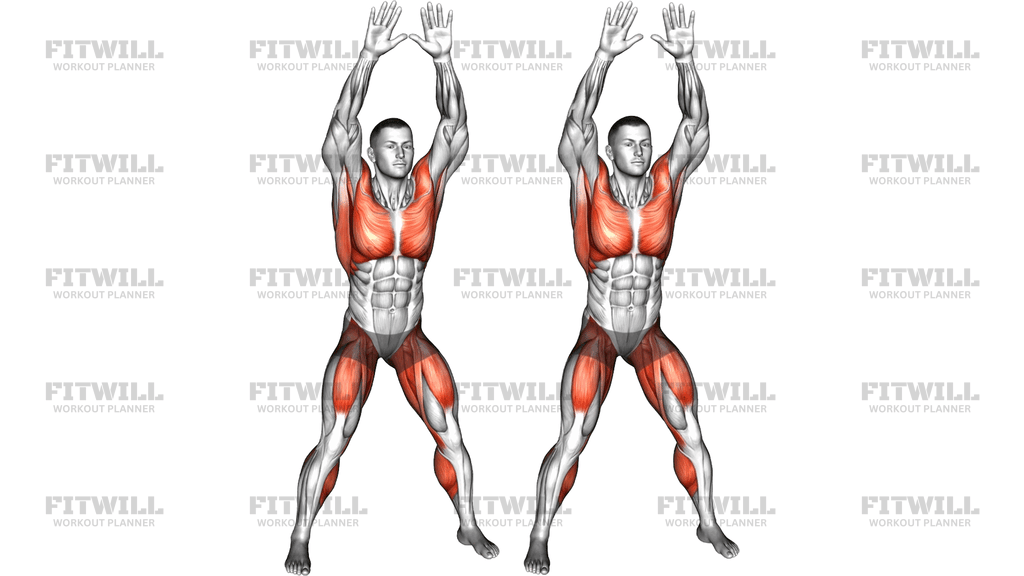
The Half Plyo Squat Twist is a body weight movement that blends a shallow, wide-stance squat with an explosive element and a rotation of the torso. You settle into a half-depth sumo-style squat, then drive up with enough force to leave the ground slightly, twisting your midsection as you rise before landing softly back into the squat position. Hands stay positioned behind the head or lightly at the sides of the head throughout, which keeps the rotation coming from your trunk rather than from swinging your arms.
Because the squat only goes to half depth, the emphasis stays on the drive and the twist rather than on deep knee flexion. The lower body does most of the power production — the glutes and quads launch you up, the adductors and outer hips control the wide stance, and the calves absorb each landing. The rotation brings the obliques and deep core into play, as they must decelerate and re-stabilize your trunk every time your feet return to the floor.
This exercise suits people who already squat comfortably and want to add a conditioning and rotational component to their training. It appears frequently in circuit workouts, warm-up blocks for field sports, and home routines where no equipment is available. Athletes in sports that demand change of direction — tennis, basketball, martial arts, soccer — get transferable value from the combination of hip drive and trunk rotation under a light plyometric load.
Setup matters more than it looks. A stance noticeably wider than shoulder width, with toes turned out, gives your hips room to reach half depth without your knees caving inward. If your stance is too narrow, the twist at the top pulls your balance sideways and the landing becomes sloppy. If the squat is too deep, the explosive element turns into a grind and your lower back tends to round under fatigue.
Execution quality comes down to three things: an upright braced torso, a controlled landing, and rotation that stays smooth rather than jerky. Twist from the ribcage and hips together — not by cranking your neck or flaring your elbows forward. Land toe-first with soft knees and immediately sink back into the half squat so the next rep flows out of the landing. That continuous rhythm is what makes the exercise effective as both a strength-endurance and coordination drill.
Keep expectations realistic about what this movement trains. It is not a maximal-power jump drill, and it will not build leg strength the way a loaded squat does. Its value is in repetition quality: teaching your hips and trunk to produce and absorb force in rotation while breathing steadily. Treat it as a moderate-intensity tool, scale the jump height to what you can land quietly, and stop the set when your landings start to sound heavy.
[ Workout Log & Planner ]
Put your next workout in Fitwill
Keep your plan and training log ready when you are.


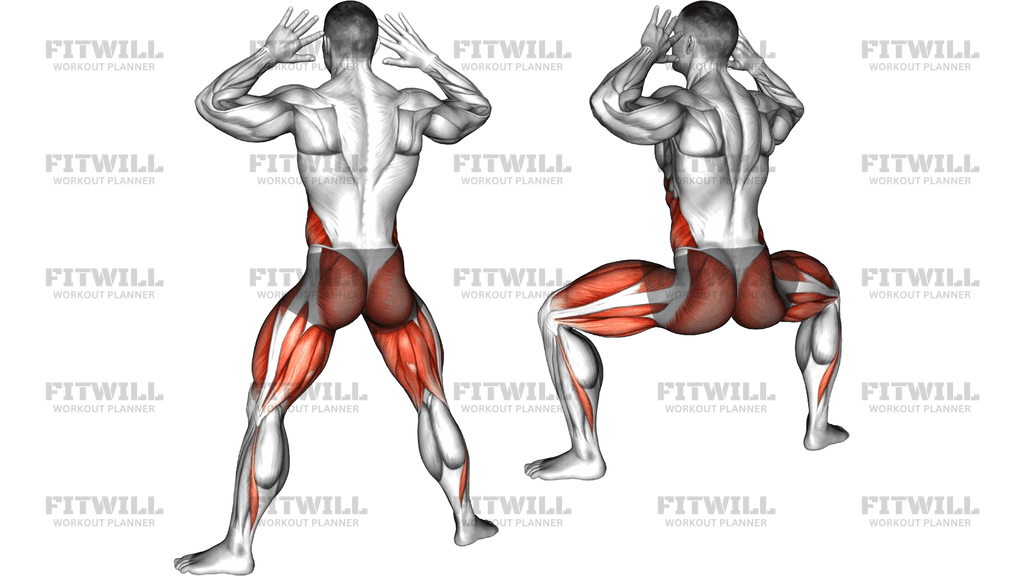
Instructions
- Stand with your feet roughly one and a half shoulder widths apart, toes turned out about 30 to 45 degrees, and place your hands lightly behind your head with elbows flared wide.
- Brace your abdominal wall, keep your chest tall, and set your weight evenly across both feet with your heels firmly planted.
- Push your hips back and bend your knees to descend into a half squat — roughly a quarter to halfway down — keeping your knees tracking over your toes.
- From the bottom of the half squat, drive forcefully through the floor with both legs and exhale sharply as you rise.
- As your body extends, twist your torso to one side, rotating from the ribcage and hips while your elbows stay wide and your head follows the rotation.
- Let your feet leave the floor only slightly — this is a hop, not a max jump — and begin untwisting in the air so you land facing forward.
- Land toe-first with soft knees and immediately sink back into the half squat to absorb the landing quietly.
- Inhale at the bottom, reset your brace, and repeat the twist to the same side for the planned reps, or alternate sides rep by rep.
- Finish the set by standing fully upright, releasing the hands from behind the head, and shaking out the hips before the next set.
Tips & Tricks
- If your knees collapse inward on the landing, narrow your stance slightly and consciously spread the floor with your feet — a wide stance only works when the hips stay active.
- Do not pull on the back of your neck with your hands; interlace the fingers lightly or touch the sides of the head so the twist is produced by the trunk, not the arms.
- A common mistake is twisting so far that the front foot rolls onto its inner edge. Keep the twist to a range where both feet stay flat through the squat portion.
- Land as quietly as you can. Heavy, flat-footed landings mean the calves and knees are absorbing shock they should not be — cut the set short or reduce the hop height.
- Keep the squat at half depth. Dropping into a deep squat under rotation fatigue tends to pull the lower back into a rounded position.
- If you lose your rhythm, pause in the half squat, reset your breathing, and restart the tempo rather than bouncing through sloppy reps.
- Alternating sides each rep challenges coordination, but when learning the movement, complete all reps to one side first so the rotation pattern stays clean.
- Warm up the hips with a few slow body weight sumo squats before adding the hop — cold rotations under a plyometric element are where form breaks down first.
- On soft surfaces like thick mats, expect slightly less spring but more joint-friendly landings; on hard floors, keep the hop height deliberately low.
Frequently Asked Questions
What muscles does the Half Plyo Squat Twist work?
The glutes and quads produce the drive out of the half squat, while the adductors and outer hips stabilize the wide stance. The obliques and deep core handle the twist and decelerate the rotation on every landing.
Why does the Half Plyo Squat Twist use a half squat instead of a full squat?
The shallow depth keeps the emphasis on explosive drive and trunk rotation rather than maximum leg loading. It also makes it easier to maintain an upright torso and a stable spine through the twist.
Is the Half Plyo Squat Twist suitable for beginners?
Beginners should first be comfortable with a wide-stance body weight squat and a quiet, controlled landing. If both feel solid, start with a very small hop or even rise onto the toes with just the twist before adding air time.
Should I alternate sides or do all reps to one side in the Half Plyo Squat Twist?
Learn the movement with all reps to one side so the rotation pattern stays consistent, then switch. Once it feels natural, alternating sides each rep adds a coordination and balance challenge.
How far should I twist during the Half Plyo Squat Twist?
Twist only as far as you can while keeping both feet flat, knees tracking over toes, and your chest upright. If your front foot rolls inward or your torso leans, you have gone past your usable range.
What is the most common mistake in the Half Plyo Squat Twist?
The most common errors are heavy flat-footed landings and pulling on the head with the hands to force the rotation. Land toe-first with soft knees, and let the trunk — not the arms — create the twist.
Can I substitute the Half Plyo Squat Twist if jumping bothers my knees?
Yes — perform the same wide-stance half squat with the torso twist but drive up without leaving the floor, rising onto the balls of the feet instead. You keep the rotation and hip drive while removing the impact.
How does the Half Plyo Squat Twist fit into a workout?
It works well as a warm-up primer for lower body days, a conditioning station in a circuit, or a finisher for the hips and core. Keep sets moderate and stop when landings get loud or sloppy.
Is the Half Plyo Squat Twist safe for people with lower back issues?
The repeated rotation under landing forces can stress a sensitive lower back. Anyone with existing back discomfort should get clearance from a qualified professional and may prefer the no-jump, reduced-rotation version first.