Cable Bent Over Single Arm Neutral Grip Kickback W
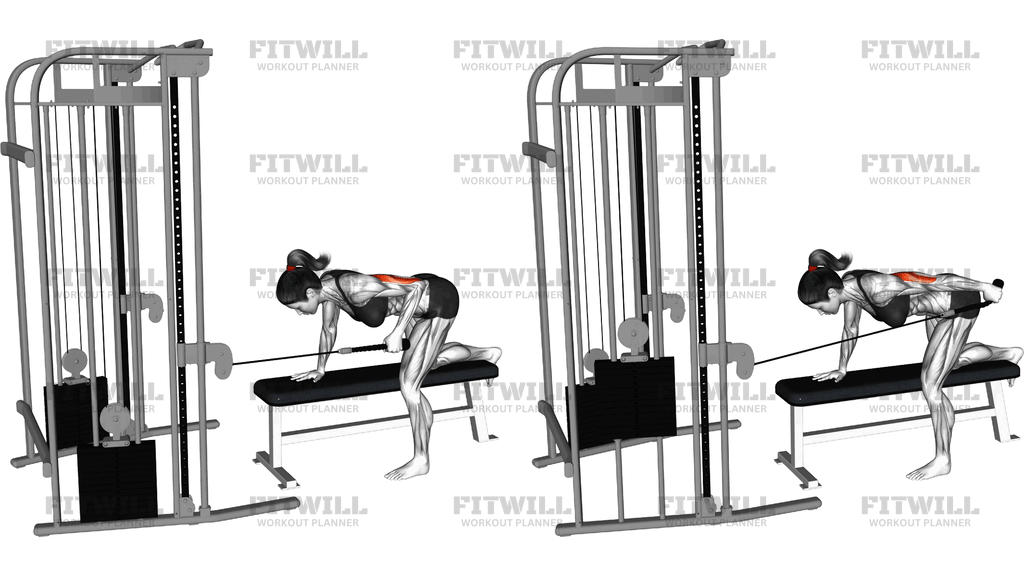
The Cable Bent Over Single Arm Neutral Grip Kickback W is a unilateral triceps exercise performed on a cable machine with a flat bench for support. You set up in a bent-over stance with one hand and the opposite knee planted on the bench, grab a single handle attached to a low pulley, and extend your arm straight back behind you until the elbow locks out at hip height. The neutral grip means your palm faces inward toward your torso throughout the movement, which keeps the wrist in a comfortable, natural line and lets the triceps do the work without awkward twisting at the forearm.
Because the resistance comes from a cable rather than a dumbbell, the tension on the triceps is smooth and constant through the entire range of motion, including the fully extended position where dumbbell kickbacks tend to lose resistance. That makes this version especially effective for the lockout portion of the rep, which is where the long head of the triceps contributes heavily. The rear shoulder and upper back also work isometrically to hold the arm position and keep the torso steady while the working arm moves.
This exercise suits lifters who want focused triceps work with minimal joint stress, people rehabbing or managing cranky elbows who prefer cable tension over free weights, and anyone who struggles to feel dumbbell kickbacks because gravity fades at the top. Training one arm at a time also exposes and helps correct left-to-right strength differences, and the bench-supported position takes the load off your lower back compared to a fully free-standing kickback.
Setup quality determines whether this movement trains your triceps or your ego. Position the bench so the low pulley is behind you, keep your torso close to parallel with the floor, and plant your supporting hand directly under your shoulder. If your torso is too upright or the cable pulls at an awkward angle, the triceps lose leverage and the shoulder starts compensating. Take a moment to line everything up before you grab the handle and you will feel the difference on the very first rep.
To execute well, pull your elbow up so your upper arm sits tight against your side and roughly parallel to the floor, then extend only at the elbow, sweeping the handle back and slightly down until your arm is straight. Pause briefly at full extension, squeeze the triceps, and return the handle under control until the forearm hangs near vertical. Keep your hips square to the bench and resist the urge to rotate your torso into the rep. Start with a light weight, since the single-arm stance and bent-over position make this far harder than it looks, and progress only when the movement stays clean through all reps.
[ Workout Log & Planner ]
Put your next workout in Fitwill
Keep your plan and training log ready when you are.


Instructions
- Set a flat bench in front of a low pulley on the cable machine and clip a single handle to the pulley.
- Stand beside the bench facing the pulley side, then place your left hand and left knee on the bench with your right foot flat on the floor, so your torso is bent over and close to parallel with the ground.
- Reach down with your right hand and grip the handle using a neutral grip, palm facing in toward your body, with the cable running back along your side from the low pulley.
- Brace your core, keep your neck in line with your spine, and pull your right elbow up until your upper arm is tucked against your ribs and roughly parallel to the floor; this is your starting position.
- Exhale and extend your right elbow straight back until your arm is fully straight, lifting the handle up and behind your hip while keeping your upper arm locked in place against your side.
- Squeeze the triceps for a beat at full extension, making sure your shoulder has not hiked up toward your ear.
- Inhale and bend the elbow slowly, letting the handle travel back down until your forearm points toward the floor near vertical, without letting your elbow drop or drift.
- Complete all reps on the right arm, then reposition and repeat on the left side, adjusting the stack or your bench position as needed so both arms get identical setup and range.
Tips & Tricks
- The most common fault is swinging the whole arm from the shoulder, turning the rep into a rear shoulder exercise. Pin your elbow against your ribs and let only the forearm move.
- If the cable path feels like it drags your arm down or forward, you are standing too far from the pulley. Shift your stance so the cable tracks close along your side.
- Keep the neutral grip honest: if your palm rotates toward the floor as you extend, your forearm is compensating. Let the handle sit naturally in your fingers with the palm facing in.
- Do not flare the working elbow out to the side. An elbow drifting away from the torso shortens the triceps range and shifts stress into the shoulder.
- Choose a lighter weight than you think you need. Because you are bent over with one point of contact on the floor, heavy loads will pull your torso out of position before the triceps fatigue.
- If your lower back fatigues before your arm does, focus on bracing and slightly softening the standing knee, or reduce the range on the return so the weight stack never slams down.
- Avoid letting the elbow drop toward the floor between reps. The upper arm should stay near parallel to the bench for the entire set so every rep starts from the same lengthened triceps position.
- Squeeze at lockout deliberately rather than rushing reps. The cable keeps tension at the top, so a one-second pause there is where most of the growth stimulus lives.
- Check your supporting hand placement each set. It should sit directly under the shoulder, not out in front, or your supporting side will start working harder than the arm doing the kickback.
Frequently Asked Questions
Which muscles does the Cable Bent Over Single Arm Neutral Grip Kickback W work?
The triceps are the primary mover, extending the elbow against the cable's resistance. The rear shoulder and upper back muscles work statically to hold the arm and torso in the bent-over position.
Why use a neutral grip instead of an overhand grip on this kickback?
The neutral grip, with the palm facing your body, keeps the wrist and forearm in a natural alignment and reduces strain at the elbow. Many lifters find it lets them focus on triceps contraction rather than fighting grip discomfort.
Can beginners do the Cable Bent Over Single Arm Neutral Grip Kickback W?
Yes, it is actually beginner friendly because the bench supports your upper body and the cable provides smooth, even tension. Start with a very light stack weight and master the elbow-stationary path before adding load.
How is this different from a dumbbell kickback?
A dumbbell loses tension as the arm reaches full extension because gravity pulls straight down, while the cable keeps steady resistance through the entire range, especially at lockout. The cable version also frees you from stabilizing a free weight, making it easier to isolate the triceps.
Why does my rear shoulder burn during this exercise?
Some rear shoulder involvement is normal because it holds the upper arm back against the cable. If it takes over completely, your elbow is likely drifting away from your ribs or the weight is too heavy; tuck the elbow and reduce the load.
What should I do if I cannot keep my torso from twisting as I extend?
Widen your base by placing your standing foot more firmly, brace your core before each rep, and lighten the weight. You can also hold the bench edge slightly farther forward with the supporting hand to give yourself a more stable counterpoint.
Can I do this exercise without a bench?
You can perform a standing version bent over with one hand braced on the cable machine frame, but you lose the stable three-point support and your lower back does more work. The bench setup shown here is the more controlled option.
How many sets and reps should I use?
Because it is an isolation exercise for a small muscle, 2 to 4 sets of 10 to 15 reps per arm works well for most lifters. Keep the weight moderate so the last few reps still show a clean, elbow-tucked path.
Is it safe for my elbows and shoulders?
The cable's smooth resistance and supported torso position make this low impact on both joints when done with light-to-moderate loads. Keep the extension controlled, avoid locking out aggressively, and stop if you feel pinching at the shoulder rather than triceps work.
Where should the cable pulley be set for this exercise?
Set the pulley at its lowest position so the cable runs from behind and slightly below your working arm. A low anchor keeps the resistance pulling back along your side, which matches the kickback's natural arm path.