Kneeling Outward Circle Leg On Bench
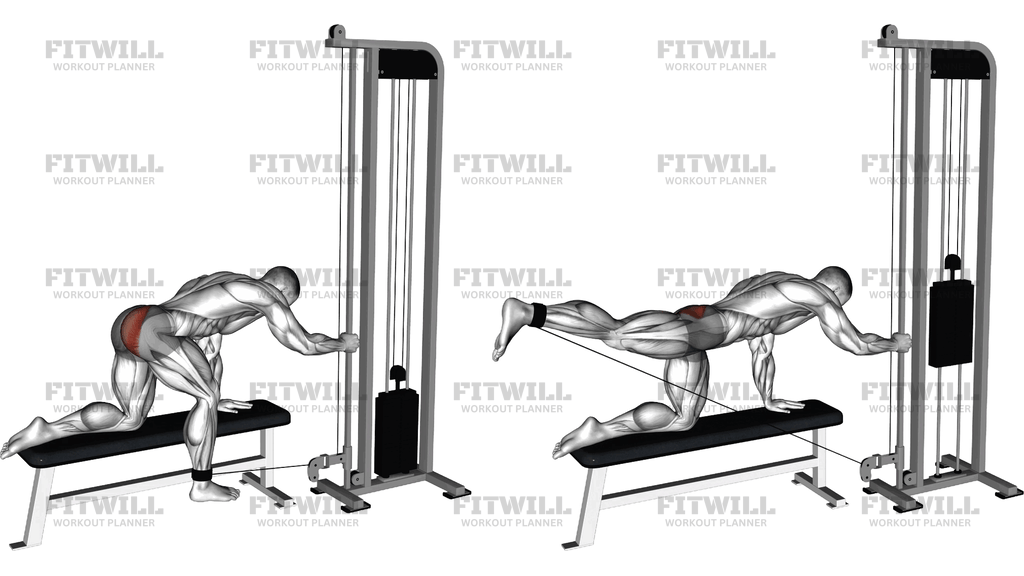
Kneeling Outward Circle Leg On Bench is a body-weight hip exercise performed on a flat bench, where you balance on one knee and both hands while sweeping the free leg through a wide outward circle. The elevated, kneeling setup changes the angle of hip abduction compared to standing or side-lying versions, letting the working leg travel through a longer arc with very little load on the spine. The highlighted working area sits at the side of the hip, so this movement mainly trains the gluteus medius and surrounding outer-hip muscles that control how your femur moves in the hip socket.
This exercise is a good fit for people who want to build hip stability without equipment beyond a bench. Runners, lifters who squat or hinge, and anyone spending long hours sitting tend to benefit from direct outer-hip work, because those muscles help keep the pelvis level during single-leg tasks like walking, stair climbing, and lunging. Since the circles combine abduction with slight extension and flexion, the hip moves through multiple directions in one rep, which is harder to achieve with a plain side leg raise.
The setup matters more than speed here. With one knee planted on the bench pad and both hands stacked under the shoulders, your torso becomes the stable base while the free leg hangs off the side of the bench. Because the working hip is loaded in a flexed, slightly rotated position, a rounded back or a collapsed supporting hip will shift work away from the outer hip and toward the lower back. Keep the torso long, the ribs down, and the supporting knee directly beneath the hip so the circles come from the hip joint rather than from trunk rotation.
To execute it well, sweep the working leg out to the side and back in a smooth, round path, as if tracing a circle on the floor with your heel. The leg stays nearly straight but not locked, and the circle should stay within a range you can control without tilting your pelvis. Smaller, cleaner circles beat giant sloppy ones every time. Breathe steadily throughout, exhaling as the leg moves away from the body, and switch sides after completing all reps.
Common use cases include warm-up activation before lower-body training, rehabilitation-style hip strengthening, and accessory work for glute development. Because the load is light, the exercise responds well to higher reps, slow tempos, and brief pauses at the far end of each circle. If you feel it mainly in your lower back or the front of your thigh, reduce the circle size and re-check that your torso is level and your pelvis is square.
For safety, make sure the bench is stable and non-slip before you put weight on your hands and knee. Stop short of any pinching sensation at the front of the hip, and avoid forcing the leg higher by arching the spine. Progress gradually by slowing the tempo or adding circles per side rather than rushing the range.
[ Workout Log & Planner ]
Put your next workout in Fitwill
Keep your plan and training log ready when you are.


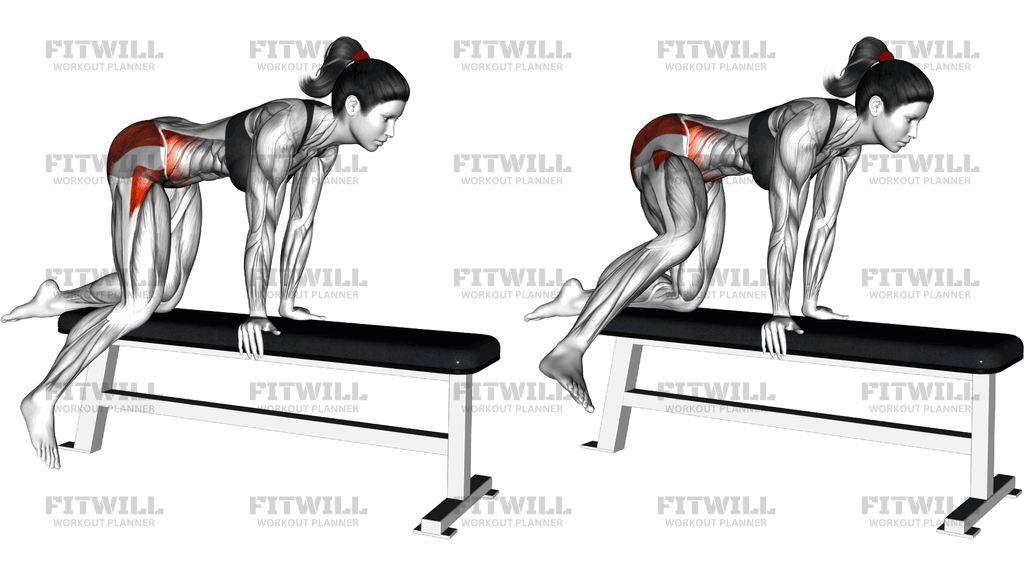
Instructions
- Place a flat, stable bench on a non-slip surface and kneel sideways beside it.
- Position yourself on all fours on the bench with both hands flat on the pad under your shoulders, then lower one knee onto the pad directly beneath your hip so your weight rests on that knee and both hands.
- Extend your other leg off the side of the bench so it hangs free, foot relaxed, leg roughly straight but not locked at the knee.
- Brace your midsection lightly, level your shoulders and hips, and let your gaze fall slightly ahead of your hands so your neck stays neutral.
- Sweep the working leg out to the side and up in a wide arc, then continue the circle by bringing it down, back, and around to the start, tracing a round path as if drawing a circle on the floor beside the bench.
- At the widest point of the circle, pause briefly and squeeze the side of your hip instead of letting momentum carry the leg.
- Reverse the circle in the opposite direction if your program calls for it, keeping the pelvis square so the movement stays in the hip joint.
- Exhale as the leg sweeps away from your body and inhale as it returns through the lower half of the circle.
- Complete all reps on one side, then carefully lift the supporting knee, reposition to the other side of the bench, and repeat with the opposite leg.
Tips & Tricks
- If your circles keep growing, the leg is drifting into momentum-driven swings. Shrink the diameter until the side of the hip, not inertia, is doing the work.
- Watch for the bench-side hip sagging toward the pad as the leg circles. Lift the waist slightly on that side to keep the pelvis level, which keeps tension on the outer hip.
- Avoid rotating your whole torso to help the leg travel farther. Imagine your shoulders and supporting knee locked into a fixed frame while only the hip joint moves.
- Keep the working foot relaxed. Pointing or flexing the foot hard tends to tighten the thigh and shifts the emphasis away from the hip.
- The knee of the working leg should stay soft but mostly extended. A very bent knee shortens the arc and turns the move into a small rotary flick instead of a circle.
- If your wrists or the supporting knee get sore, slide a folded towel under the knee and spread your fingers wide on the pad to distribute hand pressure.
- Feel a pinch at the front of the hip during the down-and-forward part of the circle? Reduce the size on that half of the path and slightly tilt your pelvis back.
- Slow the tempo before adding reps. Counting a two-second half-circle in each direction makes the outer hip work far harder than speeding through big loops.
- Do this exercise after your main lifts or on its own, but not right before heavy squats if your hips feel fatigued and unstable.
Frequently Asked Questions
Which muscles does Kneeling Outward Circle Leg On Bench work?
The primary target is the gluteus medius on the side of the working hip, supported by the gluteus maximus and other outer-hip muscles. Your core and shoulder stabilizers work isometrically to hold you steady on the bench.
Why is the leg circled outward instead of just lifted to the side?
Circling takes the hip through abduction, flexion, and extension in one continuous path, challenging the outer-hip muscles across more directions than a straight side lift. It also makes momentum harder to use, so the hip has to control the leg the whole way.
Is Kneeling Outward Circle Leg On Bench suitable for beginners?
Yes, as long as you can hold an all-fours position on a bench comfortably. Beginners should start with small, slow circles and fewer reps per side, since the balance demand is the limiting factor rather than strength.
How many reps and sets should I do?
Because the resistance is your leg weight alone, higher volumes work well. Two to three sets of 8 to 12 circles per direction, per side, with a slow tempo is a practical starting point.
My lower back works harder than my hip. What should I change?
Your pelvis is likely tilting or your torso is arching to help the leg travel. Level the hips, reduce the circle diameter, and slightly engage your midsection so the sweep stays isolated to the hip joint.
Can I do this exercise without a bench?
A similar version can be done kneeling on all fours on a mat on the floor, though the bench elevates the hip and gives the leg more clearance for a fuller circle. A sturdy box or bed edge can substitute if it will not slide.
Should I add ankle weights to Kneeling Outward Circle Leg On Bench?
Only once you can complete all reps with clean form and a level pelvis. A light ankle weight extends the movement modestly, but adding load too early usually shows up as trunk rotation or lower-back strain.
Which direction should I circle the leg first?
Start in whichever direction feels smoother, complete the planned circles, then reverse. Covering both directions gives the hip a more complete training stimulus across the arc.
Is it safe if I feel pinching at the front of my hip?
A mild pinch at the end range usually means the circle is too large or the pelvis is tilted too far forward. Shrink the path on that part of the circle; if the pinch persists or is painful, stop and have the hip assessed before continuing.