Landmine Single Arm Shoulder Press Squat
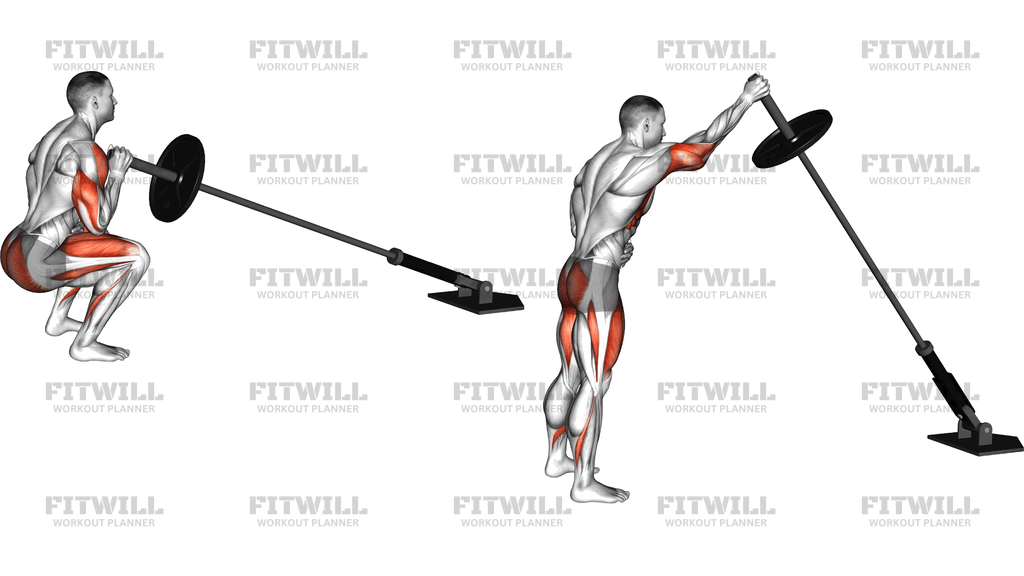
The Landmine Single Arm Shoulder Press Squat is a landmine thruster: you set up with one end of a barbell anchored in a landmine attachment (or wedged into a corner), hold the loaded end at one shoulder, squat down, then drive up to standing while pressing the bar overhead in one continuous motion. The angled bar path changes the game compared to a standard dumbbell or barbell thruster, because the landmine forces the press to travel up and slightly forward, which is friendlier to the shoulder joint and demands serious work from your trunk to keep you from twisting.
This movement hits far more than just the pressing muscles. The front shoulders and triceps finish the lockout, but the quads and glutes power the drive out of the hole, and your core, especially the obliques on the non-working side, works overtime to resist rotation as the weight tries to pull you sideways. Because you're loading one side of your body at a time, it doubles as anti-rotation and anti-lateral flexion training disguised as a press.
It suits lifters who want a time-efficient full-body strength and conditioning move, athletes who need coordinated leg-to-arm power transfer, and anyone whose shoulders complain about pressing a barbell straight overhead. The slight forward arc of the landmine press lets many people achieve a comfortable overhead position they can't get with a rigid vertical bar path.
Setup matters here more than with most presses. The landmine anchor point should be solid and the sleeve positioned so the bar tracks diagonally in front of your body, not out to the side. Your stance should be roughly shoulder-width with the working-side foot angled slightly toward the plate. If the bar starts drifting away from your midline, the squat and press both become sloppier and your lower back picks up stress it doesn't need.
To execute it well, think of the rep as one flowing action: sink into a controlled squat with the bar resting at your shoulder, then explosively stand and let that momentum carry the bar up as your arm extends. Don't squat and press as two totally separate grind phases if your goal is power and conditioning, but keep the descent controlled so the bar stays in position on your shoulder rather than sliding forward.
Use it as a main strength movement for moderate reps, as a conditioning finisher for higher reps, or in athletic circuits where you want a compound movement that links the lower and upper body. Go lighter than you think at first, because the offset loading and combined pattern make it feel very different from a standard press even with a modest plate on the sleeve.
[ Workout Log & Planner ]
Put your next workout in Fitwill
Keep your plan and training log ready when you are.


Instructions
- Place one end of a barbell in a landmine attachment or secure corner, and load the free end with a plate appropriate for your strength level.
- Stand facing the anchor point with your feet about shoulder-width apart, then lift the loaded end and rest it on the palm of one hand at shoulder height, elbow tucked close to your ribs.
- Angle your working-side foot slightly toward the plate and keep your weight balanced across your whole foot.
- Brace your core and pull your ribs down so your torso stays stacked over your hips before you start the rep.
- Push your hips back and bend your knees to lower into a full squat, keeping the bar settled on your shoulder and your chest as upright as the bar position allows.
- Drive through the floor to stand, and as your hips extend, press the bar up and slightly forward so it travels along the natural diagonal of the landmine until your arm is fully locked out overhead.
- Pause briefly at the top with your bicep near your ear and the plate stacked over your shoulder, making sure your torso hasn't twisted toward or away from the working arm.
- Lower the bar with control, catching it back on your shoulder as you sink directly into the next squat if you're chaining reps.
- Exhale as you drive up and press, and inhale at the top or during the descent, keeping your trunk tight throughout.
- Complete all reps on one side, re-grip and reset your stance, then switch arms so both sides get equal work.
Tips & Tricks
- The most common mistake is letting the bar drift out to the side of the shoulder during the squat. Keep your elbow tucked and the plate resting against your front delt so it stays over your midline.
- If your heel lifts as you squat, widen your stance slightly and work on pushing your knees out over your toes instead of collapsing inward.
- Don't rush the descent and bounce hard out of the bottom, because the bar can slide off the shoulder. Lower with control for the first couple of reps until you find the rhythm.
- Watch for your torso leaning toward the non-working side at the top of the press. Squeeze the glute on that side and brace your ribs down to stay stacked.
- Start with a smaller plate than you'd use for a regular landmine press. The squat plus offset load makes the same weight feel significantly heavier on your core.
- If you feel the press pinching at the front of your shoulder, allow the slight forward arc the landmine naturally creates rather than forcing a straight vertical bar path.
- Keep your grip firm but your wrist neutral, stacked directly over the elbow at the top, so the weight sits on your forearm bones instead of stressing the wrist joint.
- When switching sides, take a moment to reset your stance and brace rather than jumping straight into the next set with the bar already moving.
- Barefoot or flat-soled shoes work well here, since the combined squat and press rewards a stable, grounded foot position.
Frequently Asked Questions
Which muscles does the Landmine Single Arm Shoulder Press Squat work?
The front and side shoulders and triceps handle the press, while the quads and glutes power the squat and drive. Your core, especially the obliques, works hard to stop your torso from rotating under the one-sided load.
Is the Landmine Single Arm Shoulder Press Squat suitable for beginners?
Yes, as long as you start with light weight and learn the two components separately. Practice the landmine squat with the bar at your shoulder and the single arm landmine press on its own before combining them into one fluid rep.
Can I do this exercise without a landmine attachment?
You can wedge the bare end of the barbell into a corner, ideally with a towel around it to protect the wall and the bar. Just make sure the corner is solid and the bar cannot slip while loaded.
How is this different from a regular barbell or dumbbell thruster?
The anchored end of the bar creates a fixed diagonal path, so the press travels up and slightly forward instead of straight overhead. This is often more comfortable for the shoulder joint and adds a strong anti-rotation demand because you're only loading one arm.
How deep should I squat before pressing the bar?
Squat to a depth where you can keep your chest up and the bar resting securely on your shoulder without your lower back rounding. For most people that is thighs at or just below parallel, but control matters more than depth.
Why does my torso twist toward the pressing arm during the Landmine Single Arm Shoulder Press Squat?
That usually means the weight is too heavy for your core or you're losing your brace at the top. Reduce the load, exhale forcefully as you press, and think about keeping both hips pointing straight ahead throughout the rep.
How many sets and reps should I do?
For strength and power, work in sets of 4 to 6 reps per side with a challenging weight. For conditioning, lighter loads for 8 to 12 reps per side or timed intervals work well, always matching reps on both arms.
What can I substitute if I don't have a barbell for this movement?
A single dumbbell thruster is the closest alternative, holding the dumbbell at one shoulder and squatting to press. You lose the guided diagonal path, so keep the press slightly forward of your head to spare the shoulder.
Is it safe to look up at the plate at the top of the press?
Keep your neck neutral and your gaze forward or slightly up rather than craning to watch the plate. Chasing the bar with your eyes tends to pull your ribs forward and arch your lower back at lockout.
Should I do all my reps on one arm before switching, or alternate arms?
Complete all reps on one side, then reset your stance and switch. Alternating arms mid-set makes it harder to keep the bar tracked consistently and doubles your setup time.