Bodyweight Narrow Sliding Squat With Towel
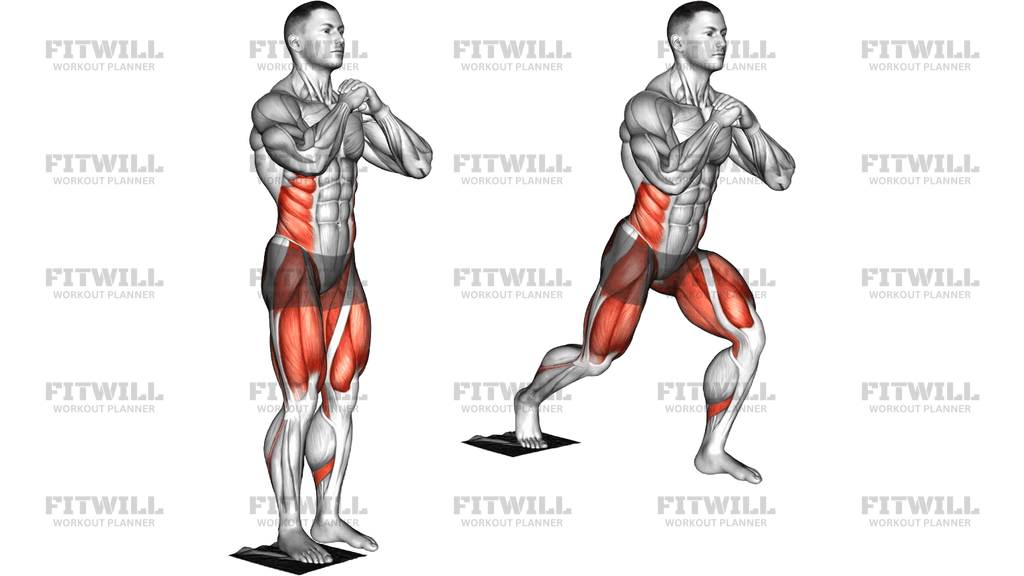
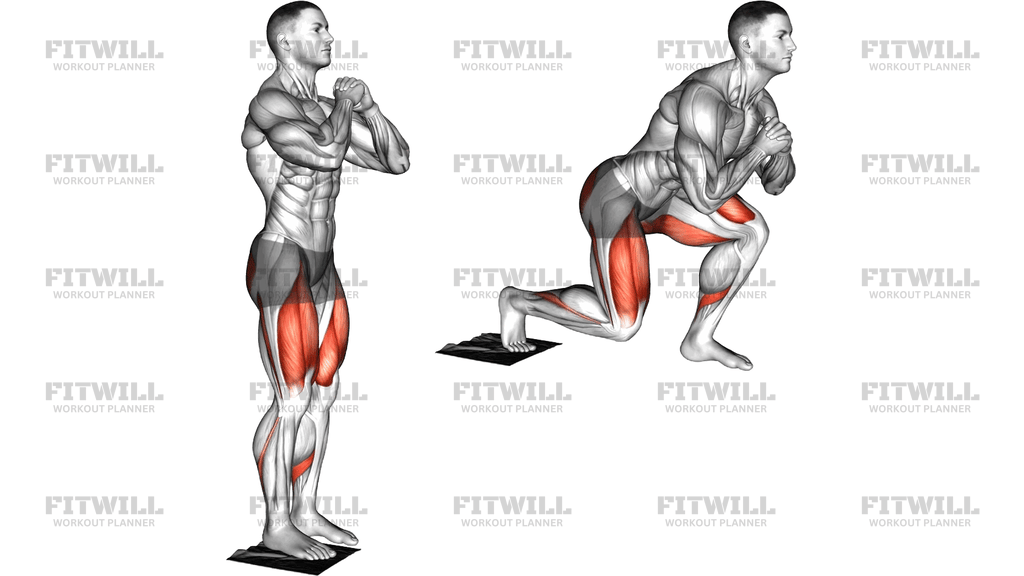
The Bodyweight Narrow Sliding Squat With Towel is a single-leg squat variation where one foot stays planted while the other slides backward on a towel until you drop into a deep split-squat position, then pulls back to a narrow standing stance. The towel turns the floor into a low-friction surface, so the moving leg controls both the descent and the return entirely through muscle effort rather than momentum. It looks like a reverse lunge, but the sliding foot never lifts or strikes the ground, which changes how the legs share the work.
Because the sliding leg stays loaded through the whole rep, this movement places steady tension on the quads of the front leg while the sliding leg's hamstrings, glutes, and adductors work eccentrically to control the glide. The narrow starting stance also challenges the hips in a slightly different way than a standard lunge, since the feet begin close together and the moving leg must travel back on a clean line without drifting outward.
This exercise suits intermediate trainees who already own a solid bodyweight squat and lunge pattern and want a unilateral leg exercise without weights. It is popular in home and hotel-room training precisely because a towel and a smooth floor are all you need. It also works well as a warm-up activation drill before heavier squatting, or as a finisher that fatigues the legs safely under bodyweight load.
Setup matters more than it appears. The towel must sit fully under the ball of the sliding foot, the floor must be smooth, and the standing foot should be angled slightly out with weight distributed mid-foot to heel. If the towel catches or the standing foot rolls inward, the glide turns jerky and the front knee absorbs stress it should not. A soft bend in both knees at the start, hands clasped at chest height for counterbalance, and a braced torso set the stage for a controlled slide.
Execution is a matter of patience. Push the sliding foot straight back, letting the front knee travel forward over the toes while the torso leans slightly ahead of the hips. Descend until the back knee hovers near the floor and the front thigh is roughly parallel, then drive through the front foot and pull the sliding leg home with the inner thigh and glute doing the towing work. Move slowly in both directions; the slower the slide, the more the muscles, not momentum, do the job.
Two practical safety points deserve attention. Keep the front heel down and the knee tracking over the foot rather than collapsing inward, and stop the range short of any pinching in the front of the hip or knee. Smooth flooring, never carpet, and a towel large enough that the foot cannot slide off the edge will keep the movement honest and repeatable.
[ Workout Log & Planner ]
Put your next workout in Fitwill
Keep your plan and training log ready when you are.


Instructions
- Place a small towel on a smooth floor and set the ball of one foot on it, with your feet about hip-width apart or slightly narrower.
- Clasp your hands together in front of your chest, stand tall, and angle the planted foot slightly outward with your weight over the mid-foot and heel.
- Brace your core and squeeze the glute of the sliding leg so your pelvis stays level before you start moving.
- Slide the towel foot straight back behind you, keeping it in contact with the floor the entire time, as the front knee bends and travels forward over the toes.
- Lower until your back knee hovers just above the floor and your front thigh is close to parallel, with the front heel still flat.
- Pause briefly in the bottom position and check that your torso is angled slightly forward with your chest up, not rounded.
- Press through the entire front foot and pull the sliding leg forward with your inner thigh and glute until both feet return to the narrow starting stance.
- Exhale as you slide down under control, and exhale again as you drive back up and in.
- Complete all repetitions on one side, reset your stance, then switch the towel to the other foot.
- Keep the sliding foot light but loaded — it should glide, not drag or lift off the towel.
Tips & Tricks
- If the towel snags halfway down, you are rushing the descent — the slide should take two to three seconds, not one.
- The most common mistake is turning this into a reverse lunge by lifting the back heel off the towel; the sliding foot must stay flat and glide the whole rep.
- Watch that the front knee tracks over your second toe. If it caves inward, shorten the range and consciously press the knee out as you descend.
- Keep your hands clasped at chest height rather than letting them drift; raising them slightly can help counterbalance a deep slide.
- If your back hip pinches at the bottom, do not force depth — slide back less far and build range over several sessions.
- On slick floors like tile or polished hardwood, fold the towel double to slow the glide; on a slightly grippier surface, use a thin towel for a faster slide.
- Your pelvis should stay square to the front. If it rotates toward the sliding leg, you are letting the back side collapse — brace harder and slow down.
- Start with the weaker or less coordinated leg first and match the rep count with the other side, so imbalances do not grow.
- If balance is shaky, hold a doorframe or wall with one hand until the pattern feels stable, then progress to hands-free.
Frequently Asked Questions
Which muscles does the Bodyweight Narrow Sliding Squat With Towel work most?
The front leg's quads take the largest share, with the glutes assisting on the drive up. The sliding leg's hamstrings, adductors, and glutes work continuously to control the backward glide and pull the foot back in.
How is the sliding squat different from a reverse lunge?
In a reverse lunge the back foot lifts and plants with each rep, while in the Bodyweight Narrow Sliding Squat With Towel the moving foot never leaves the floor. That keeps constant tension on both legs and removes any impact or momentum from the movement.
Is this exercise suitable for beginners?
It can be, as long as you first own a comfortable bodyweight squat and static split squat. Beginners should limit the slide depth, hold a wall for balance if needed, and build up to the full knee-near-floor position over time.
What kind of floor and towel work best for the sliding foot?
A smooth surface such as hardwood, tile, or laminate with a small cloth towel is ideal. Carpet creates too much friction for the foot to glide, and a towel that is too large can bunch under the toes mid-rep.
Why does my front knee hurt when I slide back too deep?
Deep slides push the front knee well forward, which loads the knee joint heavily if your heel lifts or the knee collapses inward. Keep the heel flat, track the knee over the toes, and reduce depth to a range that feels smooth and controlled.
Can I substitute anything if I do not have a towel?
Furniture sliders, a paper plate on hardwood, or a gliding disc all work the same way. If you have no slick surface at all, a slow reverse lunge with a three-second lowering phase is the closest non-sliding replacement.
How many repetitions and sets should I do of the Bodyweight Narrow Sliding Squat With Towel?
For strength-endurance, 2 to 3 sets of 8 to 12 controlled reps per leg works well. If you use it as a warm-up before squatting, drop to one lighter set of 6 to 8 reps per side.
Should my torso stay upright or lean forward during the slide?
A slight forward lean with the chest tall is natural and helps you sit into the front hip. A rounded back or a heavy collapse over the front thigh means you have gone deeper than you can currently control.
Is it safe to do this movement every day?
Because it is bodyweight-only, it is gentle enough for frequent practice, but the legs still need recovery like any strength work. Two to four sessions per week with at least one rest day between harder sets is a sensible rhythm.