Kettlebell Sumo Deadlift
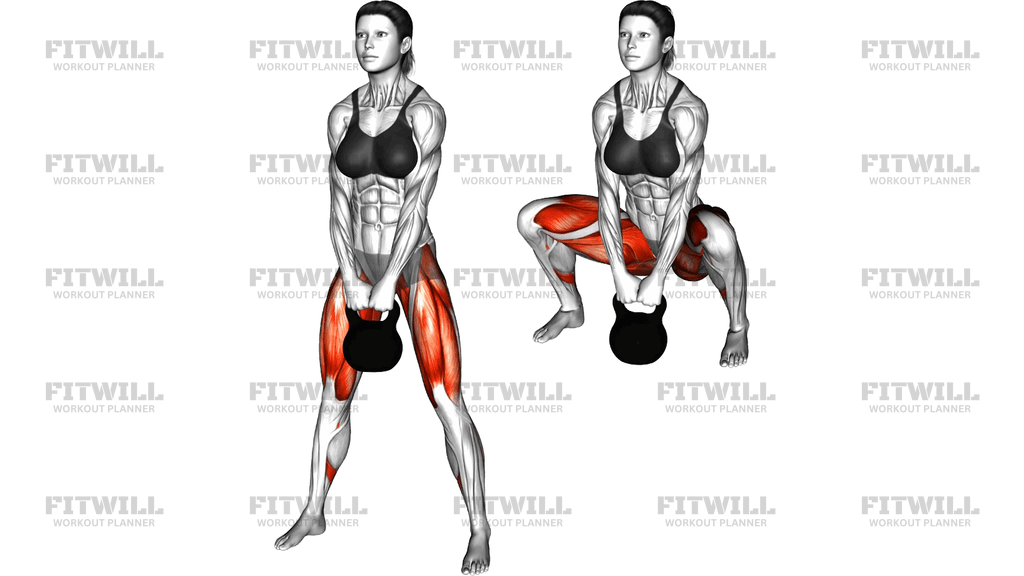
The Kettlebell Sumo Deadlift is a hip-dominant lift performed with a wide stance and both hands gripping a single kettlebell hanging between your legs. Compared with a conventional deadlift, the wider foot position opens the hips, lets you drop deeper between your knees, and shifts a large share of the work toward the glutes and inner thighs. It is one of the simplest ways to load the posterior chain heavily without a barbell or rack.
This lift suits a wide range of trainees. Beginners use it to learn the hip hinge pattern with a weight that sits low and close to the body, while more experienced lifters use it for high-rep conditioning or as a heavy strength movement when a barbell is not available. Because the kettlebell hangs between the feet rather than in front of the shins, the torso can stay more upright, which makes it friendlier to the lower back than many barbell pulling variations.
The main muscles working are the glutes and hamstrings, which extend the hips to stand you up. The wide stance brings the adductors of the inner thighs into play as they help control the knees and stabilize the hips. The quads straighten the knees from the deep bottom position, the lower back and core hold the spine neutral, and the forearms and grip handle the bell's thick handle through every rep.
Setup matters more than most people expect. The width of your stance determines whether your hips can drop low enough while keeping a flat back, and where you place the kettlebell relative to your mid-foot decides whether the load travels in a straight vertical line. A bell set too far forward pulls your chest down; feet too narrow turn the movement into a conventional deadlift and crowd the knees.
To execute it well, hinge at the hips first, grip the handle with arms hanging straight down inside the knees, then drive the floor away and stand tall, finishing with the glutes rather than leaning back. On the way down, push the hips back and let the kettlebell travel along the same vertical path it came up on. Keep the chest proud and the lats engaged so the bell stays close without rounding the spine.
Common use cases include home workouts with a single kettlebell, glute-focused leg days, warm-up ramping into heavier deadlift work, and higher-repetition conditioning circuits. The main safety points are keeping the spine neutral from the first grip to the last rep, avoiding a stance so wide that the knees collapse inward, and choosing a weight you can control in the bottom position before adding load.
[ Workout Log & Planner ]
Put your next workout in Fitwill
Keep your plan and training log ready when you are.


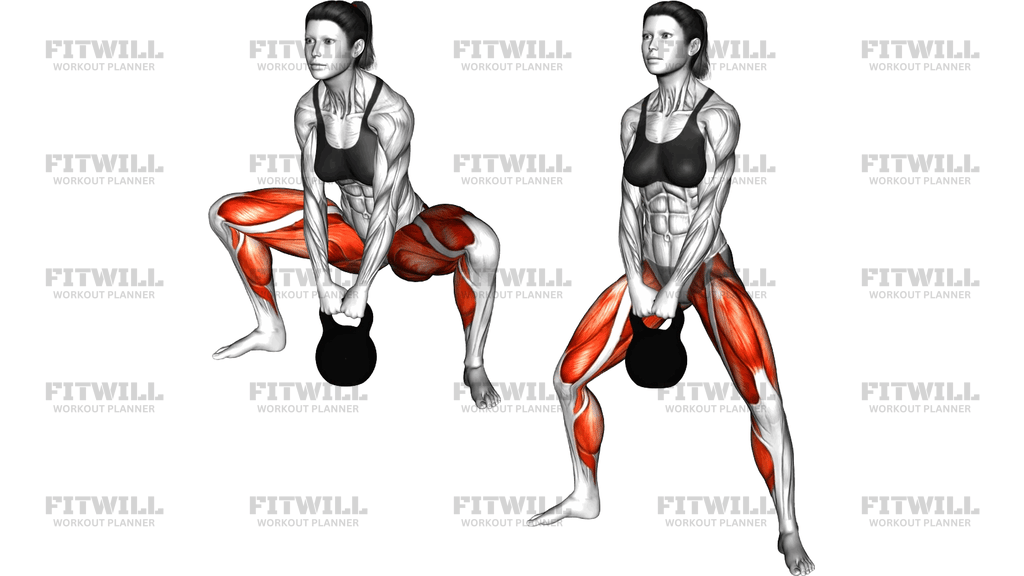
Instructions
- Place a kettlebell on the floor and step over it so it sits roughly under your hips, then set your feet wider than shoulder width with toes turned out about 30 to 45 degrees.
- Push your hips back and bend your knees until you can grip the kettlebell handle with both hands, letting your arms hang straight down between your legs with shoulders slightly above the hips.
- Check that your shins are near vertical and your knees track over your toes, not caved inward toward the middle.
- Take a breath into your belly, brace your core, and pull your shoulder blades down and back so your chest stays lifted and the back stays flat.
- Drive your feet into the floor and stand up by extending the hips and knees together, keeping the kettlebell close to your body as it rises.
- Finish standing tall with the hips fully extended and glutes squeezed, arms straight down in front of you, and no backward lean at the top.
- Reverse the movement by pushing your hips back first and bending the knees once the bell passes below hip height, lowering it along the same vertical path between your feet.
- Exhale at the top of each rep, then re-brace and reset your bottom position before pulling the next repetition.
- Once the set is finished, set the kettlebell down fully on the floor and release your grip before standing away from it.
Tips & Tricks
- If your chest collapses when you reach the handle, narrow the stance slightly or turn the toes out a little more so the hips can drop lower between the knees.
- Knees caving inward is the most common fault with the wide stance; cue yourself to spread the floor with your feet and keep the knees following the toes.
- The kettlebell handle should line up over the middle of your feet before you grip it, not in front of the toes, or the weight will drag you forward onto the balls of the feet.
- Avoid squatting down and lifting with the quads alone; initiate the pull by pulling tension into the hamstrings as you lean the chest slightly over the bell.
- Do not overextend or lean back at the top; the lift is complete when the hips and knees are straight and the glutes are tight.
- If the bell drifts away from the body, actively squeeze the handle and keep the lats tight as though protecting your armpits, so the arms stay heavy and vertical.
- For heavier sets, reset each rep on the floor and take a fresh breath; for conditioning, keep the tension and touch the bell down lightly between reps.
- Choose a bell you can control at the bottom position; if the weight forces your back to round when you reach down, drop to a lighter kettlebell or elevate it slightly on a step.
- Chalk or a dry towel on the hands helps with grip on high-rep sets, since a slipping handle usually causes the torso to round before the grip actually fails.
Frequently Asked Questions
Which muscles does the Kettlebell Sumo Deadlift work the most?
The glutes and hamstrings do most of the hip extension, and the wide stance adds significant work for the adductors of the inner thighs. The quads, lower back, core, and forearms support and stabilize through each rep.
How wide should my stance be for the Kettlebell Sumo Deadlift?
Start with your feet noticeably wider than shoulder width, toes turned out 30 to 45 degrees, and adjust until you can drop your hips between the knees with a flat back. If your chest rounds when you reach the handle, the stance is too wide or your toes need more turnout.
Is the Kettlebell Sumo Deadlift good for beginners?
Yes, it is one of the most beginner-friendly loaded hinge patterns because the kettlebell sits between the feet, allowing an upright torso and a low learning barrier. Start light and focus on a neutral spine and knees tracking over the toes.
How is the Kettlebell Sumo Deadlift different from a regular kettlebell deadlift?
The regular version uses a shoulder-width stance with the bell just outside the feet, while the sumo version uses a wide stance with the bell between the legs. The sumo setup drops the hips lower, keeps the torso more upright, and involves more inner thigh involvement.
Why do my knees cave inward during this exercise?
The wide, turned-out position demands active control from the glutes and adductors, and fatigue or a stance that is too wide lets the knees drift in. Cue spreading the floor with your feet, and slightly narrow your stance if the fault persists.
Can I use two kettlebells instead of one?
You can, placing a bell outside each foot and gripping one in each hand, which is a different variation with a slightly different balance demand. The standard Kettlebell Sumo Deadlift described here uses one bell gripped with both hands between the legs.
Should I touch the kettlebell to the floor between reps?
For strength work, letting the bell settle fully on the floor and resetting each rep gives a clean, repeatable position. For conditioning, a light touch while keeping tension is fine as long as your back position does not deteriorate.
What can I substitute if I do not have a kettlebell?
A dumbbell held vertically by one end, a single dumbbell gripped on its handle with both hands, or a barbell sumo deadlift all train the same wide-stance hinge pattern. Match the load to what lets you keep a flat back at the bottom.
How heavy should I go on the Kettlebell Sumo Deadlift?
Pick a weight you can lower to the floor and grip without your spine rounding, then progress once 8 to 12 controlled reps feel solid. Because the setup allows an upright torso, most people can handle more load here than in a single-arm or offset variation.