Resistance Band Kneeling Sissy Squat
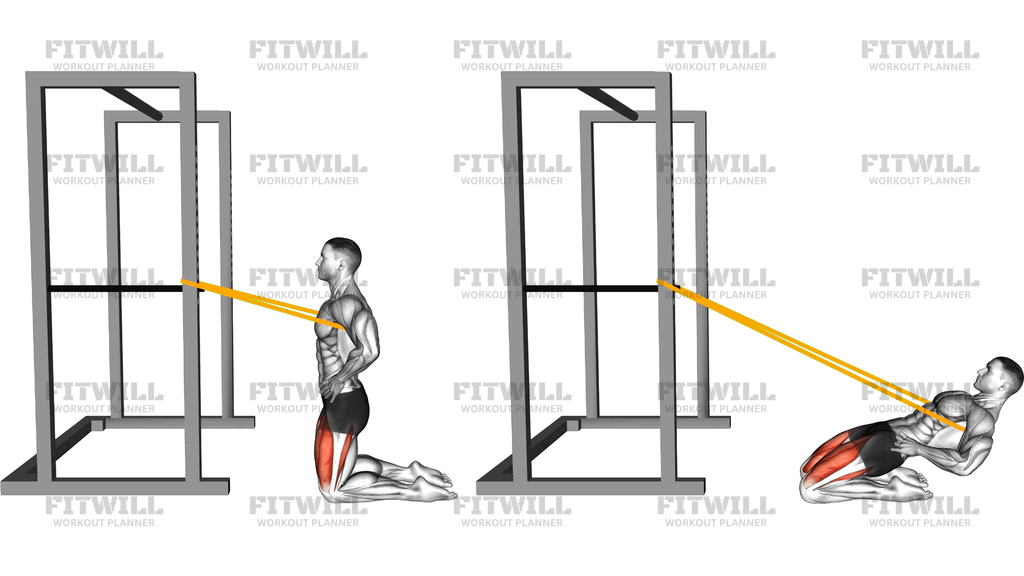
The Resistance Band Kneeling Sissy Squat is a kneeling variation of the sissy squat where you anchor a resistance band to a rack at roughly chest height, loop it behind your shoulders, and lean your entire body backward from your knees before pulling yourself back upright. Unlike the standing sissy squat, where the knees travel forward over the toes, this version keeps your knees planted on the floor and your hips extended, so the lean-back happens as one long line from your knees to your head. The band provides resistance exactly where bodyweight alone is weakest and gives you something to brace against on the way down.
The main work falls on the quadriceps, which control the backward lean and then extend to return you to the tall kneeling position. Because your hips stay open and your torso travels behind your knees, the quads are loaded through a long stretch — the same reason the movement feels demanding even with a light band. Your abdominal muscles and hip flexors work hard to keep your body rigid as a plank from the knees, and if your midsection folds or arches, you lose the line the exercise depends on.
This movement suits lifters who want quad-focused volume without heavy spinal loading, home trainees with only a band and an anchor point, and anyone using sissy squats as an assistance movement for squats or as a finishing exercise. It is also a useful bridge toward harder kneeling variations, because you can adjust the band thickness or your distance from the anchor to scale the load precisely.
Setup matters more here than in most band exercises. The anchor should sit at about chest height when you are kneeling tall, and the band must run across your upper back and shoulders — not your neck — so it pulls you into the lean rather than collapsing your posture. Kneel on a mat or padded surface, set your distance from the anchor so there is light tension while upright, and keep your hands holding the band at your chest throughout.
To execute it well, squeeze your glutes to lock your hips open, brace your trunk, and lean back slowly as one straight unit until you feel your quads working hard near the floor — or until your range ends with control. Reverse the motion by driving your shoulders forward over your hips until you are tall again. The temptation is to bend at the hips on the way down; resist it, because hinging turns a quad exercise into a hip exercise and puts the load on your lower back.
Treat the eccentric as the working portion: two to three seconds down, a brief pause at your deepest point, then a deliberate pull back up. Start with a lighter band and a shorter range, and only extend toward touching your shoulders to the floor when you can hold a straight line the whole way.
[ Workout Log & Planner ]
Put your next workout in Fitwill
Keep your plan and training log ready when you are.


Instructions
- Anchor a resistance band to a rack or sturdy upright at about chest height for your kneeling position, and kneel facing the anchor on an exercise mat with your knees roughly hip-width apart.
- Drape the band behind your upper back and across both shoulders, then grip the band with both hands at chest level so it cannot ride up toward your neck.
- Move your knees away from the anchor until you feel light tension in the band while sitting in a tall kneeling position, shoulders stacked over hips over knees.
- Squeeze your glutes to extend your hips fully and brace your abdominal muscles so your torso, hips, and thighs form one straight line from knees to head.
- Inhale, then lean your whole body backward from the knees, keeping your hips locked open and your body rigid, letting the band resist your descent.
- Continue leaning until your quads are strongly engaged near the floor or your range ends while you can still hold a straight line — do not fold at the hips to go deeper.
- Pause briefly at the bottom, then exhale and drive your shoulders forward over your hips, using your quads to pull your body back to the tall kneeling position.
- Complete your reps in one continuous set, keeping tension on the band even at the top, then step your knees forward to release the band before letting go of it.
Tips & Tricks
- The most common fault is bending at the hips so your torso folds toward your thighs — this shifts work away from the quads and onto your lower back. Fix it by squeezing your glutes hard before you lean and thinking of your body as a straight plank tipping backward.
- If the band presses into your neck, it is set too high or too narrow. Re-position it across the meat of your upper back and widen your grip on the band at chest level.
- Start with your hands holding the band against your chest, not with arms extended — reaching forward or up lets the band drag your shoulders out of position as you lean.
- Choose your distance from the anchor as your first load adjustment: moving your knees slightly toward the anchor increases tension at the top, while backing off makes the start easier.
- Your shins and the tops of your feet take your full kneeling weight, so use a mat or folded towel under your knees; raw kneecap contact on a hard floor is the usual reason people cut sets short.
- If your lower back arches and your ribs flare at the bottom, you have gone past your controllable range. Shorten the lean and build depth gradually over several weeks.
- Keep your neck in line with your torso — craning to watch the floor as you lean back twists the spine and makes the bottom position harder to hold straight.
- Two to three seconds down with a controlled pause at the bottom builds more quad tension than rushing reps, especially since the band offers little help on the descent.
- Scale down by using a lighter band or leaning only partway; scale up by using a heavier band or letting your shoulders approach the floor once your line stays solid.
Frequently Asked Questions
Which muscles does the Resistance Band Kneeling Sissy Squat work?
The quadriceps are the primary movers, controlling the backward lean and extending you back up. The abs and hip flexors work isometrically to hold your body in a straight line from knees to head.
How is the Resistance Band Kneeling Sissy Squat different from a standing sissy squat?
In the kneeling version your knees stay planted on the floor and your hips stay extended, so you lean your whole body back as one rigid line instead of driving your knees forward over your toes. This places less shear stress on the knee joint while still loading the quads through a long stretch.
Where should I anchor the band for the Resistance Band Kneeling Sissy Squat?
Anchor it to a rack or upright at roughly chest height for your kneeling position, so the band runs straight across your upper back when you sit tall. Too low and it drags your shoulders down; too high and it presses into your neck.
Should my hips bend during the lean-back?
No — the defining feature of this movement is that your hips stay locked open while your entire body tips backward as a straight unit. If your torso folds toward your thighs, the quads stop doing the work and your lower back picks up the load.
Is the Resistance Band Kneeling Sissy Squat suitable for beginners?
Yes, with modifications. Use a light band, limit the lean to a partial range where you can keep a straight body line, and kneel on a padded mat; full depth toward the floor can come later once control is established.
Why do I feel this more in my abs than my quads?
That usually means your hips are bending during the lean, turning the movement into a hip hinge, or that your midsection is working to stop your body from folding. Re-set with your glutes squeezed and reduce the range until the tension clearly sits in the front of your thighs.
How do I make the Resistance Band Kneeling Sissy Squat harder or easier?
Adjust band thickness, your distance from the anchor, and your depth. A heavier band, less distance from the anchor, and a deeper lean all increase difficulty; a lighter band, more slack, and a partial lean make it easier.
Can I do this exercise without a rack or anchor point?
You can perform the kneeling lean-back with bodyweight alone or with a partner holding a band across your shoulders from in front of you. The dedicated anchor simply makes the resistance consistent and lets you train alone.
Is it safe for my knees and lower back?
The knees stay fixed in place and the movement is low-impact, but kneeling directly on a hard surface can bruise the kneecaps, so use a mat. Stop if you feel pinching in the knees or strain in the lower back, and shorten the range rather than pushing through discomfort.
How should I breathe during the Resistance Band Kneeling Sissy Squat?
Inhale before you lean back, keep your trunk braced through the descent, and exhale as you pull yourself back up to the tall kneeling position. Avoid holding your breath through the entire rep.