Kettlebell Single Arm Shoulder Press
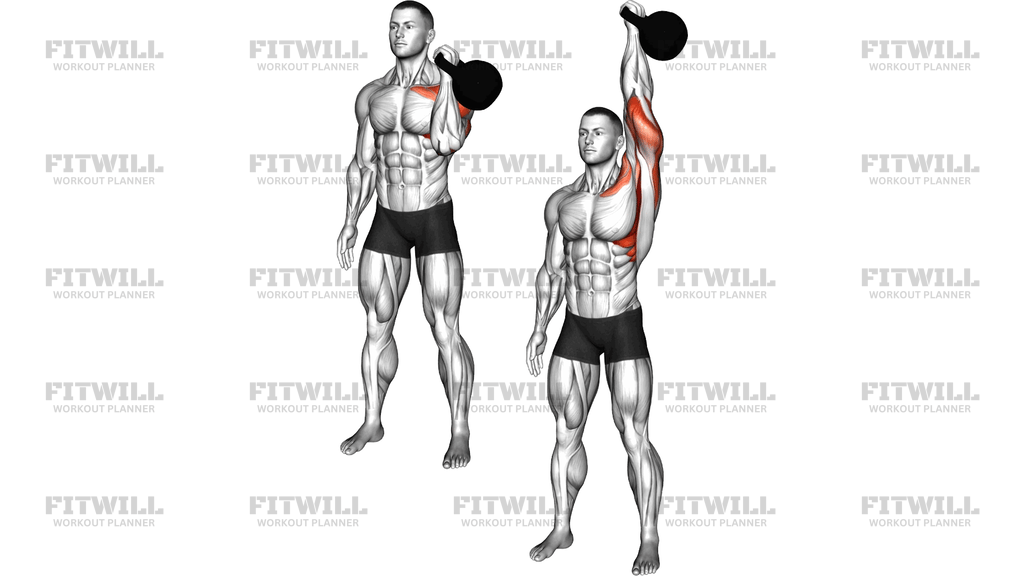
The Kettlebell Single Arm Shoulder Press is a standing overhead press performed one side at a time with a kettlebell held in the rack position at your shoulder. From there, you drive the bell straight up until your arm is locked out overhead, then lower it back to the rack under control. Because you are standing and handling an off-center load, this is more than a shoulder exercise — your trunk, hips, and legs all work to keep you upright while one arm does the lifting.
The one-arm format is the whole point of the movement. Holding the kettlebell on only one side creates a side-to-side challenge that forces your obliques and deep core to resist leaning or rotating. It also lets you spot and fix left-right strength differences that a barbell press would hide. The kettlebell itself adds to this: its weight sits below your hand, so your wrist, elbow, and shoulder must constantly make small adjustments to keep the bell balanced.
This press suits a wide range of lifters. Beginners can learn the overhead pressing pattern with a modest load before touching a barbell, while more experienced trainees use it to build pressing strength, shoulder stability, and trunk control in the same set. It fits well into full-body strength sessions, kettlebell circuits, and upper-body days, and it pairs naturally with single-arm rows or carries.
Setup matters more here than with a seated dumbbell press. The kettlebell should rest against the outside of your forearm in the rack position, with your elbow tucked close to your ribs rather than flared out. Your wrist stays neutral — neither bent back nor collapsed forward — because a soft wrist under load is one of the most common causes of discomfort in kettlebell pressing.
To execute well, brace your midsection, squeeze your free hand into a fist, and press the bell up and slightly back so it finishes over your shoulder and upper spine, not out in front of your face. Lock the elbow out fully at the top, then lower the bell along the same path back to your shoulder. Keep your ribs down and avoid arching your lower back to help the press; if you have to lean back to finish a rep, the weight is too heavy.
A few practical safety points: keep the load conservative while you learn the rack position, press in an area with clear space around you, and never fight a failing rep — guide the kettlebell away from your body rather than letting it drop toward your shoulder or face. If overhead mobility is limited, work on thoracic and shoulder flexibility before loading this pattern heavily.
[ Workout Log & Planner ]
Put your next workout in Fitwill
Keep your plan and training log ready when you are.


Instructions
- Stand with your feet about hip-width apart and place one kettlebell on the floor in front of you, handle turned slightly across your body.
- Hinge down, grip the handle, and clean the kettlebell into the rack position so it rests on the outside of your forearm and upper arm, with your elbow tucked close to your ribs and your wrist straight.
- Set your stance firmly, engage your glutes, brace your abs as if about to take a light punch, and keep your ribs stacked over your pelvis. Clench your empty hand into a fist to add tension.
- Look straight ahead and keep your shoulders level — do not let the loaded side pull your torso sideways before you press.
- Press the kettlebell straight up, letting the handle sit in the heel of your palm, and allow the bell to travel slightly back so it lines up over your shoulder at the top.
- At the top, fully straighten your elbow, keep your biceps near your ear, and hold the lockout for a beat with your shoulder packed and stable.
- Lower the kettlebell along the same vertical path back into the rack position, letting your elbow drop back down to your side to absorb the weight.
- Exhale as you press up and inhale as you lower, or take a breath at the rack position and re-brace before each rep.
- Complete all planned repetitions on one arm, then re-clean the bell with the other hand or set it down safely before switching sides.
- Reset your brace between sets or sides rather than letting your posture drift as fatigue builds.
Tips & Tricks
- Keep the kettlebell handle resting across the heel of your palm rather than in your fingers — a low grip lets the wrist bend back under load and strains the joint.
- If your elbow flares far out to the side at the start, you lose the rack position; pull it down toward your ribs so the bell sits on your forearm, not hanging off your hand.
- A common mistake is arching the lower back and pushing the ribs up to finish heavy reps. Squeeze your glutes and brace harder instead — if you still need to lean back, reduce the weight.
- Think of pressing slightly up and back rather than straight ahead; finishing with the bell over your shoulder joint, in line with your ear, keeps the shoulder in a stronger position.
- Do not let your head jut forward toward the rising kettlebell. Keep your neck tall and shift your head only slightly out of the path as the arm passes it.
- Your empty side is not passive — squeezing the free hand and keeping that shoulder blade steady stops you from tilting or rotating as you press.
- Control the descent just as much as the press. Letting the bell crash down into the rack position beats up your elbow and shoulder and gives away half the training effect.
- If your wrist aches even with a neutral position, your load is likely too heavy or you are letting the bell rotate off your forearm during the press.
- Start with a weight you could clean comfortably for several reps; pressing weight you cannot control in the rack position turns this into an accident waiting to happen.
Frequently Asked Questions
What muscles does the Kettlebell Single Arm Shoulder Press work?
The front and side shoulders are the main movers, with the triceps locking out each press. Your upper traps, rotator cuff, and core — especially the obliques resisting the one-sided load — work hard throughout.
Is the Kettlebell Single Arm Shoulder Press good for beginners?
Yes, as long as the weight is modest. Beginners should first practice the rack position and a light press to get comfortable balancing the bell before adding real load.
Why press a kettlebell instead of a dumbbell for this movement?
A kettlebell rests on your forearm in the rack position, so the load sits closer to your body and your wrist stays neutral. The offset center of mass also demands more stabilizing work from your shoulder and trunk.
Why does the kettlebell end up slightly behind my head at the top of the press?
The strongest and safest lockout places the bell over your shoulder joint, roughly in line with your ear. Pressing it out in front of your face puts constant strain on the shoulder and shifts load away from the pressing muscles.
How do I know if my weight is too heavy for the Kettlebell Single Arm Shoulder Press?
If you arch your lower back, lean sideways, or lose the rack position to complete a rep, the load is beyond what you can control. Drop to a lighter bell and rebuild with strict posture.
Should I sit on a bench or stand for this press?
Standing is standard here and is what makes the movement valuable: your legs, glutes, and core stabilize you while one arm presses overhead. Seated versions remove most of that trunk demand.
Can I use this press if my shoulders feel tight overhead?
If you cannot raise your arm fully overhead without arching back or shrugging, work on thoracic and shoulder mobility first, or press with a reduced range on a lighter bell until the pattern improves.
How many reps should I do per set?
For strength, work in the range of 4-6 controlled reps per arm; for general conditioning and volume, 8-12 reps per side works well. Always match the weaker side's rep count.
What can I substitute if I don't have a kettlebell?
A single dumbbell press standing on one side at a time is the closest substitute. You lose the forearm-supported rack position, so pay extra attention to keeping your wrist straight.
How do I switch arms safely between sets?
Lower the kettlebell back into the rack, then set it on the floor with a hinge rather than dropping it, or use a proper hand-to-hand clean transfer. Never switch mid-air with a tired grip.