Resistance Band Sitting Posterior Tibialis Mobiliz
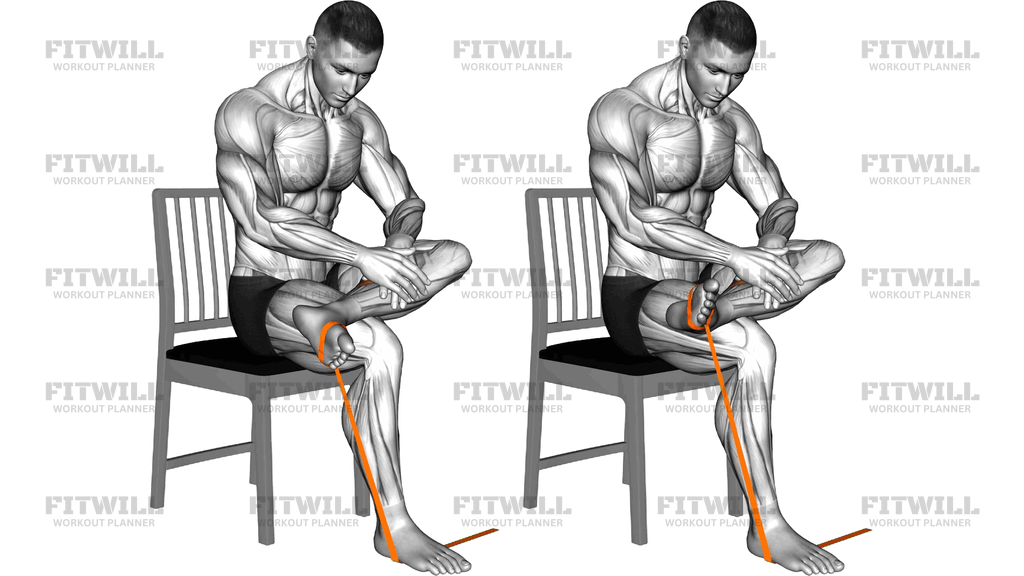
The Resistance Band Sitting Posterior Tibialis Mobiliz is a seated, band-resisted drill that targets the tibialis posterior — the deep muscle that runs along the inside of your lower leg and behind the inner ankle bone. You sit on a chair, cross one ankle over the opposite knee, and loop a resistance band around the forefoot of the raised leg. The other end of the band is anchored under your bottom foot on the floor, so when you pull your raised foot up and inward against the band's pull, you're working the exact line of the posterior tibialis.
This muscle rarely gets direct attention, yet it does a lot of quiet work. It controls how your arch behaves with every step, supports the inner ankle, and helps decelerate pronation when your foot lands. People who spend long hours walking or running, those rebuilding after an ankle sprain, or anyone whose arches collapse inward under load tend to benefit from giving it some dedicated, low-load work. Because it is a small, deep muscle, the right stimulus is controlled, moderate resistance — not heavy effort.
The setup is what makes this version effective. Crossing the ankle over the knee puts the lower leg in a position where the band pulls the foot down and slightly outward, which is precisely the opposite of what the tibialis posterior does. Anchoring the band under your grounded foot keeps the tension angle consistent, and it means you don't need to attach anything to a rack or door. The figure-four position also lets you see and feel the inside of your ankle and arch working, which helps with awareness — a big part of training a muscle you can't easily see in a mirror.
Execution is simple but demands patience. With the band looped around the ball of the raised foot, pull your foot up and in toward your shin against the band's downward pull, pause briefly at the top, then lower slowly back down. The working range is fairly short — a few inches of controlled movement at the foot — so the temptation to rush or use big, sloppy motions is real. Keep the movement confined to the ankle and foot; your knee, hip, and torso should stay still throughout.
Use this as a warm-up primer before lower-body training or running, as focused accessory work on leg days, or as part of a foot and ankle care routine. Start with a light band for sets of 10–15 controlled reps per side, and only progress the resistance once the movement feels smooth and you can genuinely feel the inner ankle and arch doing the work. If you have a current ankle or foot injury, check with a qualified professional before adding resisted work like this to your routine.
[ Workout Log & Planner ]
Put your next workout in Fitwill
Keep your plan and training log ready when you are.


Instructions
- Sit sideways-to-forward on a sturdy chair with both feet flat on the floor and your torso upright.
- Cross your right ankle over your left knee so the sole of your right foot faces down and slightly outward, resting comfortably on your left thigh.
- Loop a resistance band around the ball of your raised right foot, then run the band down and anchor the opposite end under your left foot, which stays planted on the floor.
- Hold the band or rest your hands on your raised shin to stabilize the leg, and let the band pull your right foot gently down and outward — this is your starting position.
- Brace your core lightly and keep your torso still so the only moving joint is the ankle of the raised leg.
- Pull your right foot up and inward toward your shin against the band's resistance, feeling the work along the inner ankle and arch.
- Pause for one to two seconds at the top of the pull without letting your knee or hip shift.
- Lower your foot back down slowly, resisting the band on the way down until you reach the starting position.
- Exhale as you pull up and inhale as you lower back down, keeping the breathing rhythm steady.
- Complete all reps on the right side, then re-loop the band and repeat on the left with your left ankle crossed over the right knee.
Tips & Tricks
- Anchor the band under the ball of your bottom foot, not your heel — a forefoot anchor keeps the line of pull consistent through the whole set.
- The most common mistake is turning this into a knee or hip movement. If your crossed leg starts bobbing up and down, the ankle has stopped doing the work; lighten the band and isolate the foot.
- Keep the band looped across the ball of the foot, not the toes. Looping it too far forward turns the drill into a toe-flexion exercise and takes load off the tibialis posterior.
- If the band digs into your foot, place a small towel between the band and your skin rather than shortening the range.
- Moving quickly is the easiest way to cheat here. A one-to-two second pause at the top and a slow three-count lower make a light band feel appropriately challenging.
- Watch the inside of your working ankle — if the arch doesn't visibly lift as you pull up, you're likely compensating with your toes or shin muscles instead.
- Don't let the raised knee drift outward as you fatigue; keep it stacked over your planted foot so the ankle stays in a clean line of pull.
- Choose a band you can control for 12–15 reps with a crisp pause. A band that's too heavy will pull you into cranking with the hands or shifting the torso.
Frequently Asked Questions
What muscles does the Resistance Band Sitting Posterior Tibialis Mobiliz work?
The primary target is the tibialis posterior, the deep muscle along the inner lower leg that supports the arch and inner ankle. The calf muscles and other ankle stabilizers assist to a smaller degree.
Why is the ankle crossed over the knee instead of sitting normally?
The figure-four position exposes the inner ankle and lets the band pull the foot down and outward at an angle that directly opposes the tibialis posterior's action. It also lets you watch your arch and ankle working in real time.
Is this exercise suitable for beginners?
Yes. It is low-load, seated, and uses a short range of motion, which makes it very approachable. Beginners should start with the lightest available band and focus on feeling the inner ankle and arch rather than forcing reps.
How many reps and sets should I do of the Resistance Band Sitting Posterior Tibialis Mobiliz?
Start with 2–3 sets of 10–15 controlled reps per foot. Because the muscle is small and the movement is short, quality of the pause and slow lowering matters far more than total volume.
Where exactly should the band sit on my foot?
Loop it around the ball of the foot, just behind the toes. If it slides onto the toes, you'll end up working toe flexion instead of the ankle inversion and support this drill is designed for.
Can I do this without a chair?
A chair or bench is strongly recommended because it lets your torso stay upright and your bottom foot anchor the band securely. Sitting on the floor makes it hard to keep the band angle and the figure-four leg position stable.
What's the most common mistake in this movement?
Rushing the reps and letting the whole crossed leg move instead of just the ankle. If your knee or torso is bouncing, reduce the band tension and confine the motion to the foot pulling up and inward.
Should I feel this in my arch or my calf?
The strongest sensation should be along the inner ankle and into the arch. Mild lower-leg involvement is fine, but if you only feel your calf or toes working, recheck the band placement and slow the tempo down.
Can I substitute anything if I don't have a resistance band?
You can perform the same pull-up-and-inward foot motion unresisted as an activation drill, but the band is what provides the opposing load that makes it a real training stimulus. A light loop band is inexpensive and the easiest fix.
Is this exercise safe if I've had an ankle sprain?
Resisted ankle work is often part of return-to-activity routines, but every sprain is different. Get clearance from a physical therapist or qualified professional first, and start with very light tension and a pain-free range only.