Dumbbell Good Morning
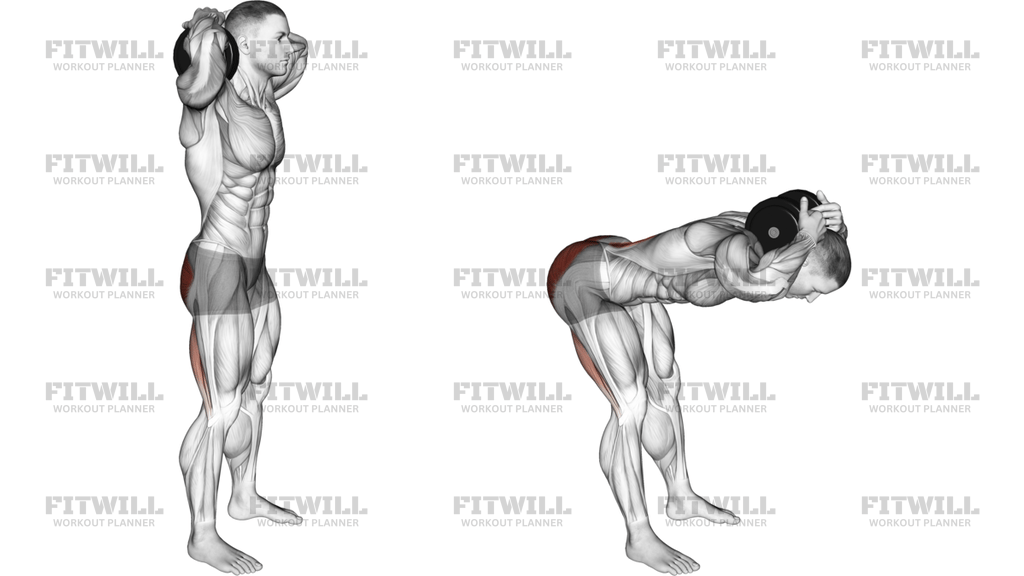
Dumbbell Good Morning is a loaded hip-hinge exercise where a single dumbbell is braced across the upper back behind the head while you fold forward at the hips and keep a soft bend in the knees. The image shows a controlled hinge with the torso traveling forward while the spine stays long, which makes the movement a useful posterior-chain builder for the glutes, hamstrings, and spinal erectors.
Because the dumbbell sits behind the head, the setup matters more here than in many other hinge exercises. The weight should rest high on the upper traps and be held steady with both hands, not balanced on the neck. A stable stance, stacked ribs, and a neutral chin help keep the load from pulling you into lumbar extension or rounding as you descend.
Each repetition should feel like a deliberate hinge rather than a squat or a back bend. Push the hips straight back, keep the shins nearly vertical, and lower only as far as you can maintain a neutral spine and controlled tension through the hamstrings. At the bottom, the torso will usually be close to parallel to the floor or stopped slightly above that point depending on mobility and load.
On the way back up, drive the hips forward and squeeze the glutes to stand tall again without snapping the lower back. That makes the exercise useful as accessory work for hip strength, posterior-chain coordination, and hinge patterning. It also means the safest version is usually the one with lighter loading, a slower tempo, and a range of motion you can repeat cleanly every rep.
Use Dumbbell Good Morning when you want a lower-load hinge variation that still challenges posture and hamstring length under tension. It fits well in accessory blocks, warm-ups, or technique-focused strength sessions. If the dumbbell drifts into the neck, the lower back takes over, or the torso can only move by rounding, shorten the range or reduce the load before adding volume.
Fitwill
Log Workouts, Track Progress & Build Strength.
Achieve more with Fitwill: explore over 9600 exercises with images and videos, access built-in and custom workouts, perfect for both gym and home sessions, and see real results.
Start your journey. Download today!




Instructions
- Stand tall with your feet about hip-width apart and place one dumbbell across the upper traps behind your head, holding it steady with both hands.
- Soften your knees, tuck your chin slightly, and stack your ribs over your pelvis before you start the hinge.
- Pull your shoulders down enough to keep the dumbbell anchored on your upper back without shrugging.
- Push your hips straight back and let your torso tip forward as one long line from head to tailbone.
- Keep your shins nearly vertical and keep your weight centered through the midfoot and heels.
- Lower until you feel a strong hamstring stretch or until your torso is close to parallel without losing the neutral spine.
- Reverse the motion by driving your hips forward and squeezing your glutes to stand tall again.
- Exhale as you stand, reset your brace at the top, and repeat for the planned reps.
Tips & Tricks
- Start lighter than you would for a barbell good morning; the behind-the-head position makes control matter more than load.
- Keep the dumbbell high on the traps, not on the cervical spine, or the position will feel unstable fast.
- Think about sending the hips back, not the chest down, so the hinge stays in the hips instead of the low back.
- If your knees keep drifting forward, widen the stance slightly and reset the hinge before the next rep.
- Stop the descent the moment your pelvis starts to tuck or your back begins to round.
- Keep your gaze a few feet in front of you so the neck stays neutral while the torso folds.
- Use a slower lowering phase to keep tension on the hamstrings and make the rep easier to repeat cleanly.
- If the dumbbell slides or your upper back cannot hold position, shorten the range and reduce the load before adding sets.
Frequently Asked Questions
What muscles does Dumbbell Good Morning work?
It emphasizes the glutes and hamstrings, with the spinal erectors and core helping you hold the hinge position.
Where should the dumbbell sit during the set?
It should rest high across the upper traps behind the head, not on the neck or too low on the shoulders.
How low should I hinge before coming back up?
Lower only as far as you can keep a long neutral spine and a strong hamstring stretch, usually near parallel for most people.
Is this a squat or a hip hinge?
It is a hip hinge. The hips move back while the knees stay softly bent instead of driving forward like a squat.
Can beginners use Dumbbell Good Morning?
Yes, but only with a light dumbbell and a short range until the hinge pattern feels stable.
What should I do if I feel it in my lower back?
Reduce the range, brace harder at the top, and lighten the dumbbell so the hips and hamstrings can do the work.
Should my knees bend a lot?
No. Keep only a soft bend so the movement stays a hinge and does not turn into a squat.
What is a good way to progress this exercise?
Add load slowly only after you can keep the dumbbell stable, the spine neutral, and every rep identical.