Cambered Bar Lying Row
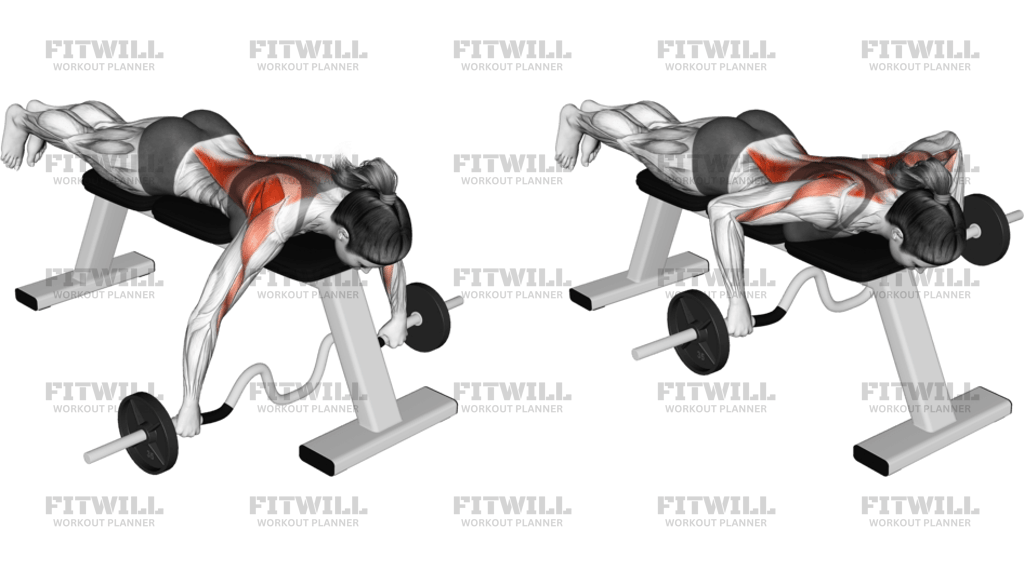
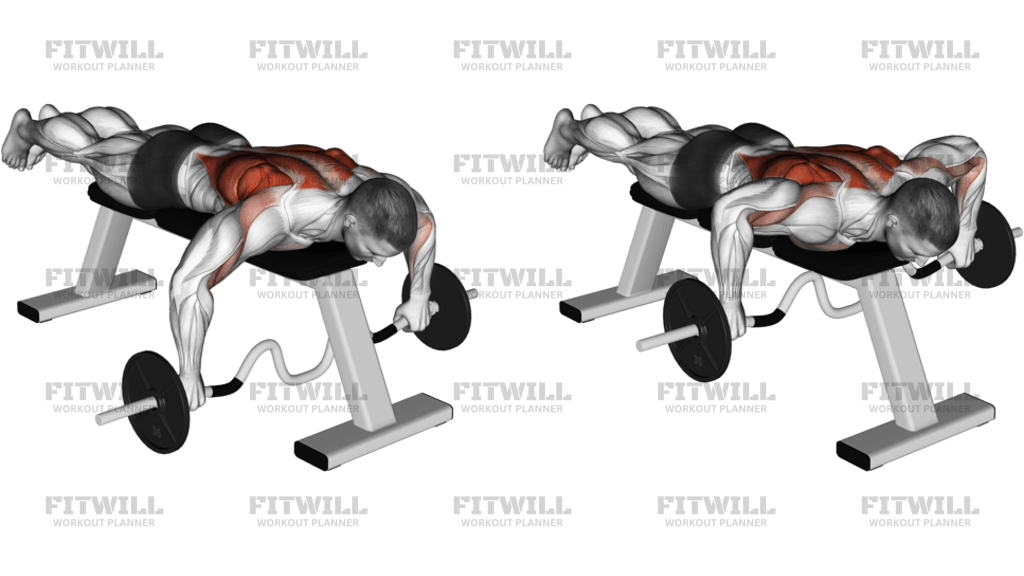
Cambered Bar Lying Row is a chest-supported rowing exercise that lets the upper and mid-back work hard without requiring the lower back to hold the whole position. The cambered bar gives a little extra clearance and can make the pull path feel more comfortable through the top half of the row. Because the chest is supported, the movement often feels cleaner and easier to isolate than a free-standing row.
The primary emphasis is the trapezius and upper back, with the latissimus dorsi, rhomboids, and biceps brachii assisting through the pull. That means the row should feel like the elbows are driving back while the chest stays planted on the bench. The neck stays neutral, the spine stays quiet, and the shoulders avoid shrugging so the upper and mid-back can do the work without extra noise.
Set up prone on a bench with the chest supported and grip the cambered bar at a stable hand width. Keep the torso pressed into the pad and the spine neutral before the first rep. The setup should feel locked in and ready to row, not loose or bouncy. If you are sliding around or losing contact with the bench, the row will become less effective very quickly.
Row the bar toward the lower chest area, pause briefly with the elbows back, and lower it slowly to the stretch. The return phase matters because it keeps the back under tension and prevents the weight from dropping away from you. The clean version of the lift is controlled and compact, with the elbows finishing the pull and the shoulders staying out of the ears.
Cambered Bar Lying Row works well as a back accessory when you want supported rowing volume and less lower-back fatigue. It is a strong choice after heavy compounds or on days when you want to isolate the upper back more directly. Use a manageable load, keep the chest firmly supported, and stop the set when the torso starts losing contact or the shoulders begin to shrug into the pull.
[ Workout Log & Planner ]
Put your next workout in Fitwill
Keep your plan and training log ready when you are.


Instructions
- Set up bench support for a prone lying row.
- Grip the cambered bar with a stable hand width.
- Keep your chest supported and your spine neutral.
- Brace your core lightly before each pull.
- Keep your torso pressed into the bench.
- Row the bar toward the lower chest area.
- Pause briefly with the elbows back.
- Lower the bar slowly to the stretch.
- Repeat without bouncing.
Tips & Tricks
- Keep the neck neutral against the bench.
- Avoid shrugging the shoulders into the pull.
- Use controlled tempo so the chest support does its job.
- Lead with the elbows, not the wrists.
- Do not overextend the low back; the bench should own the position.
- Exhale during the pull and keep the brace light but steady.
- Use full shoulder-blade motion without losing torso contact.
- Choose a load that keeps the reps clean rather than explosive.
Frequently Asked Questions
What muscles are primary in this row?
The upper and mid-back muscles, including the trapezius, are primary.
Why use a cambered bar?
The cambered shape can improve range and bench clearance.
Is Cambered Bar Lying Row easier on the lower back?
Yes, chest support often reduces lower-back strain.
Can beginners perform it?
Yes, with light to moderate load and proper setup.
Should I pause at the top?
A short pause can improve back engagement.
What is a common mistake?
Using momentum and losing chest support contact.
How many reps are typical?
Moderate reps are common for chest-supported rows.
Can it replace regular barbell rows?
It can be an excellent alternative, especially for back isolation.