Dumbbell Single Leg Squat
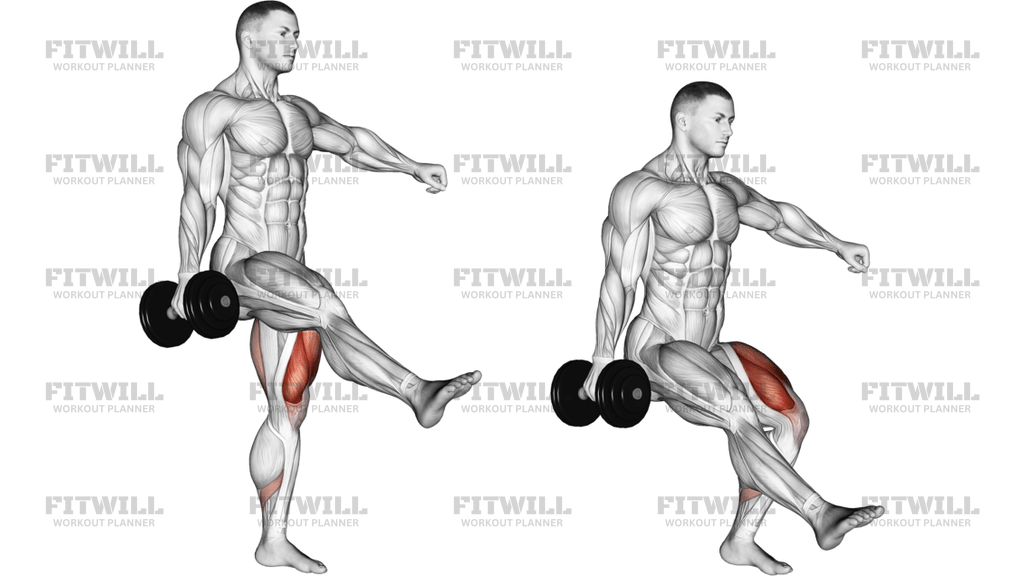
Dumbbell Single Leg Squat is a unilateral lower-body strength exercise that challenges the glutes, quads, hamstrings, calves, and ankle stabilizers while also demanding balance and hip control. Holding dumbbells at your sides adds a small amount of counterbalance and makes it easier to load the movement without forcing the torso into an upright, unstable position. The free leg stays extended forward, so the working leg has to control both the descent and the return.
This variation is useful when you want single-leg strength without turning the movement into a full pistol squat. It trains the standing leg to absorb load through the foot, ankle, knee, and hip in one coordinated pattern. Because the dumbbells hang naturally at your sides, the exercise also teaches you to keep the shoulders quiet and let the lower body do the work.
Set up by standing tall with one dumbbell in each hand, arms straight, and the weight hanging beside your thighs. Shift all of your weight onto one foot, then lift the other leg slightly forward so it stays off the floor as you descend. Keep the standing foot rooted and the toes of the free leg pointed forward so the squat starts from a stable base rather than a twisting position.
On each rep, sit the hips back and down over the standing heel while the free leg reaches forward for balance. The standing knee should track over the toes instead of caving inward, and the torso can lean slightly forward as long as the back stays long and controlled. Lower only as far as you can keep the heel planted, the knee aligned, and the dumbbells steady at your sides.
Use Dumbbell Single Leg Squat as a strength builder, accessory lift, or balance drill when bodyweight squats are no longer challenging enough on one side. Start with a shallow range if the ankle or hip on the working side feels unstable, then earn more depth over time. A clean rep should look smooth from top to bottom, with no hop, swing, or shove off the floor from the free leg. If you need to reset between reps, place both dumbbells down before switching sides so every rep starts from the same stable setup.
Fitwill
Log Workouts, Track Progress & Build Strength.
Achieve more with Fitwill: explore over 9600 exercises with images and videos, access built-in and custom workouts, perfect for both gym and home sessions, and see real results.
Start your journey. Download today!




Instructions
- Stand tall with a dumbbell in each hand, arms straight, and the weights hanging at your sides.
- Shift all of your weight onto one foot and lift the other leg slightly in front of you so it stays off the floor.
- Plant the standing foot firmly and keep the toes of the free leg pointed forward.
- Brace your torso, set your shoulders down, and keep the dumbbells still beside your thighs.
- Sit the hips back and down over the standing heel as the standing knee bends and tracks over the toes.
- Lower until your thigh is as close to parallel as you can keep with control, or stop sooner if balance breaks down.
- Keep the free leg extended in front of you and avoid letting it touch down to help you out of the bottom.
- Drive through the whole standing foot to rise, pressing the floor away while keeping the dumbbells vertical.
- Straighten the standing leg at the top without snapping the knee, then reset the free leg before the next rep.
- Repeat on the same side for the planned reps, then switch legs and lower the dumbbells carefully when finished.
Tips & Tricks
- Hold the dumbbells low and quiet at your sides; if they swing, the working hip is losing control.
- Keep the free leg out in front as a counterbalance, not as a kickstand for pushing out of the bottom.
- Let the torso lean forward a little, but keep the chest and pelvis moving together instead of folding at the waist.
- If the standing heel starts to lift, shorten the depth and work on ankle control before adding more range.
- Think about the knee tracking between the second and third toe of the standing foot on every descent.
- Use a slower lowering phase than the rise so the standing leg has to absorb the load instead of dropping into the bottom.
- Choose dumbbells that let you balance without gripping so hard that your shoulders shrug up.
- Stop the rep before the pelvis twists or the free leg drops and touches the floor.
- A small pause near the bottom can help you find stability, but only if the standing leg stays stacked and steady.
- If full depth turns into a wobble, reduce the range before you reduce the load.
Frequently Asked Questions
What muscles does Dumbbell Single Leg Squat work?
Dumbbell Single Leg Squat mainly trains the glutes and quads of the standing leg, with the hamstrings, calves, and deep hip stabilizers helping control the descent. The free leg and trunk work mostly to keep the body balanced.
Why is the free leg held out in front in Dumbbell Single Leg Squat?
Reaching the free leg forward helps counterbalance the dumbbells and keeps the movement organized around the standing hip. It also makes it easier to stay on one leg without falling backward.
How low should I go in Dumbbell Single Leg Squat?
Go only as low as you can keep the standing heel down, the knee tracking over the toes, and the dumbbells under control. Depth is useful only when you can hold the same shape on every rep.
Is Dumbbell Single Leg Squat easier than a pistol squat?
Usually yes, because the dumbbells hanging at your sides help balance the body and the free leg can stay slightly forward instead of locked straight ahead. It is a good bridge between a bodyweight single-leg squat and a full pistol squat.
What should I do if my standing knee caves inward?
Reduce the depth, lighten the dumbbells, and focus on keeping pressure through the big toe, little toe, and heel of the standing foot. If needed, hold onto a rack or wall lightly until the knee tracks cleanly.
Can I use Dumbbell Single Leg Squat if my balance is poor?
Yes, but start with a very light load and a shorter range, or use fingertip support from a post or rack. The goal is to keep the standing leg doing the work instead of turning the rep into a hop.
What is the biggest mistake in Dumbbell Single Leg Squat?
The most common mistake is letting the free leg drop and touch down to escape the bottom position. That usually means the range is too deep or the load is too heavy for clean single-leg control.
How heavy should the dumbbells be for Dumbbell Single Leg Squat?
Choose a weight that lets you stay smooth, upright enough to balance, and consistent from the first rep to the last. If the dumbbells start swinging or pulling your shoulders forward, the load is too heavy.