Kettlebell Goblet Squat
Kettlebell Goblet Squat is a front-loaded squat that keeps the weight close to the chest and the torso more upright than a back-loaded squat. It is a simple but effective way to train the thighs while also challenging the glutes, adductors, core, and upper back. The kettlebell acts as a counterbalance, which can make it easier to learn good squat mechanics and find a deeper position without folding forward.
The setup matters because the bell changes how you balance. Holding the kettlebell at the sternum encourages a stacked ribcage, a tall chest, and a more controlled descent. When the stance is stable and the feet are planted evenly, the squat becomes a clean pattern of bending at the hips and knees together instead of collapsing into the knees or rounding through the lower back.
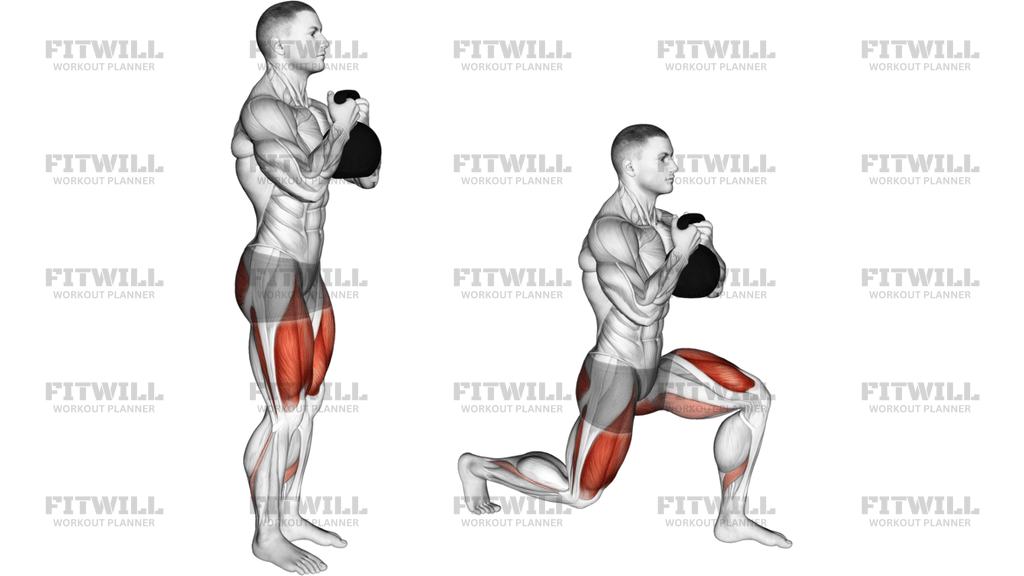
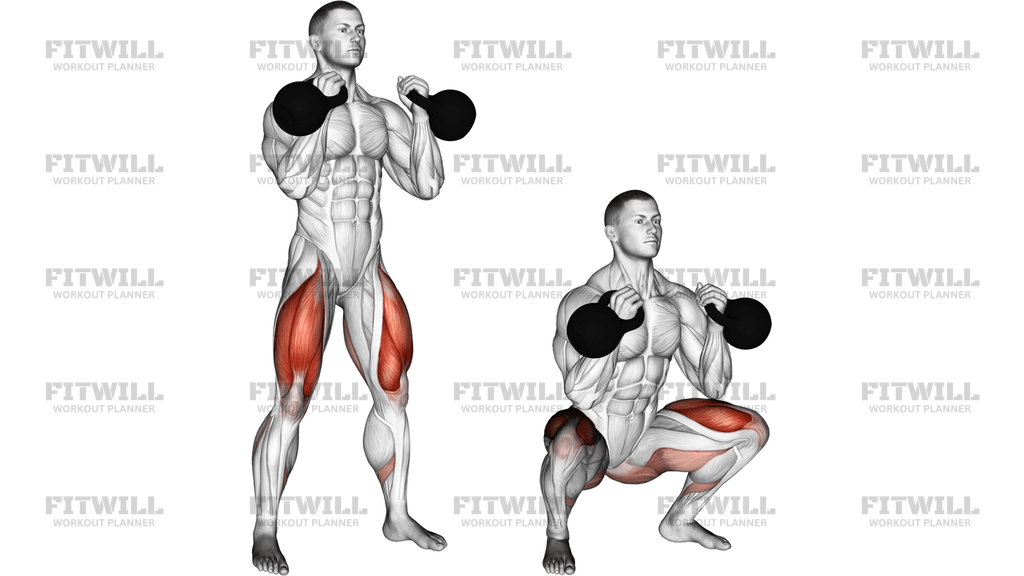
At the bottom, the goal is to keep the whole foot rooted, the knees tracking in line with the toes, and the elbows moving inside the knees only as far as mobility allows. A good goblet squat usually finishes with the thighs at or below parallel, but depth should never come from losing heel contact or dumping the torso forward. The image shows the kettlebell held high, elbows tucked, and the hips dropping between the legs in a controlled seated position.
This exercise is useful for beginners learning to squat, lifters using a lighter accessory movement, or anyone who needs a front-loaded squat that reinforces upright posture and controlled breathing. It fits well in strength blocks, lower-body accessories, warmups, and mobility-focused sessions. Use a load that lets you stay smooth through the full rep, pause briefly if needed to own the bottom, and stop the set when the bell drifts away from the chest or the knees cave inward.
[ Workout Log & Planner ]
Put your next workout in Fitwill
Keep your plan and training log ready when you are.


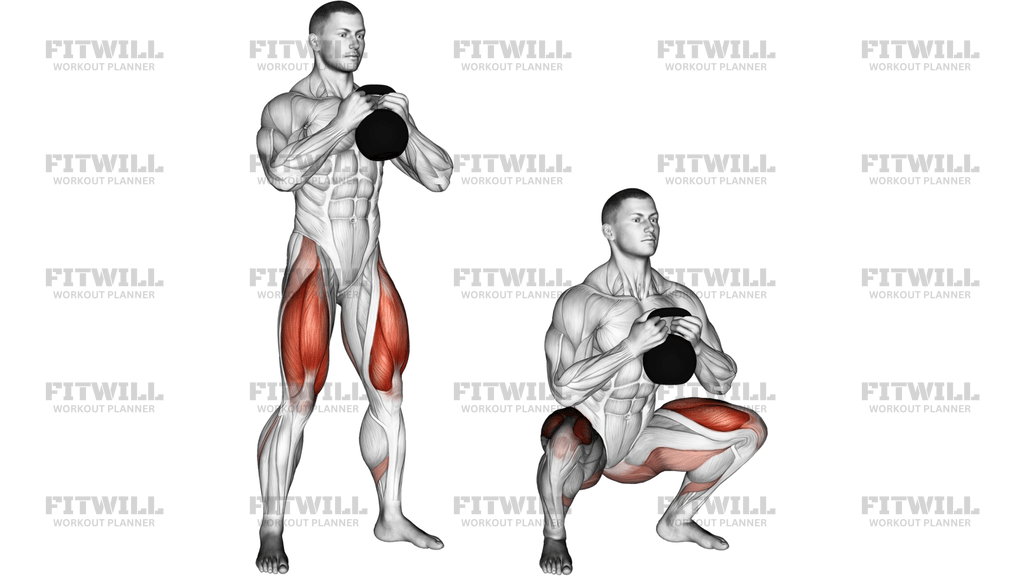
Instructions
- Stand with feet about shoulder-width apart and turn the toes slightly out so the knees can travel naturally.
- Hold the kettlebell by the horns at chest height with the bell tucked against your sternum and your elbows pointing down.
- Stack your ribs over your pelvis, brace your trunk, and keep your eyes forward before you descend.
- Sit down between your heels by bending the hips and knees at the same time.
- Let the knees track in the same direction as the toes while keeping the whole foot pressed into the floor.
- Lower until your thighs reach at least parallel, or as deep as you can without losing heel contact or a neutral spine.
- Pause briefly in the bottom with the chest tall and the kettlebell still close to your body.
- Drive through the midfoot and heels to stand up, pushing the knees out as you rise without letting the torso collapse forward.
- Finish tall at the top, reset your breath, and repeat with the same stance and tempo.
Tips & Tricks
- Keep the kettlebell glued to your chest; if it drifts forward, the torso will tip and the squat turns into a hinge.
- Think about lowering your hips between your heels instead of reaching your chest toward the floor.
- Let the knees travel forward and out a little, but keep them aligned with the toes rather than collapsing inward.
- If your heels pop up, widen the stance slightly or reduce depth until ankle mobility catches up.
- Use a slower descent than ascent so you can own the bottom position instead of bouncing out of it.
- Take a breath and brace before each rep, then exhale only as you pass the hardest part of the stand-up.
- Stop a rep short of the point where your lower back rounds or your elbows are forced far off the inner thighs.
- Choose a kettlebell you can hold high for the full set without your forearms dropping or your wrists bending back.
- If your upper back gets tired before your legs, the bell is probably too heavy for clean goblet positioning.
Frequently Asked Questions
What muscle does Kettlebell Goblet Squat target most?
The main target is the thighs, especially the quadriceps, with strong work from the glutes, adductors, and core.
Can beginners perform this exercise?
Yes. The front-loaded hold makes it one of the most beginner-friendly ways to learn squat mechanics when the load is kept light.
Where should the kettlebell sit during the squat?
It should stay high against the chest, with the elbows tucked down and the bell close enough that you do not have to reach for it.
How deep should I go in a goblet squat?
Go as deep as you can while keeping both heels down, the spine neutral, and the knees tracking cleanly over the toes.
Why do my elbows touch my knees at the bottom?
That is usually fine if it helps you stay upright and balanced. The contact should not force your back to round or your knees to collapse inward.
What does the kettlebell change compared with a bodyweight squat?
Holding weight in front acts as a counterbalance, which can help you stay upright and often makes depth easier to control.
What if I feel this mostly in my lower back?
That usually means you are leaning forward, losing brace, or holding the bell too far from your chest. Lower the load and keep the ribs stacked over the pelvis.
Is this a good replacement for barbell squats?
It is a great accessory or teaching squat, but the load will usually be lighter than a barbell squat, so it is not a one-to-one replacement for heavy strength work.