Mountain Climber Lunge
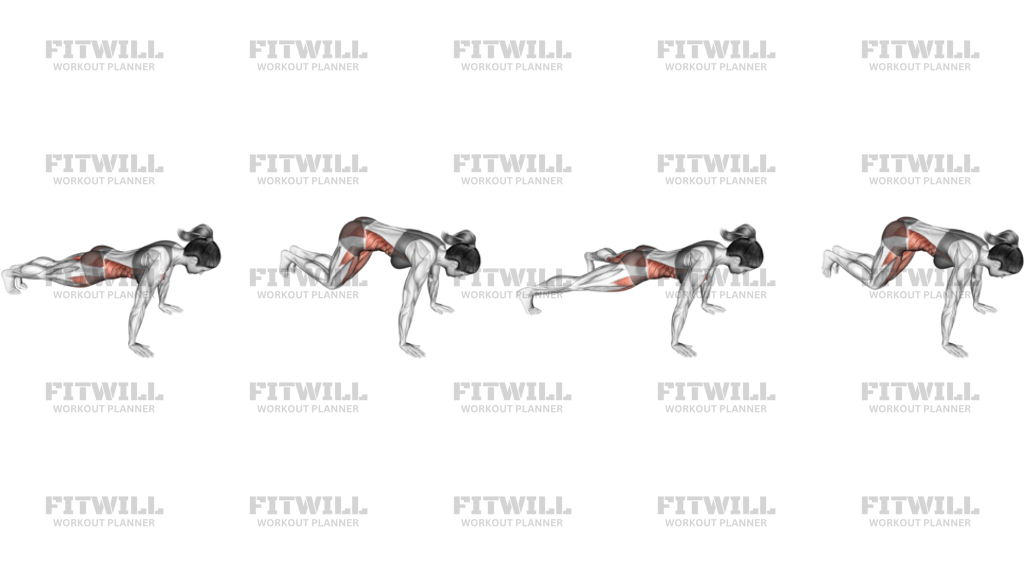
Mountain Climber Lunge is a bodyweight floor exercise performed from a strong hands-and-toes plank. One knee drives forward under the torso while the other leg stays long behind you, creating a fast but controlled lunge-like rhythm that challenges the core and lower body at the same time. The movement is simple to describe, but the setup matters because a loose plank turns the drill into bouncing hips and rushed feet instead of clean, repeatable reps.
The exercise is most useful when you want conditioning with structure: warmups, athletic circuits, core blocks, and metabolic finishers all fit well. It loads the shoulders isometrically while the abs, hip flexors, quads, and glutes work to keep the pelvis steady as the legs switch. The target is not height or speed alone. A good rep looks sharp because the trunk stays quiet while the knees travel smoothly under the body.
Start with the hands planted under or slightly in front of the shoulders, fingers spread for a stable base, and step both feet back into a firm plank. Keep the ribs down, squeeze the glutes, and avoid letting the low back sag as one knee comes forward. Depending on the variation, the knee can drive toward the chest or slightly out toward the same-side elbow, but the torso should stay square and the planted foot should return under control before the next switch.
Breathing and rhythm are part of the exercise. Exhale as the knee drives in, inhale as the leg returns, and keep the pace even enough that each rep looks identical. If the shoulders start wobbling, the hips hike up, or the feet slap the floor, shorten the range and slow the cadence. The best version of Mountain Climber Lunge feels athletic, balanced, and crisp from the first rep to the last.
[ Workout Log & Planner ]
Put your next workout in Fitwill
Keep your plan and training log ready when you are.


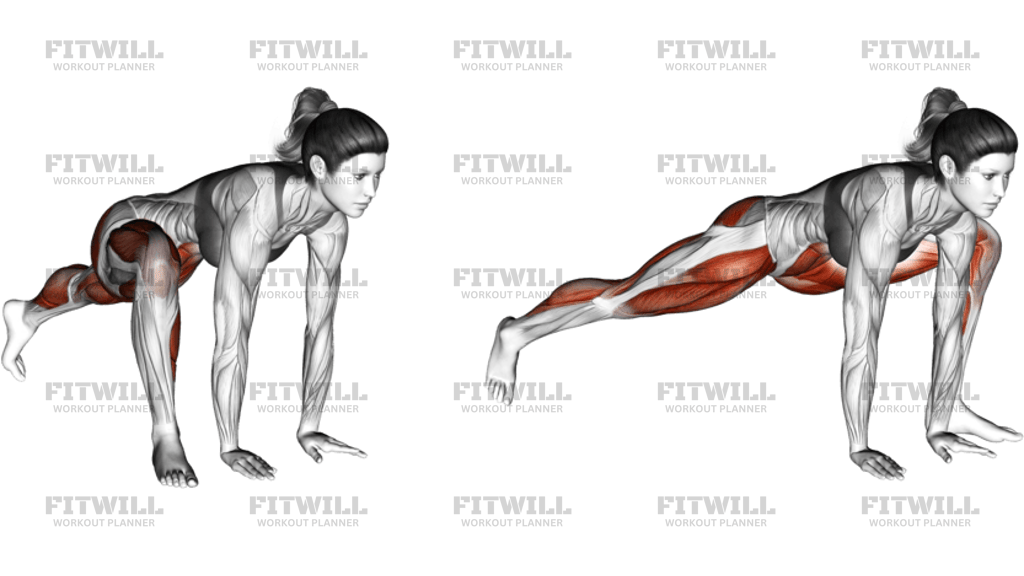
Instructions
- Place your hands on the floor under your shoulders or just in front of them, with your fingers spread wide for balance.
- Step both feet back into a straight-arm plank, keeping your head, ribs, hips, and heels in one line.
- Brace your midsection and lightly squeeze your glutes so the low back stays from dropping toward the floor.
- Drive one knee forward under your torso toward the chest or same-side elbow, depending on the variation shown.
- Keep the planted leg active and the shoulders stacked over the hands as the knee travels in.
- Return the driving foot back to the plank position under control without letting the hips rock side to side.
- Switch legs and repeat the same path on the opposite side at an even, repeatable pace.
- Breathe out on each knee drive and inhale as the leg extends back to plank.
- Stop the set if the hips pike, the lower back sags, or the feet start slapping the floor.
Tips & Tricks
- Treat every rep like a plank first and a knee drive second; the torso should stay as still as possible.
- If your shoulders drift behind your wrists, reset your hand position before the next round.
- A shorter knee travel is better than a bigger one if your hips start bouncing or twisting.
- Keep pressure through the whole hand, especially the base of the index finger and thumb, to avoid collapsing into the wrists.
- Move the feet quickly but not wildly; the goal is a clean switch, not a jump.
- Keep the neck long by looking at the floor a few inches ahead of your hands.
- Raise the hips slightly only if needed to maintain a strong plank, but do not turn the drill into a pike.
- Use a steady cadence you can hold for the entire set instead of sprinting the first 10 seconds.
Frequently Asked Questions
What does Mountain Climber Lunge train most?
It mainly trains core stability, hip flexor drive, shoulder support, and conditioning through a plank-based knee drive.
Should my hands stay directly under my shoulders?
Usually yes. A stacked hand-and-shoulder position gives you the most stable plank before each knee drive.
Do I need to bring the knee all the way to the chest?
Only as far as you can without losing the plank. A smaller, cleaner knee drive is better than forcing extra range.
Why do my hips bounce during the movement?
That usually means the rep is too fast or the plank is too loose. Slow the cadence and shorten the knee travel.
Can beginners do this exercise?
Yes. Beginners can start with slower alternating mountain climbers or by stepping the knees in one at a time from a high plank.
What should I feel in my shoulders and wrists?
A steady support demand is normal, but you should not feel sharp wrist pain or sinking shoulders. Spread the fingers and keep the elbows straight but not locked hard.
What is a common mistake with the knee path?
Letting the knee drift out of control or twisting the torso to chase range. The pelvis should stay square while the leg moves underneath you.
How can I make Mountain Climber Lunge easier?
Slow it down, reduce the knee travel, or perform it with your hands elevated on a bench or box.
How can I make it harder without adding equipment?
Increase the pace slightly while keeping the plank strict, or pause for a beat when the knee is forward before returning to plank.