Push-Up Close-Grip Off Dumbbell
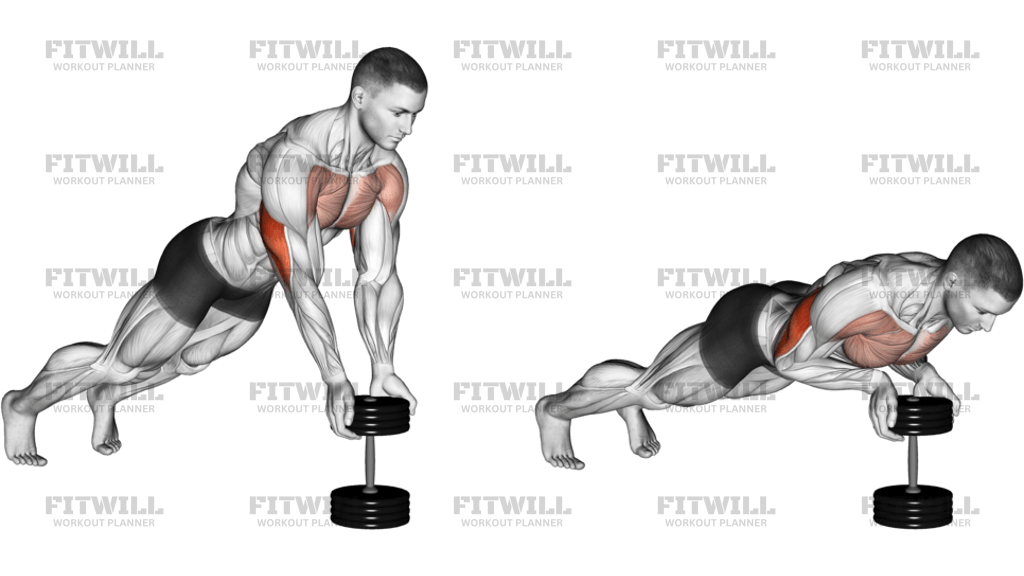
Push-Up Close-Grip Off Dumbbell is a close-grip push-up performed with each hand on a dumbbell used as a handle. The neutral grip reduces wrist extension and usually feels friendlier on the wrists than a flat-palmed push-up, while the raised handles can let the chest travel a little deeper if the dumbbells are stable and tall enough.
This version of the push-up is a bodyweight pressing exercise, so the main movers are the triceps, chest, and front delts, with the core, glutes, and upper back working hard to keep the body in a straight line. The narrow hand position shifts more work toward elbow extension and demands tighter shoulder control than a wider push-up.
Setup matters more here than in a basic floor push-up because the dumbbells become your support points. They need to sit flat, parallel, and close enough for a strong pressing line, but not so close that the shoulders collapse inward. A stable plank, quiet ribs, and controlled elbow tracking are what keep the exercise productive instead of shaky.
Lower under control until your chest approaches the floor between the dumbbells, then press back up by driving the handles straight down and away from you. Keep the elbows tucked, the neck relaxed, and the hips from sagging or piking. If the dumbbells roll, the wrists hurt, or the shoulders lose position, the setup or the range is too aggressive.
Use this exercise for home training, accessory pressing, or any session where you want a wrist-friendlier push-up with a little extra range of motion. It works well for beginners on an incline or with knees down, and it also scales well for stronger lifters by slowing the descent, elevating the feet, or adding a vest once bodyweight reps are clean and repeatable.
[ Workout Log & Planner ]
Put your next workout in Fitwill
Keep your plan and training log ready when you are.


Instructions
- Place two dumbbells on a flat, non-slip surface, parallel to each other and just wider than shoulder width.
- Grip the dumbbell handles and set up in a high plank with your hands under your shoulders and your body in a straight line from head to heels.
- Squeeze your glutes, brace your abdomen, and keep your neck long so your head stays in line with your spine.
- Lower your chest between the dumbbells by bending your elbows back at about a 20 to 45 degree angle from your torso.
- Keep the dumbbells planted and control the descent until your chest is close to the floor or you reach the deepest pain-free position.
- Press through both handles and drive the floor away until your elbows are straight without locking them forcefully.
- Keep your ribs from flaring and your hips from sagging as you return to the top.
- Reset your plank before the next rep and breathe steadily throughout the set.
Tips & Tricks
- Use hex dumbbells or another stable handle shape so the support points cannot roll as you shift your weight.
- Set the dumbbells wide enough that your shoulders do not collapse inward, but not so wide that the elbows flare out.
- Think about lowering the chest between the handles instead of letting the head reach forward first.
- Keep the elbows tucked close to the ribs to shift more work toward the triceps and keep the shoulders organized.
- If your wrists feel better on the dumbbells but your shoulders feel pinched, reduce depth or move the hands slightly wider.
- A slower 2 to 3 second descent makes it easier to keep the dumbbells quiet and the torso rigid.
- Do not let the hips sag when you press; the plank should stay firm from the first rep to the last.
- Stop the set as soon as one dumbbell shifts, because instability usually means the shoulders and core have already lost position.
Frequently Asked Questions
What muscles does Push-Up Close-Grip Off Dumbbell work most?
It mainly trains the triceps, chest, and front delts, with the core and glutes helping you keep a rigid plank.
Can beginners perform this exercise?
Yes. Beginners often do best with hands on a bench or box first, or with knees down if the dumbbells stay stable.
Why use dumbbells instead of putting my hands flat on the floor?
The dumbbell handles give you a neutral grip, which usually feels easier on the wrists and can allow a slightly deeper bottom position.
How close should the dumbbells be for a close-grip push-up?
Keep them just inside or around shoulder width. Too narrow usually makes the shoulders collapse; too wide turns it into a different press.
What is the most common mistake with this variation?
Letting the elbows flare and the dumbbells shift. That usually means the setup is unstable or the set is too heavy.
How deep should I lower on the dumbbells?
Lower until your chest is near the floor between the handles, but stop sooner if the shoulders lose position or the dumbbells become unstable.
Can I substitute other equipment for the dumbbells?
Stable push-up handles or parallettes can work, but avoid anything that can roll or tip when you shift your weight.
How do I make this harder once bodyweight reps are easy?
Slow the lowering phase, elevate your feet, add a vest, or add a brief pause near the bottom while keeping the dumbbells steady.