Side Lying Feet Raise
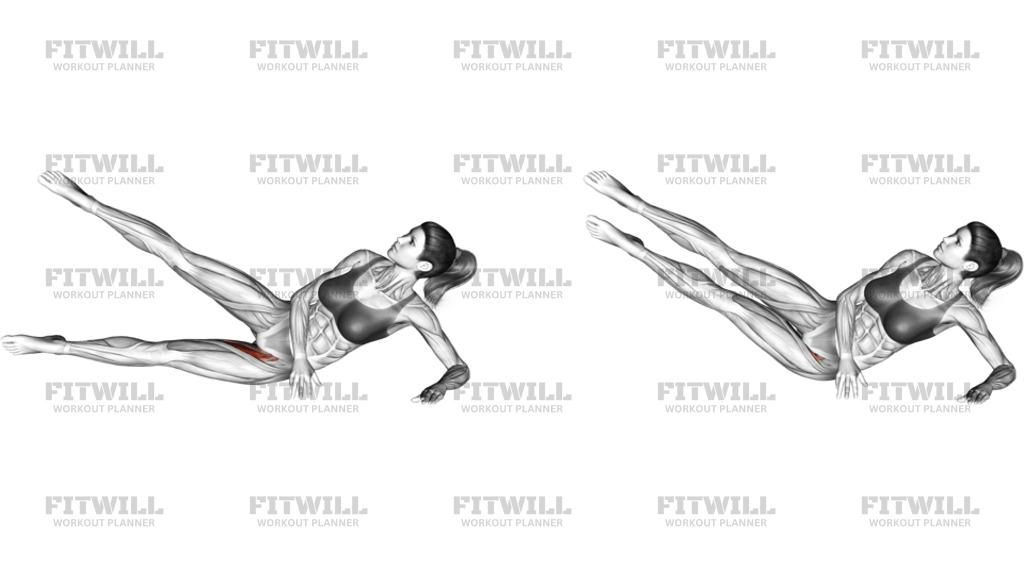
Side Lying Feet Raise is a bodyweight side-lying hip abduction exercise that lifts the top leg while the torso stays stacked and quiet. It is a simple movement on paper, but the quality of each rep depends on how well you keep the pelvis still and move from the hip instead of swinging the leg.
The main training effect is on the outer hip and thigh, with the supporting muscles around the trunk helping you resist rolling backward or forward. That makes the exercise useful for building controlled hip strength, improving side-to-side stability, and teaching cleaner single-leg mechanics without needing external load.
The setup matters because the starting position determines where the tension goes. Lie on your side with the lower leg long on the floor, the top leg stacked over it, and the trunk aligned from shoulder to hip. Keep the bottom arm under your head or in front for support, and use the free hand lightly on the floor if you need help keeping your balance. A stacked body makes the outer hip do the work instead of the lower back.
On each repetition, raise the top leg under control, pause briefly near the top, and lower it slowly until the legs nearly touch. The movement should feel smooth and deliberate, not jerky or rushed. Breathe out as the leg lifts and keep the rib cage and pelvis from twisting as the leg moves through the range.
This exercise is often used as a warm-up, accessory drill, or low-load strength builder when you want targeted hip work without heavy equipment. It is also easy to progress by slowing the tempo, adding a pause, or using a small ankle weight once the bodyweight version stays clean. Keep the range pain-free and stop the set if the pelvis starts rotating or the lower back takes over.
Fitwill
Log Workouts, Track Progress & Build Strength.
Achieve more with Fitwill: explore over 9600 exercises with images and videos, access built-in and custom workouts, perfect for both gym and home sessions, and see real results.
Start your journey. Download today!




Instructions
- Lie on your side with the lower leg long on the floor and the top leg stacked directly above it.
- Place your bottom arm under your head or extend it on the floor, and use the free hand in front of your torso for balance if needed.
- Stack your shoulders, ribs, and hips so your pelvis stays square to the floor.
- Keep both legs straight but not locked, with the top foot neutral or slightly turned down.
- Brace lightly through the waist before you start the first rep.
- Lift the top leg up and slightly back from the hip without rolling the torso.
- Pause for a moment at the top while keeping the pelvis still.
- Lower the leg slowly until it is just above the bottom leg.
- Breathe out as you lift and keep the neck and shoulders relaxed.
- Complete all reps on one side, then switch and repeat on the other side.
Tips & Tricks
- Lead the lift with the heel so the outer hip, not the toes, drives the motion.
- Turn the top toes only slightly down if you feel the hip opening too much at the top.
- Stop the rep when your pelvis starts to roll backward, even if the leg could go higher.
- Keep the bottom hand in front of your chest if you need a little counterbalance to stay stacked.
- Use a slower lowering phase than lifting phase to keep tension on the outer hip.
- A small range with perfect control is better than a high leg swing with a twisting torso.
- If you feel the lower back, shorten the range and focus on moving from the side of the hip.
- Higher reps usually work better than heavy load for this drill, especially with bodyweight only.
- Add difficulty with a pause at the top before adding ankle weight.
- Stop the set as soon as the leg starts to swing or the waist loses its steady line.
Frequently Asked Questions
What muscles does Side Lying Feet Raise train?
It mainly trains the outer hip and thigh on the top leg, with the trunk muscles helping keep the body stacked.
Where should I feel Side Lying Feet Raise?
You should feel the work along the outside of the hip and upper thigh, not in the lower back.
How high should the top leg go?
Raise it only as far as you can without the pelvis rolling open or the torso shifting backward.
Should my toes point up or down?
Neutral is fine, but slightly pointing the top toes down often helps keep the hip from rotating open.
Can beginners do this exercise?
Yes. Bodyweight and a short, controlled range make it a good beginner-friendly hip stability drill.
What is the biggest form mistake?
Rolling the hips back and turning the lift into a swing instead of a controlled hip raise.
How can I make Side Lying Feet Raise harder?
Slow the lowering phase, add a pause at the top, or use a light ankle weight once bodyweight reps stay clean.
Is this a good warm-up exercise?
Yes, it works well before lower-body training because it wakes up the side of the hip without fatiguing you heavily.