Step-Up Opposite Elbow To Knee Twist
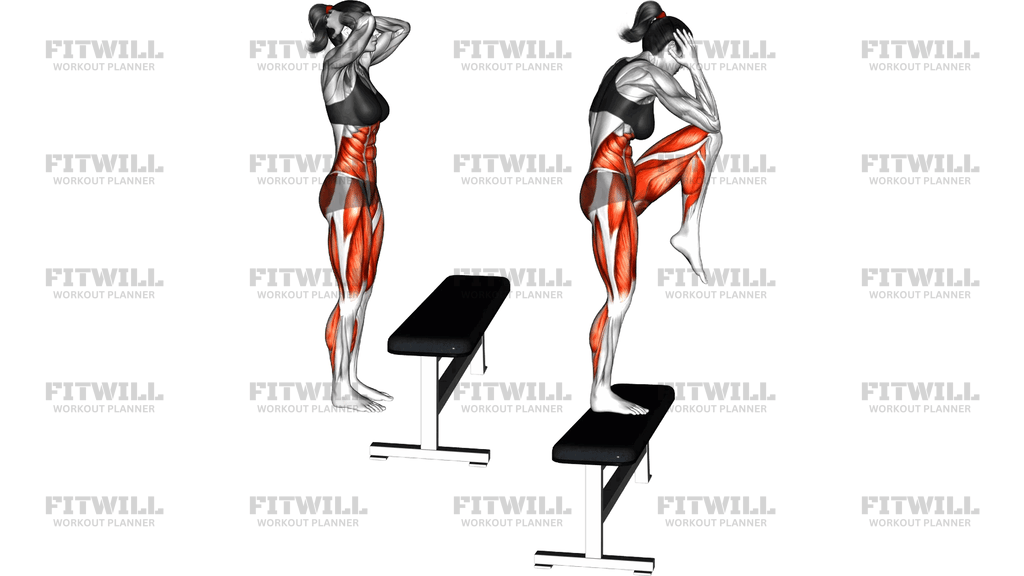
Step-Up Opposite Elbow To Knee Twist is a bodyweight cardio drill performed on a stable bench or step. One foot stays planted on the platform while the other leg drives up into a high knee, and the torso closes toward that raised knee so the opposite elbow can meet it. The movement blends stepping power, balance, coordination, and trunk control into one repeating pattern.
The exercise works best when the step height lets you keep the full foot on the bench and stay upright at the top. If the platform is too high, the hip on the stepping leg will collapse and the twist becomes a shrugging, rushing motion instead of a controlled knee drive. A lower bench or aerobic step usually makes it easier to keep the planted foot stable, the knee tracking cleanly, and the chest from folding forward.
Because the hands stay behind the head, the movement should come from the legs and trunk, not from yanking the neck. As you step up, drive through the heel and midfoot of the working leg, lift the free knee with intent, and bring the opposite elbow toward that knee by rounding the ribcage slightly. The goal is a crisp contact or near-contact without crashing the elbow into the knee or losing balance on the platform.
This is a useful conditioning choice when you want more than simple step-ups. The added twist increases core demand, challenges single-leg stability, and keeps the heart rate up with rhythmic reps. It fits well in warm-ups, athletic circuits, and low-equipment conditioning blocks, especially when you want a dynamic movement that still rewards control and posture.
Keep the descent just as deliberate as the rise. Step down under control, reset your stance, and alternate sides or continue on the same side depending on the workout plan. If the bench wobbles, your knee caves inward, or your neck feels strained, lower the step height and slow the tempo before adding speed or volume.
Fitwill
Log Workouts, Track Progress & Build Strength.
Achieve more with Fitwill: explore over 9600 exercises with images and videos, access built-in and custom workouts, perfect for both gym and home sessions, and see real results.
Start your journey. Download today!




Instructions
- Place one foot fully on a stable bench or step and stand close enough that your whole foot can stay planted without hanging off the edge.
- Keep your hands behind your head, elbows open, chest lifted, and your standing knee slightly bent before you begin the first rep.
- Brace your midsection, then drive through the planted foot to step up onto the platform.
- As you rise, bring the opposite knee up toward your torso instead of swinging it forward loosely.
- Rotate your ribcage slightly and draw the opposite elbow toward the lifted knee until they meet or come close together.
- Pause briefly at the top with your standing hip tall, then keep your torso stacked rather than collapsing over the thigh.
- Lower the lifted leg back down under control and step off the bench with the same planted foot.
- Reset your posture, alternate sides as programmed, and keep the movement smooth rather than bouncing from rep to rep.
- Exhale as you drive up and twist, then inhale as you return to the floor.
Tips & Tricks
- Choose a bench height that lets you stand on top without leaning hard over the thigh or losing balance at the knee drive.
- Keep the supporting foot flat on the step; if the heel floats or the toes slide, the platform is too narrow or the setup is too aggressive.
- Let the twist come from the ribs and trunk, not from pulling hard on the neck with the hands.
- Aim the lifted knee slightly across the body only as far as you can keep the standing knee tracking over the toes.
- Keep the standing hip from dropping outward; a level pelvis makes the step-up and twist cleaner.
- Use a controlled descent, because the lowering phase exposes balance problems faster than the upward drive.
- If you want more conditioning, increase speed only after the rep pattern stays crisp at a slower tempo.
- Stop the set when the elbow misses the knee by a large margin or when you have to hop to reach the platform.
Frequently Asked Questions
What does the opposite elbow to knee twist train in this step-up?
It combines leg drive with trunk rotation and balance, so the quads, glutes, and core all contribute to each rep.
Should my hands stay behind my head the whole time?
Yes. Keep the hands lightly supporting the head so the torso can rotate without pulling on the neck.
How high should the step or bench be?
Use a height that lets the whole foot stay planted and allows you to stand tall at the top without leaning or wobbling.
What is the most common form mistake?
Most people rush the rep, pull on the neck, or let the standing knee cave inward instead of controlling the step and twist.
Can I alternate sides every rep?
Yes. Alternating sides keeps the pattern balanced, while doing several reps on one side can make the conditioning demand more focused.
Do I need to touch elbow to knee on every rep?
No. A controlled near-contact is fine if full contact would make you round the spine, yank the neck, or lose balance.
Is this more of a cardio move or a strength move?
It is primarily a conditioning drill with a strength-and-stability component, especially for the stepping leg and trunk.
How can I make it harder without adding weight?
Use a slightly higher step, slow the lowering phase, or increase the pace only after the balance and twist stay clean.