High Knee
High Knee is a bodyweight cardio drill that uses fast alternating knee drives to raise the heart rate, challenge coordination, and reinforce upright running mechanics. The exercise works best when the torso stays tall and the legs move under control, because the goal is not to jump higher but to repeat crisp, rhythmic knee lifts without losing posture.
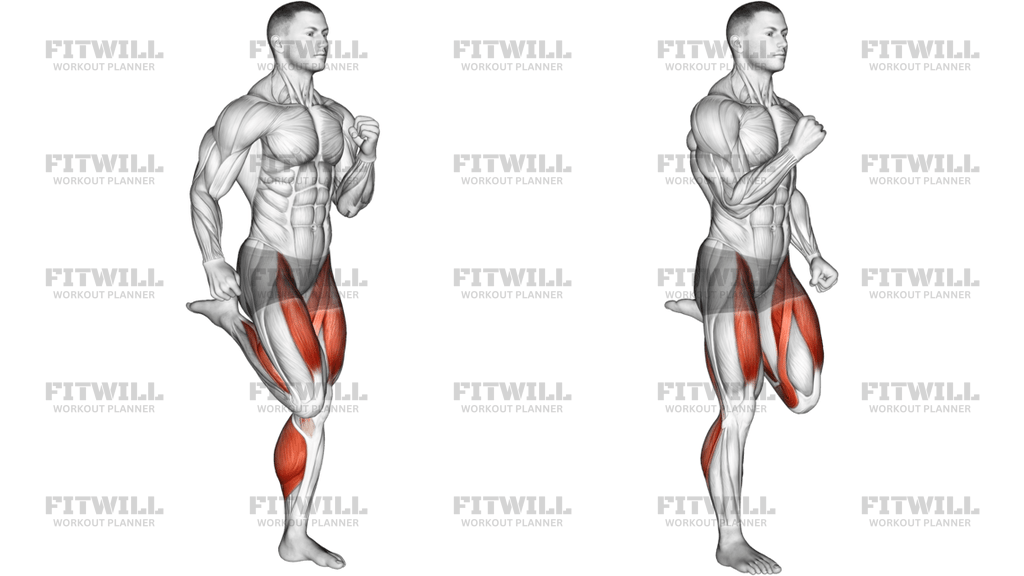
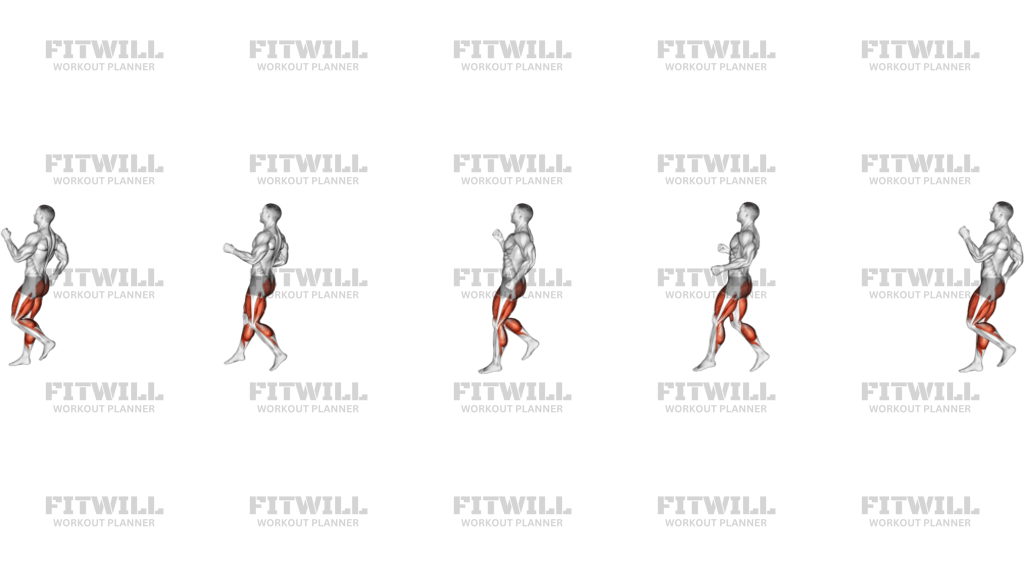
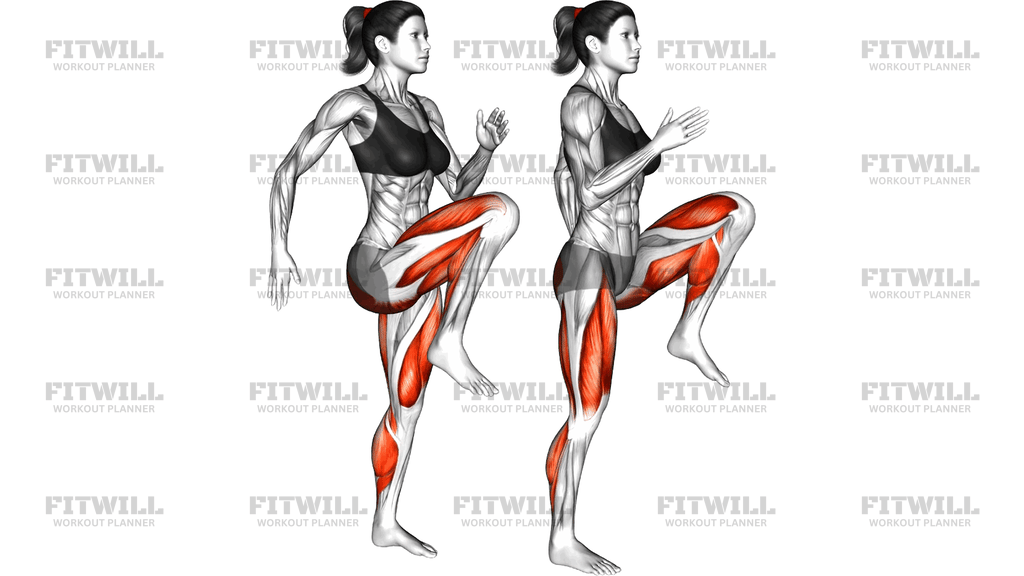
In the image, the movement is shown as a standing alternation: one knee drives up toward hip height while the opposite arm comes forward in a running pattern. That arm action matters because it helps balance the pelvis and keeps the drill from turning into a sloppy hop. The supporting foot should stay under the hip, the chest should stay lifted, and the standing leg should absorb each landing quietly.
Set the drill up by standing with feet about hip-width apart, knees soft, and ribs stacked over the pelvis. From there, shift into a quick march or light run in place and lift each knee on its own track rather than letting it sweep across the body. A good rep feels like a short, powerful drive from the hip with a controlled return to the floor, not a backward lean or a stomp. Breathing should stay rhythmic so the effort can be sustained for intervals or warm-up sets.
High Knee is useful as a warm-up, conditioning interval, or low-equipment cardio option when you want a simple movement that still demands timing and body control. Beginners can keep it low impact with a marching version, while faster or more advanced sets can use a quicker cadence and a higher knee drive. The main safety points are to keep the torso upright, land softly, and reduce speed if the hip flexors, knees, shins, or ankles start to feel irritated.
[ Workout Log & Planner ]
Put your next workout in Fitwill
Keep your plan and training log ready when you are.


Instructions
- Stand tall with your feet about hip-width apart and your arms bent like a light running position.
- Stack your ribs over your pelvis, keep your shoulders relaxed, and look straight ahead.
- Shift onto the balls of your feet and start with a quick march or light run in place.
- Drive one knee up toward hip height while the opposite arm swings forward naturally.
- Keep the lifted foot dorsiflexed and the chest upright instead of leaning back to chase height.
- Lower that foot under your body with a soft landing, then switch immediately to the other knee.
- Keep each support leg slightly bent so the landing stays quiet and springy.
- Maintain a steady rhythm for the planned time or repetitions, then slow to a march before stopping.
Tips & Tricks
- Think of the drill as quick, light contacts with the floor rather than a series of hard jumps.
- Lift the thigh from the hip; do not arch your low back to make the knee look higher.
- Let the opposite arm drive forward and back to keep your torso organized and your cadence even.
- Keep the lifted toes up so the foot can come down softly instead of slapping the floor.
- If you want a lower-impact version, keep the same posture but shorten the knee drive into a fast march.
- Use a slightly slower tempo if your hips start rocking side to side or your shoulders tense up.
- Exhale on each knee drive so the rhythm stays consistent through longer intervals.
- Stop before the drill turns into a bounce with no knee lift or a stomp with no control.
Frequently Asked Questions
What does High Knee train most?
It mainly trains cardio capacity, hip flexor speed, core control, and running-style coordination.
Should my knee always reach hip height?
Hip height is a good target if your mobility and balance allow it, but a lower marching version is still useful.
Why do the arms matter in a high knee drill?
The arm swing helps balance the opposite leg drive and keeps the movement closer to a real running pattern.
What is the most common form mistake?
People usually lean back, lift the knee with momentum, or land too hard instead of keeping the torso tall and the steps quick.
Is High Knee supposed to be a jump or a march?
It can be either. Marching is the lower-impact version, while the faster run-in-place version is used for conditioning.
Where should I feel the exercise?
You should notice the hip flexors, quads, calves, and abs working, along with a rising heart rate.
How do I keep the drill low impact?
Stay tall, keep the steps short, and land softly under the hips instead of hopping upward.
When is High Knee most useful in a workout?
It fits well in warm-ups, conditioning circuits, athletic prep, or short cardio intervals where quick rhythm matters.