Smith One Leg Deadlift
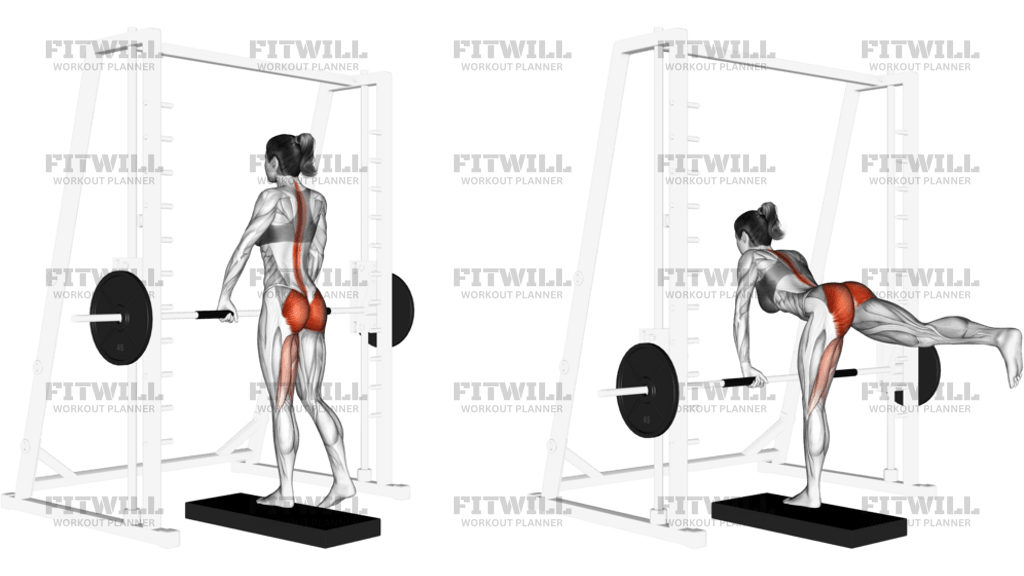
Smith One Leg Deadlift is a single-leg hip hinge done on a Smith machine, with the bar moving on fixed rails while one foot stays planted and the other leg reaches back for balance. The guided bar path makes the exercise feel more stable than a free one-leg deadlift, but the movement still depends on a clean hinge, a square pelvis, and steady tension through the working hip.
The main training effect comes from the glutes and hamstrings, with the core and spinal erectors working hard to keep the trunk from twisting or rounding. In anatomy terms, the primary work centers on the Gluteus maximus, with help from the Biceps femoris, Rectus abdominis, and Erector spinae. It is a useful unilateral posterior-chain exercise when you want to build hip strength, address left-right differences, or add controlled hamstring and glute volume without the extra balance demand of a free bar.
Setup matters because the Smith bar fixes the direction of travel. Stand centered in the machine with the working foot flat, the knee slightly soft, and the bar held just in front of the thighs at about hip height. The free leg should start lightly behind you as a counterbalance. If you stand too far from the bar, the hinge turns into a reach; if you stand too close, the bar can crowd the thighs and force the hips forward too soon.
Each rep should feel like a hip hinge, not a squat. Push the working hip back, keep the rib cage stacked over the pelvis, and let the torso tip forward as the bar slides straight down the rails. The rear leg extends behind you as the torso lowers, but the torso and pelvis should stay controlled and level. Descend only as far as you can keep the back long and the hamstrings loaded, then drive the floor away through the heel and midfoot to return to standing and finish with the glute, not a lean-back.
This movement fits well in glute, hamstring, and lower-body accessory work, or as a technique-focused unilateral hinge in a strength session. It is especially useful when you want repeatable reps with a clear tension curve and less balance noise than a dumbbell version. Keep the load moderate, respect the fixed bar path, and stop a set when your hips start opening, the bar drifts away from the leg, or the lower back takes over from the hip.
[ Workout Log & Planner ]
Put your next workout in Fitwill
Keep your plan and training log ready when you are.


Instructions
- Set the Smith bar at about hip height and stand centered so the bar starts in front of your thighs.
- Plant the working foot flat on the floor, keep a soft bend in that knee, and hold the bar with an overhand grip just outside your thighs.
- Brace your torso, square your hips, and lift the free foot slightly behind you so it acts as a counterbalance.
- Push the working hip back and hinge forward while the bar slides straight down the Smith rails.
- Keep the bar close to the standing leg and let the rear leg reach back as your torso lowers.
- Lower until you feel a strong hamstring stretch without rounding your back or opening the hips.
- Drive through the heel and midfoot of the standing leg to return to upright and squeeze the glute at the top.
- Reset your balance between reps, inhale on the way down, and exhale as you stand.
Tips & Tricks
- Keep the standing foot close enough to the bar that the plates travel just in front of your thigh and shin, not out in front of you.
- Use a slight knee bend on the working leg; turning this into a squat usually reduces hamstring tension.
- Think about sending the free heel backward, not upward, so the pelvis stays level and the trunk does not rotate open.
- Stop the descent when your back starts to round or the bar drifts away from the leg, even if that is above mid-shin.
- A slower lowering phase usually keeps the glutes and hamstrings under tension and makes the Smith path feel smoother.
- Keep your arms long and relaxed; they hold the bar, but they should not pull the torso upright.
- Choose a load that lets you keep the same hip angle from rep to rep instead of using momentum to stand up.
- Finish tall without leaning backward or snapping the hips through at the top.
Frequently Asked Questions
What muscle does Smith One Leg Deadlift target most?
The main target is the glutes, with the hamstrings doing a lot of the work as the hip folds and extends.
Can beginners perform this exercise?
Yes, if they start light and keep the range short enough to hold a neutral spine and level hips.
Where should the Smith bar be at the start?
Set it around hip height so you can stand tall, grip the bar comfortably, and begin the hinge without reaching.
How far should I lower on each rep?
Lower only until the hamstrings are loaded and your back stays long; you do not need to chase the floor.
Should my free leg stay straight behind me?
It should reach back as a counterbalance, with only a slight bend if that helps you keep the pelvis square.
Why do I feel this in my lower back instead of my glutes?
That usually means the hips are not moving back enough, the bar is too far from the leg, or the load is too heavy.
Is this easier than a dumbbell single-leg deadlift?
Usually yes, because the Smith machine removes some balance demand and gives you a fixed bar path to control.
What is the best cue for the top of the rep?
Stand up by driving the standing hip through and squeezing the glute, not by leaning your torso backward.