Band Deadlift
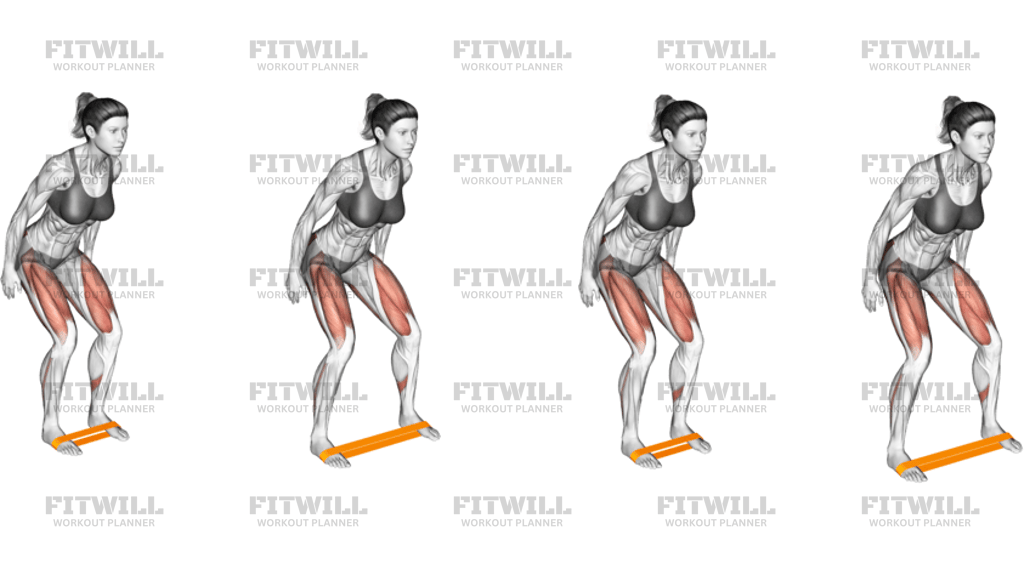
Band Deadlift is a standing hip-hinge exercise that uses band resistance to train the glutes, hamstrings, and trunk without the fixed path of a barbell. It is especially useful when you want to rehearse the deadlift pattern, warm up the hips, or build posterior-chain strength with a simpler and more joint-friendly setup. The band adds tension as you stand up, so the hardest part of the rep is usually the lockout rather than the floor position.
The exercise works best when the feet, hips, and rib cage stay stacked before the pull begins. Stand on the band with a stance about hip-width apart, hold the handles or ends close to your thighs, and keep the shoulders down so the band does not yank you forward. That setup matters because Band Deadlift is driven by a clean hinge, not by rounding the back and muscling the weight up with the arms.
As you descend, send the hips back, keep a soft bend in the knees, and let the torso tip forward as one solid unit. The handles should travel close to the legs, and the spine should stay long while the shins stay nearly vertical. On the way up, drive the floor away, bring the hips through, and finish tall without leaning back or overextending the lower back.
Band Deadlift is a good option for beginners learning how a hip hinge should feel, and it is also useful for experienced lifters who want a lighter accessory lift after heavier deadlift work. Because the band changes tension through the range, it rewards smooth tempo and a controlled return rather than a jerky pull. It can fit in lower-body sessions, warm-ups, or circuit training when you want focused glute and hamstring work with minimal equipment.
Treat the top position as a strong standing finish, not as a backward lean. Keep the neck long, the ribs from flaring, and the weight balanced through the whole foot so the glutes do the work instead of the lower back. With crisp setup and steady pacing, Band Deadlift gives you a simple, practical way to train the hinge pattern and reinforce better deadlift mechanics.
[ Workout Log & Planner ]
Put your next workout in Fitwill
Keep your plan and training log ready when you are.


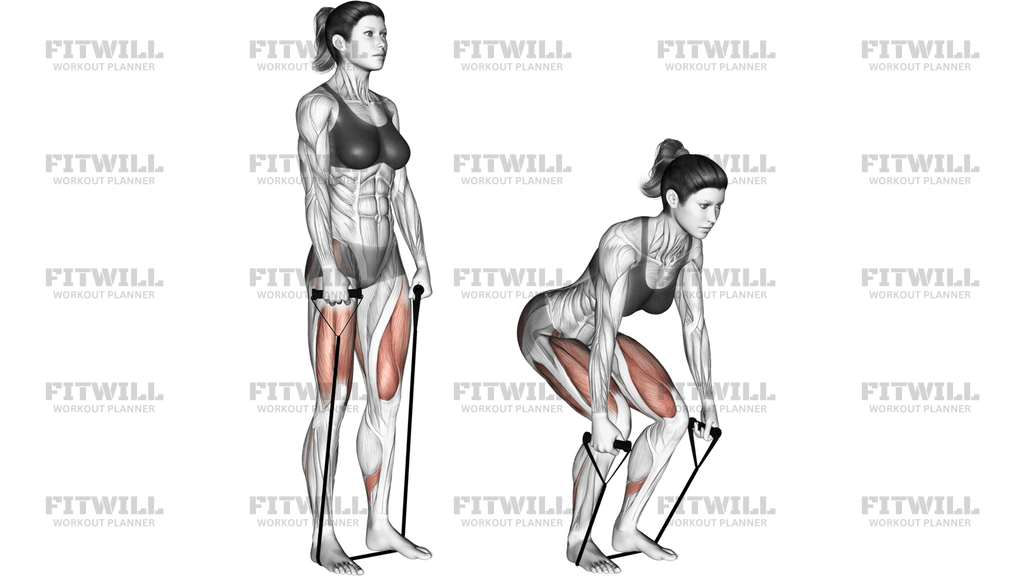
Instructions
- Stand on the center of the band with your feet about hip-width apart, and hold the handles or ends at the sides of your thighs with straight wrists.
- Set your feet flat, soften your knees, and let the band hang with light tension while your shoulders stay down and your chest stays open.
- Brace your midsection, keep your spine neutral, and hinge your hips backward as if reaching your hips toward a wall behind you.
- Lower the handles close to the front of your legs while your torso leans forward and your shins stay nearly vertical.
- Stop when your hamstrings are loaded and your back can stay flat without rounding, usually around mid-shin for most people.
- Drive through your whole foot, squeeze your glutes, and stand back up by bringing your hips forward under your torso.
- Finish tall with the band at your thighs, ribs stacked over your pelvis, and no extra lean or shrug at the top.
- Inhale on the way down and exhale as you stand, then reset the hips before the next repetition.
Tips & Tricks
- If the handles pull your shoulders forward, widen your stance slightly and start each rep with the shoulder blades set down, not shrugged.
- Keep the band close to your shins and thighs; letting it drift forward turns the movement into a back-heavy pull.
- Use a shorter range if your lower back starts rounding before the band reaches mid-shin.
- Think about pushing the floor away on the way up instead of yanking the handles with your arms.
- Do not lock the knees hard at the top; finish with the glutes and stand tall without leaning back.
- The band gets harder as you rise, so smooth speed matters more than trying to explode off the bottom.
- If you lose balance, check that both feet are even on the band and that your weight is centered through the heel and midfoot.
- Keep your neck in line with your torso and look a few feet ahead of you rather than cranking your chin up.
- Use lighter band tension if the top half of the rep makes you lose rib and pelvis position.
- Stop the set when the hinge turns into a squat or when the handles start drifting away from your legs.
Frequently Asked Questions
What does Band Deadlift work most?
Band Deadlift primarily targets the glutes, with strong help from the hamstrings and lower back during the hinge and standing finish.
Is Band Deadlift good for beginners?
Yes. The band version is a good way to learn the hip hinge because it is easy to load lightly and the handles give you a clear path to follow.
Where should I hold the handles during Band Deadlift?
Keep the handles or band ends beside your thighs at the start, then slide them close to the front of your legs as you hinge and stand.
How low should I lower on a Band Deadlift?
Lower only until you feel the hamstrings load and your back can stay flat. For many people that is around mid-shin, but the exact depth depends on hamstring length and band tension.
Should Band Deadlift feel more in my glutes or my back?
You should feel the main effort in the glutes and hamstrings. If your lower back is doing most of the work, shorten the range and keep the ribs from flaring at the top.
Can I use Band Deadlift instead of a barbell deadlift?
It can be a useful alternative for lighter training, warm-ups, or home workouts, but it will not replace the same absolute loading you can get from a barbell.
What stance works best for Band Deadlift?
A hip-width stance usually works best because it keeps the band centered and makes it easier to hinge without turning the rep into a squat.
Why does the top of Band Deadlift feel harder than the bottom?
Band tension increases as you stand up, so the lockout gets more difficult. That is normal and is one reason the exercise is useful for glute and hip extension work.