Band Kneeling Rear Kick
Band Kneeling Rear Kick is a floor-based glute exercise that uses band tension to make a kneeling rear kick more demanding and more controlled. The movement is simple on paper, but the quality of each rep depends on how well you keep your ribs stacked, pelvis square, and working leg driving from the hip instead of the lower back. It is useful when you want focused glute work without loading the spine, and it fits well in warmups, activation work, accessory blocks, or higher-rep lower-body sessions.
The main emphasis is on the glutes, with the hamstrings helping finish the kick and the core and lower back working to keep the torso steady. In anatomy terms, the primary driver is the gluteus maximus, with assistance from the biceps femoris, rectus abdominis, and erector spinae. Because the load is light and the range is controlled, Band Kneeling Rear Kick is often chosen when the goal is to feel the working side clearly, clean up hip extension mechanics, or add extra volume without heavy axial loading.
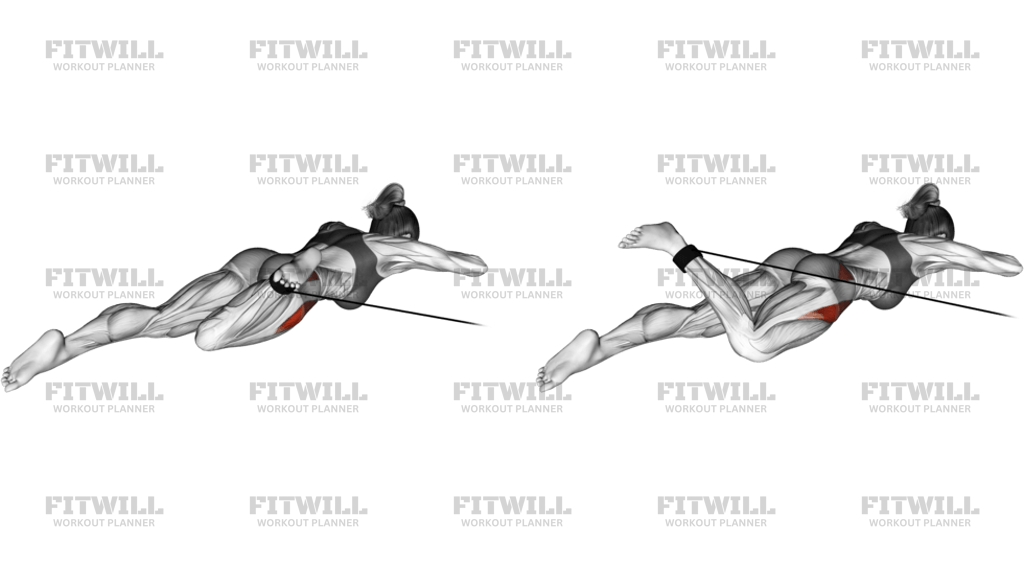
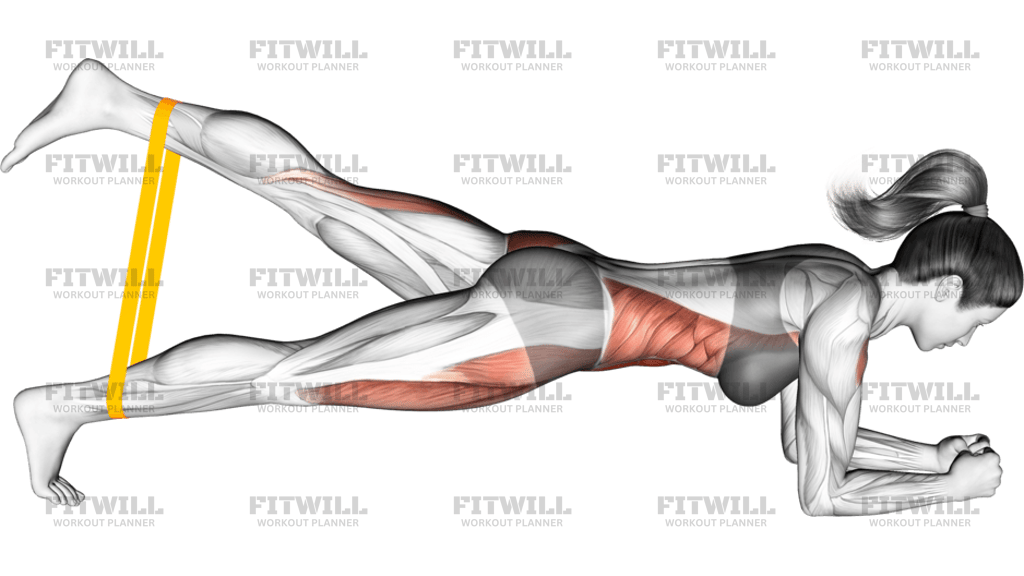
The setup matters more than it looks. On the floor, place your forearms under your shoulders and your knees under your hips, then set the working leg so the band can create forward resistance as you extend back. Keep the support side stable, lightly brace your midsection, and avoid collapsing into the shoulders. If the pelvis tips, the low back usually steals work from the glutes, so the starting position should feel organized before the leg begins to move.
Each rep should come from a smooth hip drive. Kick the working leg straight back and slightly up until you feel a strong glute contraction, then pause briefly without twisting the torso or over-arching the back. Lower the leg under control until the knee returns near the starting line, keeping tension on the band instead of letting the rep snap back. Exhale on the kick, inhale as you return, and keep the motion deliberate enough that the rep looks the same from start to finish.
Band Kneeling Rear Kick is especially useful when you want a low-impact glute option that still rewards precision. It can help prepare the hips before squats or deadlifts, or provide a finishing burn after heavier work when you still want clean pelvic control. The exercise should feel like a targeted hip extension drill, not a lower-back arching contest or a momentum-based swing.
[ Workout Log & Planner ]
Put your next workout in Fitwill
Keep your plan and training log ready when you are.


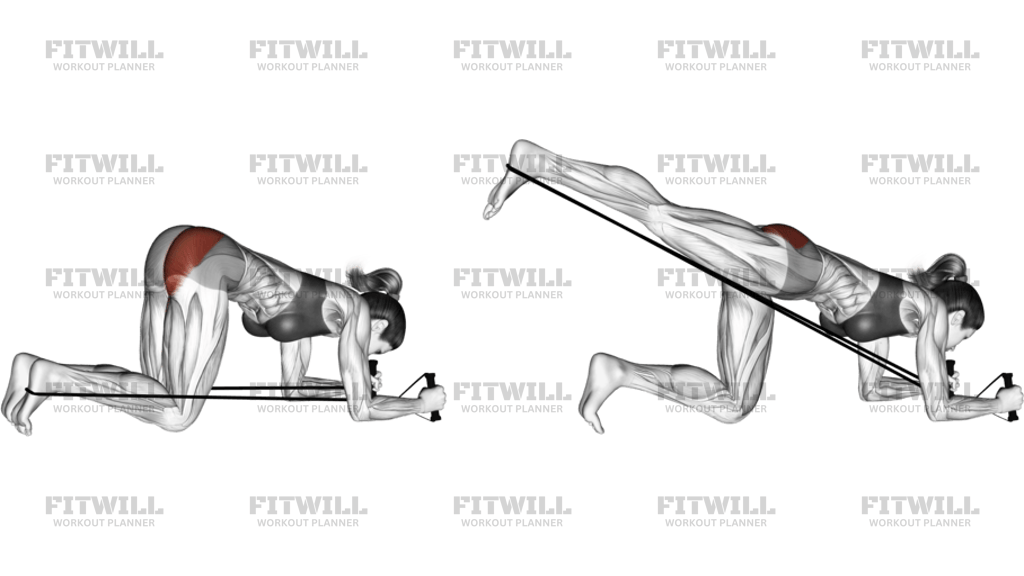
Instructions
- Place your forearms on the floor under your shoulders and set your knees under your hips with your torso long and steady.
- Loop or anchor the band so it resists the working leg as it moves back, then keep the support knee planted and the working knee bent to start.
- Square both hip bones toward the floor and brace your midsection before the leg leaves the ground.
- Drive the working heel back and slightly up until the thigh moves behind the torso and the glute contracts hard.
- Pause for a moment at the top without opening the hip or arching your lower back.
- Lower the leg slowly until the knee returns near the starting line and the band stays under control.
- Keep the shoulders quiet and breathe out on the kick, then inhale on the return.
- Reset the pelvis before the next rep and repeat for the planned set.
Tips & Tricks
- Think about moving the thigh from the hip socket, not lifting the foot with your lower back.
- If your ribs flare on the top rep, shorten the kick and keep the pelvis level.
- A smaller band tension is better than a heavier one that makes you twist or shrug into the floor.
- Keep the support forearms pressed down so the torso does not slide forward as the leg extends.
- Stop the rep when the glute finishes contracting; forcing extra height usually turns the movement into a back extension.
- A brief pause at the top makes the glutes work harder than fast, bouncing reps.
- Keep the working foot pointed naturally or slightly flexed, but do not let the knee flare outward to fake range.
- Use smooth reps and avoid letting the band snap the leg forward on the way down.
Frequently Asked Questions
What does Band Kneeling Rear Kick train most?
It primarily trains the glutes, especially the gluteus maximus, with the hamstrings and core helping stabilize the body.
Is Band Kneeling Rear Kick a good beginner exercise?
Yes. A light band and a short, controlled range make it a good option for learning hip extension without heavy loading.
Why are the forearms on the floor in Band Kneeling Rear Kick?
The forearm support keeps the torso quieter and makes it harder to cheat with the upper body or swing the leg.
How high should the leg go in Band Kneeling Rear Kick?
Only as high as you can lift it while keeping your pelvis square and your lower back from arching.
What if I feel Band Kneeling Rear Kick more in my lower back than my glutes?
Shorten the range, keep your ribs down, and think about driving the heel back rather than lifting the leg higher.
Can I do Band Kneeling Rear Kick instead of a cable kickback?
Yes. It is a useful home or accessory variation, though the band gives a slightly different resistance curve than a cable.
How many reps work well for Band Kneeling Rear Kick?
Higher-rep sets usually work best, often 12 to 20 controlled reps per side, because the goal is tension and clean execution.
What is the biggest mistake in Band Kneeling Rear Kick?
The most common mistake is rotating the hips or arching the low back to make the leg look higher than it really is.