Band Standing Leg Curl
Band Standing Leg Curl is a single-leg hamstring exercise that challenges both knee flexion strength and balance. It is especially useful when you want to train the hamstrings without lying down or loading the spine heavily, and it works well as accessory work in a home or gym session. The standing position also makes it easy to notice side-to-side differences, because each leg has to control its own path against the band.
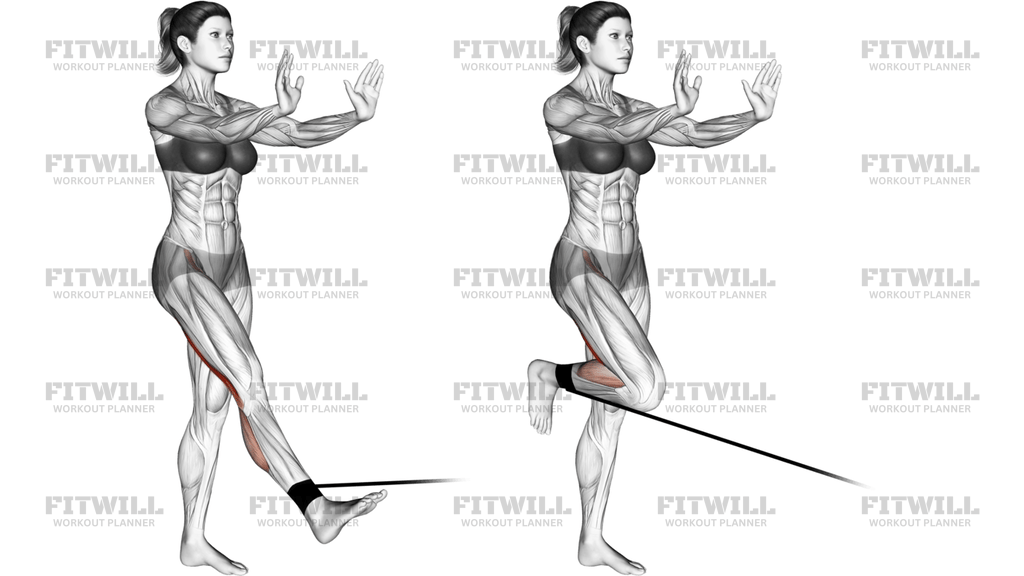
The setup matters because the band should pull from a low anchor in front of you while the working ankle stays free to bend back toward the glutes. In this variation, one leg stands on the floor while the other leg curls through the banded resistance. Your torso should stay tall, your hips square, and your balance steady so the hamstrings do the work instead of a hip swing or back arch.
During each rep, think about bending the knee and bringing the heel up rather than kicking the foot behind you. Keep the thigh of the working leg mostly still, especially at the start of the curl, so the movement stays focused on the hamstrings. A short squeeze near the top helps reinforce control, but the pause should not turn into an exaggerated lean, hip twist, or lower-back arch.
Band Standing Leg Curl is a practical choice for warm-ups, hamstring finishers, and unilateral lower-body work when you want constant tension with light equipment. It can be scaled by using a lighter band, a lower anchor, or a wall nearby for balance support. That makes it approachable for beginners, but the exercise still rewards deliberate control and clean repetition quality more than load.
Use a smooth lowering phase to keep tension on the hamstrings and to avoid snapping the band back toward the floor. If the standing leg starts wobbling, reduce resistance before the set gets sloppy, because the balance demand is part of the exercise and not an obstacle to ignore. When performed well, Band Standing Leg Curl builds useful hamstring strength while teaching you to stay organized through the trunk, hips, and ankle.
[ Workout Log & Planner ]
Put your next workout in Fitwill
Keep your plan and training log ready when you are.


Instructions
- Anchor a light band low in front of you and loop it around the ankle of the working leg.
- Stand on the other leg with your toes pointing forward, your knee softly bent, and your weight centered over the middle of the foot.
- Lift your hands in front of your chest or lightly hold a wall so you can balance without twisting your torso.
- Square your hips and brace your midsection before you start the curl.
- Bend the working knee and pull the heel toward your glute against the band.
- Keep the thigh mostly still and avoid driving the knee forward or letting the hip open to the side.
- Pause briefly at the top when the heel is close to the glute and the hamstring is fully shortened.
- Lower the foot slowly until the knee is almost straight again, then repeat for the planned reps before switching sides.
Tips & Tricks
- Keep the anchor low enough that the band stays taut through most of the curl instead of going slack at the bottom.
- If your standing hip shifts or spins open, shorten the range and use a lighter band.
- Think about lifting the heel straight back toward the glute, not swinging the lower leg behind you.
- A slight bend in the standing knee usually makes balance easier and keeps the movement cleaner.
- Hold a wall with one hand if the balance demand is limiting the hamstring work.
- Do not let the standing foot collapse inward; keep pressure through the big toe, little toe, and heel.
- Lower the banded foot under control so the return phase still loads the hamstrings.
- If the band rubs or pulls the ankle awkwardly, adjust the anchor point before adding more resistance.
- Stop the set when you start leaning forward to get extra range, because the curl should come from knee flexion, not momentum.
Frequently Asked Questions
What does Band Standing Leg Curl train most?
It mainly trains the hamstrings through knee flexion, with the standing leg, hips, and core working hard to keep you stable.
Where should the band be anchored for Band Standing Leg Curl?
Use a low anchor in front of you so the band pulls on the working ankle as you curl the heel back toward the glute.
Should my thigh move during Band Standing Leg Curl?
The thigh should stay mostly quiet. If it swings forward or the hip opens, the hamstrings lose tension and the rep turns into a compensation.
Can I hold onto something while doing Band Standing Leg Curl?
Yes. A wall or rack support is useful if balance is the weak link, and it lets you focus on the curl instead of wobbling.
Is Band Standing Leg Curl good for beginners?
Yes, as long as the band is light and the range stays controlled. Beginners often do better with a hand support until the standing leg feels steady.
What is the most common mistake in Band Standing Leg Curl?
The biggest mistake is leaning the torso or swinging the thigh to fake a bigger curl. Keep the chest tall and let the knee do the work.
How can I make Band Standing Leg Curl harder?
Use a stronger band, slow the lowering phase, or pause longer at the top. You can also remove hand support once your balance improves.
What should I feel besides the hamstrings?
You will feel the standing foot, glutes, and core working to stabilize, but the working leg should still feel the strongest squeeze behind the thigh.