Cat Pose
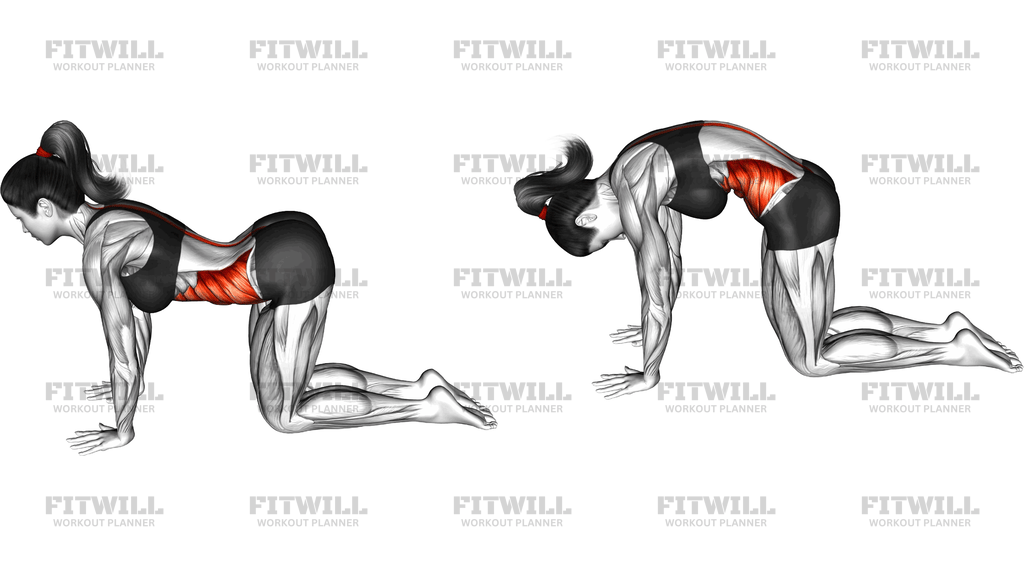
Cat Pose is a bodyweight floor movement performed from a quadruped position with the hands under the shoulders and the knees under the hips. The exercise is used in yoga and mobility work to train controlled spinal flexion, awareness of pelvic position, and smooth breathing while the torso moves as one unit instead of collapsing in one segment.
The pose matters because the setup decides whether the curve comes from the entire spine or just the neck and low back. In a clean Cat Pose, the shoulders stay stacked over the wrists, the knees stay planted, and the rib cage narrows as the pelvis tucks under. That coordinated rounding is what makes the movement useful for warm-ups, recovery sessions, and mobility-focused training blocks.
The visible target is not a heavy muscle contraction in the usual gym sense. Instead, the exercise asks the abdominals, deep trunk stabilizers, and muscles around the shoulder girdle to organize the body while the spine flexes. When done well, the back rounds smoothly, the head follows the line of the spine, and the hips stay centered over the knees without rocking forward or backward.
Use a slow exhale to move into the rounded position and let the ribs draw up and in without forcing the shoulders toward the ears. On the way back to neutral, keep pressure spread through both hands and both knees so the return is controlled rather than abrupt. This keeps the movement gentle on the neck and wrists while still giving a strong stretch through the back of the torso.
Cat Pose is especially useful for beginners, for spinal warm-ups before lifting, and for cooldowns after higher-load training. It can also be paired with a separate extension pattern such as Cow Pose when a full mobility sequence is desired. Stay inside a pain-free range, keep the motion smooth, and stop short of any sharp pinch in the low back, neck, or wrists.
[ Workout Log & Planner ]
Put your next workout in Fitwill
Keep your plan and training log ready when you are.


Instructions
- Start on all fours with your hands under your shoulders, your knees under your hips, and your fingers spread for a stable base.
- Keep your palms flat, your elbows straight but not locked, and your weight balanced evenly between both hands and both knees.
- Set your spine in a neutral tabletop position before the first rep, with your neck long and your gaze down toward the floor.
- Exhale and slowly tuck your pelvis under as you round your lower back, then continue the curve up through your mid-back and upper back.
- Let your rib cage draw upward and your shoulder blades separate slightly as the spine flexes, without pushing your shoulders toward your ears.
- Allow your head to follow the curve of your spine so the neck stays long rather than cranking up or hanging heavily down.
- Pause briefly at the top of the rounded position when the curve is smooth and complete, then keep the breath controlled.
- Inhale and return to a neutral tabletop position with the movement under control, then repeat for the planned number of reps or holds.
Tips & Tricks
- Think about moving one vertebra at a time so the spine rounds smoothly instead of hinging only in the lower back.
- Press the floor away lightly through your hands to keep the chest open enough for the upper back to round cleanly.
- If your wrists feel irritated, place the hands slightly wider or turn the fingers out a few degrees to reduce pressure.
- Keep the knees directly below the hips so the pelvis can tuck without drifting forward into a shoulder-heavy position.
- Use a long exhale to help the ribs come up and in; forcing the breath usually makes the neck and shoulders tense.
- Do not jam the chin to the chest; let the head follow the curve of the spine and stop before the neck feels compressed.
- Keep the motion small if needed and prioritize an even spinal curve over chasing a dramatic arch or roundness.
- If you feel pinching in the low back, reduce the depth of the tuck and make the rep slower and smoother.
Frequently Asked Questions
What does Cat Pose primarily train?
It mainly trains spinal control, trunk organization, and breathing coordination rather than a single large prime mover.
Do my hands and knees need to be in a specific position?
Yes. Keep your hands under your shoulders and your knees under your hips so the rounding comes from the spine instead of a shifted base.
Should I tuck my pelvis during the rounded phase?
Yes. A gentle posterior pelvic tilt helps the lumbar spine round with the rest of the back instead of only bending at the neck or low back.
What is the most common mistake in Cat Pose?
People often collapse only the head and lower back while the mid-back stays stiff. The goal is a smooth curve from tailbone to neck.
Is Cat Pose a good beginner exercise?
Yes. It is low impact, easy to scale, and a good entry point for learning how to control the spine and breath together.
How should I breathe while doing it?
Exhale as you round into the cat position, then inhale as you return to neutral. The breath should stay slow and smooth.
Why do my wrists get uncomfortable in this pose?
The hands take bodyweight in a long, closed-chain position. Spreading the fingers, stacking the shoulders correctly, and reducing load usually helps.
How is Cat Pose different from Cow Pose?
Cat Pose is spinal flexion and pelvic tuck. Cow Pose is the opposite pattern, with the chest opening and the spine extending.