Child Pose
Child Pose is a floor-based yoga rest position used to unload the spine, lengthen the back body, and restore easier breathing. The position can feel passive, but the setup matters: where the knees go, how far the hips sink back, and how long the arms reach forward all change whether the stretch lands in the low back, lats, hips, or shoulders. It is commonly used between harder floor exercises, during mobility work, or as a short recovery position when the torso needs a break.
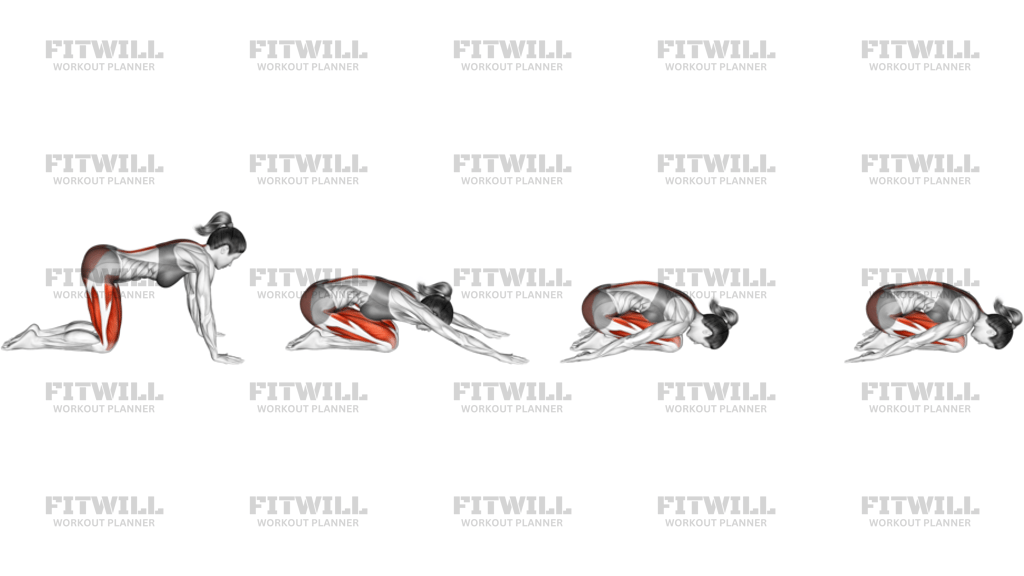
In the image, the body is folded over the thighs with the shins on the floor and the arms stretched long in front. That long-reach version increases the sensation through the armpits, lats, and side ribs while still giving the hips a chance to settle toward the heels. A narrower-knee version usually feels more like a general back and hip release, while a wider-knee version opens the inner thighs and gives the torso more room to descend.
Good Child Pose is quiet and deliberate. You are not trying to force the hips to touch the heels or drive the chest flat to the floor. Instead, you create a comfortable fold, let the pelvis settle back as far as it can without pinching the knees or ankles, and then keep the rib cage soft so the breath can expand into the back. That makes the stretch useful as both a mobility drill and a down-regulation position after more demanding training.
This movement is especially helpful when the lower back feels compressed after hinging, squatting, jumping, or prolonged standing. It can also be used to open the shoulders if the arms are reaching forward, or to relax the neck if the forehead is supported on the floor or on a pad. If the knees are sensitive, the ankles ache, or the hips feel blocked, the answer is usually a simpler setup with padding under the knees or a smaller range rather than forcing the fold deeper.
Treat Child Pose as a position to breathe into rather than a rep-based strength exercise. The best version is the one you can hold without gripping your neck, shrugging your shoulders, or sliding into discomfort. When the posture is organized, the stretch becomes a practical reset for the spine, hips, and upper back and a clean way to prepare for the next floor, core, or yoga sequence.
[ Workout Log & Planner ]
Put your next workout in Fitwill
Keep your plan and training log ready when you are.


Instructions
- Kneel on the floor with your big toes touching or close together and your knees either together or comfortably wide, depending on how much room your hips need.
- Sit your hips back toward your heels and walk your hands forward on the floor until your arms are long and your chest can soften toward the mat.
- Let your forehead rest on the floor or on a folded towel, block, or pad if you need a little support under your head.
- Keep your hips heavy as you lengthen through your lower back, ribs, and armpits instead of actively pressing into the floor.
- Reach forward through your fingertips and allow the shoulders to glide away from the ears without forcing the chest lower.
- Take slow breaths in through the nose and feel the back of your rib cage expand into the floor or into the air behind you.
- Hold the position for the planned time, then walk your hands back underneath your shoulders and rise from the floor slowly.
- Reset your knees, hips, or arm reach before the next hold if any part of the setup feels pinchy or cramped.
Tips & Tricks
- If your hips do not reach your heels, keep the fold shorter and use a cushion under the seat or thighs instead of forcing depth.
- A wider knee position usually makes room for the belly and chest; a narrower stance usually feels more like a back and lat stretch.
- Support the forehead with a towel, block, or stacked fists if the neck wants to hang or turn to one side.
- Keep the hands active enough to reach away from the knees, but do not collapse the shoulders into an uncomfortable shrug.
- Breathe slowly into the lower ribs and back ribs; if the breath becomes shallow, ease out of the stretch slightly.
- Pad the knees on a mat or folded towel if kneeling pressure becomes the limiting factor rather than the stretch itself.
- Avoid driving the hips aggressively backward, because that usually turns the pose into a knee or ankle compression drill.
- If the low back feels tight, focus on a longer exhale and a smaller fold rather than trying to sit deeper.
Frequently Asked Questions
What does Child Pose stretch the most?
It usually stretches the low back, lats, hips, and side ribs, with the exact emphasis changing based on knee width and arm reach.
Is Child Pose a strength exercise or a recovery position?
It is mainly a recovery and mobility position. The goal is to breathe, relax, and open the back side of the body rather than load the muscles.
Should my knees be together or apart in Child Pose?
Either works. Knees together tends to feel more like a general back stretch, while wider knees usually give the torso more space and add inner-thigh relief.
Why do my hips not sit all the way back to my heels?
Tight ankles, knees, or hips can limit the fold. Stop short of pain and use padding or a narrower range instead of forcing the position.
Why are the arms reaching forward in the image?
The long reach increases the stretch through the shoulders, lats, and upper back while still keeping the torso supported on the floor.
Can beginners do Child Pose safely?
Yes. It is beginner-friendly when the knees are padded and the fold stays comfortable rather than forced.
What should I do if Child Pose bothers my knees?
Use a thicker mat or folded towel, keep the knees a little wider, or reduce how far you sit back so the pressure stays manageable.
How long should I hold Child Pose?
Hold it long enough for the breath to slow and the back of the body to soften, often 20 to 60 seconds or longer in recovery work.