Crescent Moon Pose
Crescent Moon Pose is a bodyweight yoga lunge that moves from a kneeling setup into a tall crescent stance with both arms reaching overhead. In this version, the front foot stays planted, the back leg lengthens behind you, and the torso stacks over the hips so the pose becomes a mix of mobility, balance, and upright control rather than a fast strength drill.
The main training value is in the way it opens the hip flexors and front thigh while asking the glutes, core, and shoulders to keep the body aligned. The lifted chest and overhead reach make the pose feel simple, but small changes in pelvic position, rib flare, and knee tracking decide whether it feels stable or compressed. That is why the setup matters as much as the stretch itself.
Start from a kneeling lunge, place the front knee over the ankle, and square the hips toward the front edge of the mat or floor. As you rise, keep pressure through the front heel and length through the back leg while you lift the spine tall. The back knee may stay down for a gentler version or lift for the full crescent variation shown in the image.
Once you are upright, reach both arms overhead without letting the lower back overarch. Keep the ribs knitted down, the neck long, and the shoulders away from the ears. Breathe slowly into the front of the hip and the front thigh, then lower with control and repeat on the opposite side. The best version of the pose feels steady, open, and clean rather than forced.
Use Crescent Moon Pose in a warmup, yoga sequence, or mobility block when you want hip opening and balance work in one position. It is especially useful after sitting, before lower-body training, or as part of a flow that needs a controlled transition from kneeling to standing support. Beginners can use the back knee down and a shorter stance, while more advanced users can keep the back leg active and hold the overhead line longer.
Fitwill
Log Workouts, Track Progress & Build Strength.
Achieve more with Fitwill: explore over 9600 exercises with images and videos, access built-in and custom workouts, perfect for both gym and home sessions, and see real results.
Start your journey. Download today!




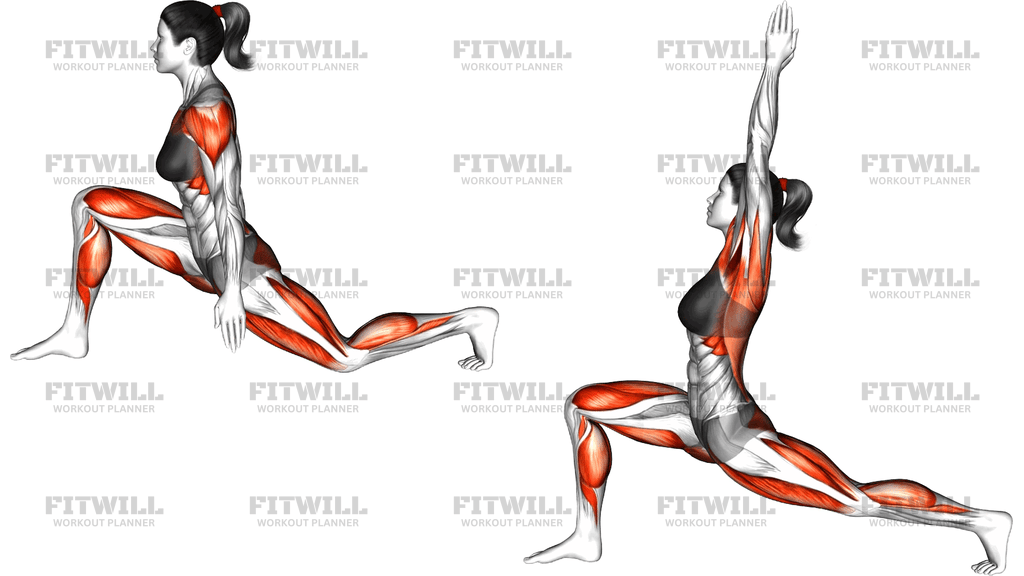
Instructions
- Start in a kneeling lunge with one knee down, the other foot flat in front, and the front knee stacked over the ankle.
- Square your hips toward the front and press the top of the back foot or toes into the floor for a stable base.
- Lift your torso tall over the pelvis before you reach for any overhead position.
- Keep the front shin vertical as you shift weight into the front heel and the back leg reaches long.
- Raise the back knee for the full crescent version, or leave it down if you need a gentler entry.
- Sweep both arms overhead with palms facing in and keep the shoulders relaxed away from the ears.
- Draw the ribs down so the lower back does not overarch while you hold the pose.
- Breathe slowly through the front hip and thigh, then lower the back knee with control to exit.
- Switch sides and repeat with the same tempo and alignment.
Tips & Tricks
- If the lower back arches as you raise your arms, shorten the stance and tuck the pelvis slightly.
- Keep the front knee pointing in the same direction as the second or third toe.
- A padded mat or folded towel under the back knee makes the entry much more comfortable.
- Do not let the front heel lift when you move into the taller crescent position.
- Reach up through the fingertips, but keep the shoulders soft instead of shrugging hard.
- The pose should feel like a long front-hip stretch, not a pinch in the lumbar spine.
- Use the back knee-down version if balance is the limiting factor, not the overhead reach.
- Exhale as you settle into the pose and inhale to create length through the torso.
- Hold each side long enough to calm the breath rather than bouncing in and out of the stretch.
Frequently Asked Questions
What does Crescent Moon Pose work most?
It mainly targets the hip flexors, quads, glutes, core, and shoulders while training upright balance and control.
Can beginners do the back-knee-down version first?
Yes. Keeping the back knee down is the easiest way to learn the front-foot alignment and overhead reach.
Should my front knee stay over my ankle in the lunge?
Yes. That stack keeps the front leg stable and helps you avoid dumping the stretch into the knee joint.
Why do my ribs flare when I reach overhead?
Usually the stance is too short or the hip flexors are tight. Lengthen the lunge and keep the ribs knit down.
Where should I feel the stretch in Crescent Moon Pose?
Most people feel it in the front hip, upper thigh, and sometimes the chest and shoulders from the overhead reach.
What is the biggest form mistake in this pose?
Leaning forward, arching the lower back, or letting the front heel come off the floor are the most common problems.
Can I hold this pose for more than one breath?
Yes. Longer holds are useful if you want a steadier mobility or yoga practice instead of a quick transition.
Do I need to keep the back leg straight?
For the full crescent variation, yes, the back leg should lengthen actively. In the easier version, the knee stays down.