Half Moon Pose Ardha Chandrasana
Half Moon Pose Ardha Chandrasana is a standing yoga balance that builds lateral line strength, hip stability, and body awareness while opening the side body and hamstrings. The pose asks one leg to support the full weight of the body while the torso rotates open and the opposite leg reaches long behind you, so the setup matters as much as the finish. When the stance is organized, the pose feels steady and expansive instead of wobbly and collapsed.
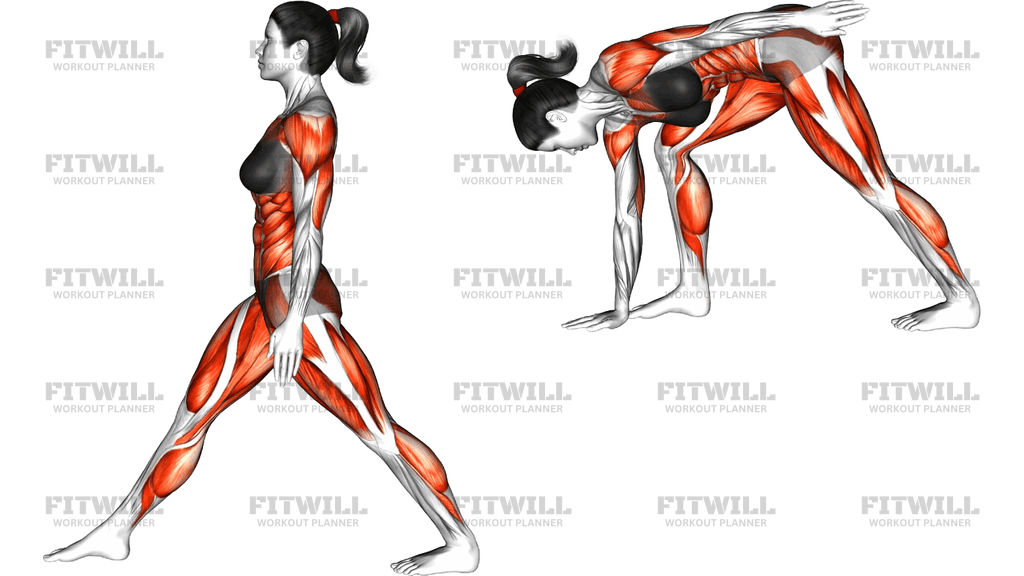
The visible line in this exercise starts with a forward hinge from the hip, one hand reaching to the floor or a block under the shoulder, and the lifted leg extending to roughly hip height. From there, the chest turns open and the top arm stacks over the shoulder. That stacked shape trains the glute, hip abductors, foot, and trunk to work together while the standing leg keeps the pelvis from tipping or twisting.
Because Half Moon Pose is a balance, the goal is not to force the biggest possible range. A small bend in the standing knee, active pressure through the standing foot, and a long reach through the lifted heel usually make the pose cleaner than trying to lock everything straight. The standing hip should stay firm, but the ribs and neck need to stay free enough for you to breathe and turn without gripping.
This pose is commonly used to improve single-leg control, rotational stability, and confidence in standing transitions. It also helps reveal side-to-side differences in hamstring length, hip mobility, and foot stability. If the floor is too far away, a block under the lower hand makes the pose more accessible and often improves alignment by keeping the torso from collapsing.
Treat the pose as a controlled hold rather than a rushed shape. Enter slowly, find the stacked position, keep the lifted leg active, and exit with the same level of control you used to enter. Over time, cleaner balance and steadier breathing matter more than how high the top leg is or how open the chest looks.
[ Workout Log & Planner ]
Put your next workout in Fitwill
Keep your plan and training log ready when you are.


Instructions
- Stand in a short lunge or triangle setup, then shift your weight onto the front foot and hinge forward from the hip.
- Lower the hand on the same side as the standing leg to the floor or a block directly under the shoulder.
- Stack the pelvis by turning the top hip open and reaching the lifted leg long behind you.
- Press firmly through the standing foot and keep the standing knee softly unlocked.
- Lift the rear leg until it lines up near hip height, with the toes pointing forward or slightly down.
- Open the top arm toward the ceiling and stack the shoulders without shrugging.
- Keep the chest broad, the gaze steady, and the neck long as you breathe through the hold.
- Lower the raised leg and return to the floor slowly, then reset before repeating.
Tips & Tricks
- A block under the lower hand is often the best way to keep the chest open and the standing hip from collapsing inward.
- Keep a soft bend in the standing knee if the hamstring is pulling you out of alignment.
- Think about lifting from the outer hip of the standing leg, not just swinging the raised leg higher.
- Flex the lifted foot and reach through the heel so the back leg stays active instead of hanging loose.
- Do not let the top shoulder roll forward; stack it over the lower shoulder as much as your balance allows.
- Rotate from the ribs and upper back without overtwisting the pelvis away from the floor.
- Keep the standing arch active and spread the toes so the foot can stabilize the whole pose.
- Move slowly out of the pose; dropping out quickly usually means the standing leg and hip never had to control the exit.
Frequently Asked Questions
What does Half Moon Pose Ardha Chandrasana train most?
It challenges single-leg balance, hip stability, and the side body while also opening the standing hamstring and inner thigh.
Can beginners do this pose without falling over?
Yes. Using a block under the lower hand and keeping a slight bend in the standing knee makes the pose much more beginner-friendly.
Should my lower hand touch the floor or can I use a block?
A block is often the better choice because it shortens the reach and helps you keep the chest and pelvis more stacked.
What is the biggest mistake in Half Moon Pose?
Most people collapse into the standing hip or turn the chest open by twisting the pelvis instead of stabilizing the standing leg first.
Where should I look during the pose?
A steady gaze at the floor or slightly forward helps balance better than looking around or forcing the head to turn too far.
Why does my lifted leg feel heavy?
If the standing hip is unstable or the torso is rotating without support, the raised leg loses the base it needs and starts to feel heavy.
What if my hamstrings are too tight to reach the floor?
Bend the standing knee a little and place the lower hand on a block or higher support so you can keep length through the spine.
How is Half Moon Pose different from Triangle Pose?
Triangle stays more closed at the torso, while Half Moon removes the back support and asks you to balance on one leg with the chest fully open.