Tree Pose Vrksasana
Tree Pose Vrksasana is a standing yoga balance drill that trains steadiness, body awareness, and calm breathing while you hold one foot against the inside of the opposite leg. It is less about load and more about control: the standing foot, ankle, hip, and trunk all have to cooperate so the pose feels tall rather than shaky. The lifted leg opens the hip while the planted leg learns to support your weight without collapsing inward.
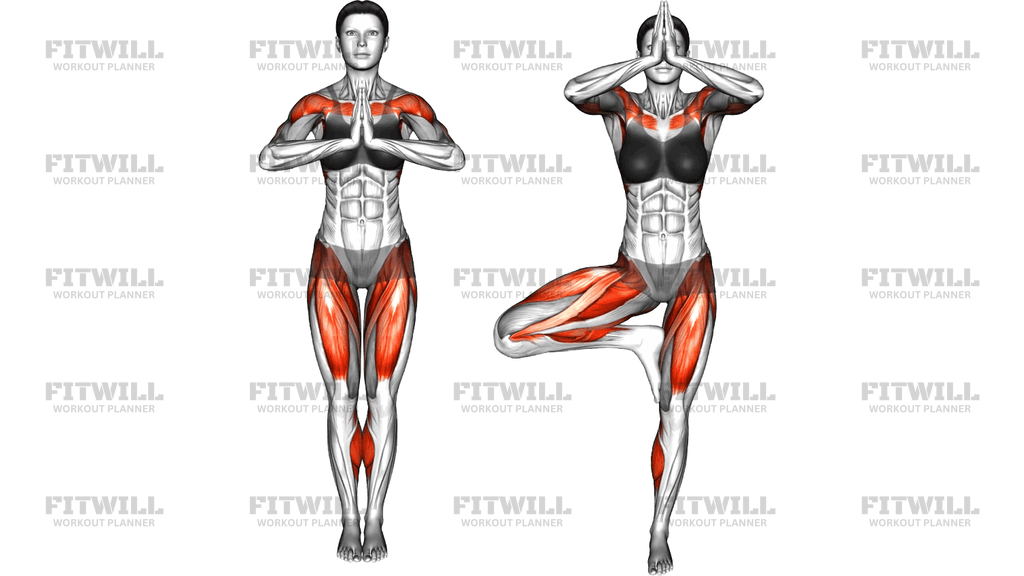
This pose is useful when you want a simple way to work on single-leg balance, ankle stability, and posture at the same time. The image shows the lifted foot placed high on the inner standing leg with the knee turned out, plus arm variations from relaxed at the sides to overhead. That progression matters because the arms change the balance demand, and the easiest version is usually the one with the hands low and the gaze fixed straight ahead.
Tree Pose Vrksasana should feel rooted through the standing foot and long through the spine. Instead of gripping the floor with the toes, spread the foot and press through the heel, base of the big toe, and base of the little toe. Keep the pelvis level, draw the ribs over the hips, and let the lifted thigh open without forcing the knee or twisting the lower back.
Use the pose as a warmup, a balance-focused accessory, or a slow control drill between more demanding lower-body movements. It also works well in recovery sessions because the pace is easy to regulate and the breathing stays smooth. If you are new to the pose, keep the lifted foot lower on the ankle or calf and use a wall or fingertip support until the standing leg feels steady.
The main safety point is to avoid pressing the lifted foot into the standing knee. Place it on the ankle, calf, or inner thigh instead, and lower it immediately if the standing hip starts to dump sideways or the torso twists. A clean Tree Pose Vrksasana looks quiet and deliberate: no rushing, no hopping, and no strain in the neck or low back.
Fitwill
Log Workouts, Track Progress & Build Strength.
Achieve more with Fitwill: explore over 9600 exercises with images and videos, access built-in and custom workouts, perfect for both gym and home sessions, and see real results.
Start your journey. Download today!




Instructions
- Stand tall on one foot with the weight centered over the middle of that foot and the other leg free to move.
- Place the sole of the lifted foot on the inside of the standing leg, choosing the ankle, calf, or inner thigh, but never the knee.
- Press the standing foot into the floor and lightly turn the lifted knee out so the hip can open without the pelvis twisting.
- Lengthen through the crown of your head, stack your ribs over your hips, and keep both sides of the waist long.
- Bring your hands to your chest or raise them overhead once the standing leg feels steady.
- Fix your gaze on one spot in front of you and breathe slowly through the hold.
- Keep the lifted foot active against the standing leg and stay tall instead of leaning into the hip.
- Lower the arms first, then remove the lifted foot with control and return to standing before switching sides.
Tips & Tricks
- If the standing knee locks back, soften it slightly so the hip and ankle can do more of the work.
- Place the lifted foot lower on the leg if the full inner-thigh position makes you wobble or twist.
- Keep the lifted foot below the standing knee; pressing on the joint can irritate it and makes balance less stable.
- Use a wall or fingertip support until you can hold the shape without hopping.
- Spread the toes of the standing foot so the arch does not collapse as the pose gets harder.
- Keep the ribs from flaring when the arms go overhead; that usually shifts the balance backward.
- A steady exhale helps when the lifted knee opens and the arms move up.
- If your hips drift to one side, lower the arms and reset the standing foot before trying again.
Frequently Asked Questions
What muscles does Tree Pose Vrksasana work?
It mainly challenges the standing foot, ankle, glute, and hip stabilizers, with the core helping you stay upright. The lifted leg works more as a positioning and mobility driver than a load-bearing mover.
Is Tree Pose Vrksasana good for beginners?
Yes. Beginners usually do best with the lifted foot on the ankle or lower calf and one hand near a wall until the standing leg stops shaking.
Where should my lifted foot rest in Tree Pose Vrksasana?
Place it on the inside of the standing ankle, calf, or inner thigh. Avoid the standing knee, because that joint needs room and the pose should feel stable, not jammed.
Why do I keep losing balance in Tree Pose Vrksasana?
Most wobbling comes from gripping the floor, locking the standing knee, or letting the ribs drift in front of the pelvis. A fixed gaze and a softer standing leg usually help right away.
Should my hips face forward or open out?
Keep the pelvis mostly forward and let the lifted thigh open from the hip. If the pelvis turns a lot, the pose usually becomes less about balance and more about twisting.
Can I do Tree Pose Vrksasana with a wall?
Yes. A light fingertip touch on the wall is a good way to learn the standing foot and hip positions before you try it completely unsupported.
How long should I hold Tree Pose Vrksasana?
Hold it long enough to breathe steadily and keep the shape quiet, usually 10 to 30 seconds per side. If the pose starts to shake or the shoulders tense up, reset sooner.
What should I avoid if my knee hurts?
Do not press the foot into the knee or force the lifted thigh higher than your hip mobility allows. Move the foot down to the calf or ankle and keep the knee soft and pain-free.