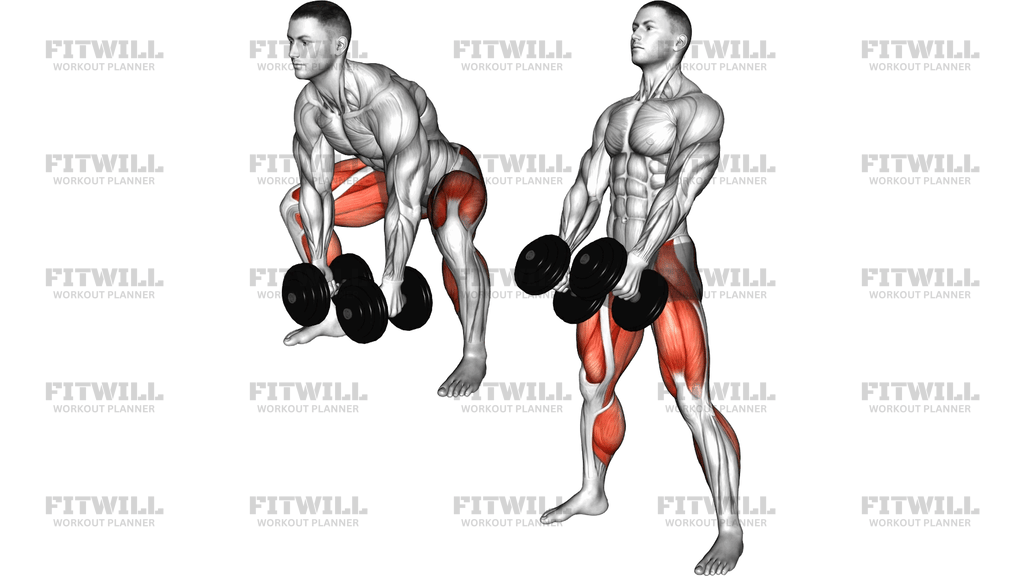
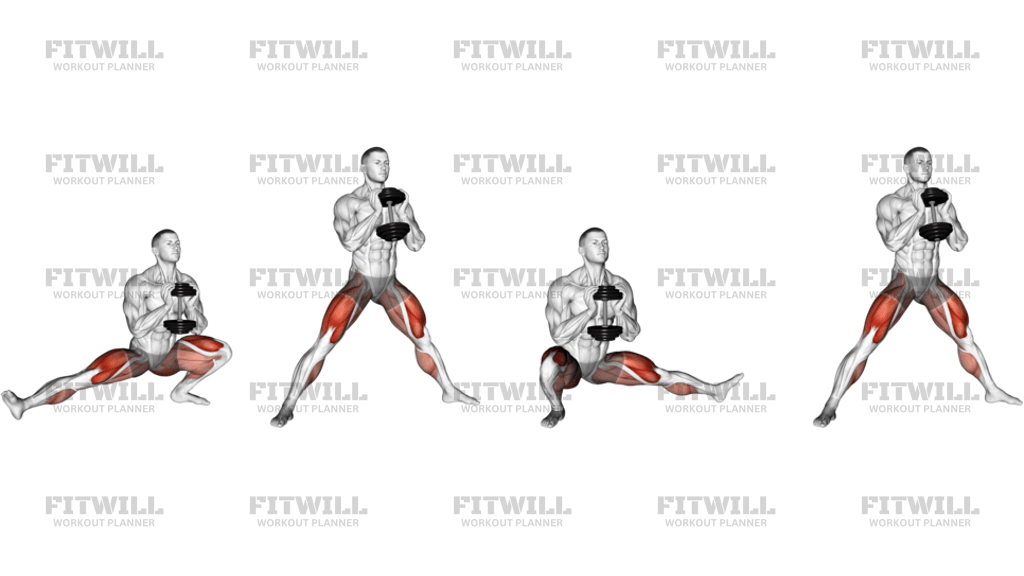
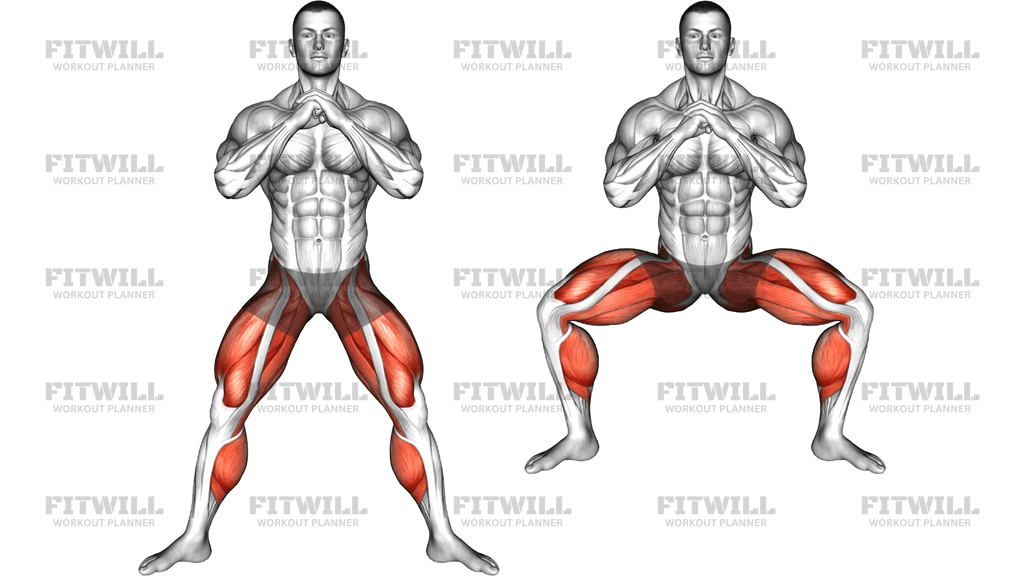
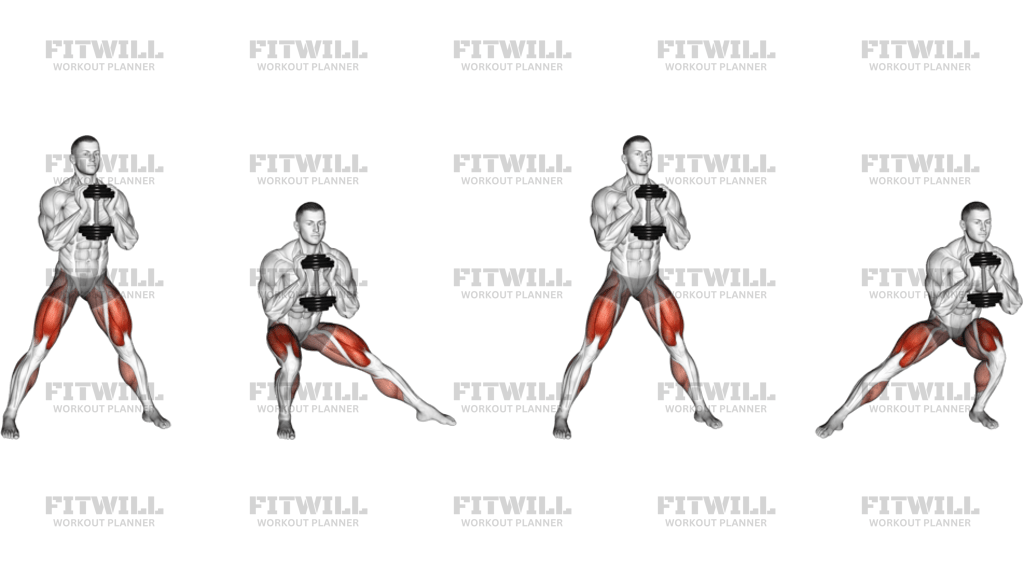
Dumbbell Narrow Squat Lunge
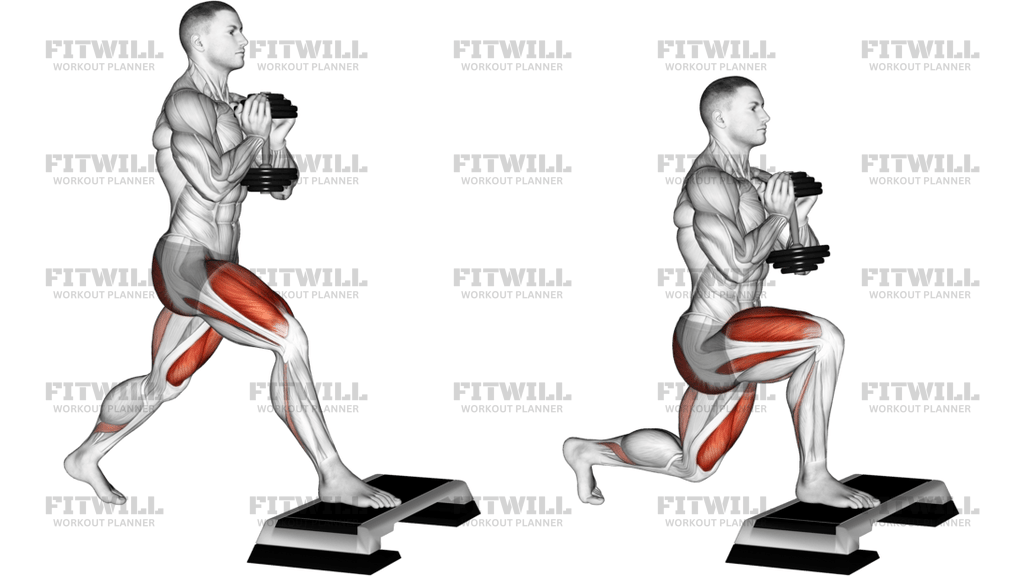
The Dumbbell Narrow Squat Lunge is a single-leg strength exercise performed with one dumbbell held vertically against your chest in a goblet-style grip. From a narrow standing stance, you step one foot back into a split position and lower until the rear knee approaches the floor, then drive through the front foot to return to standing. The narrow stance and the close-to-body load force your front leg to handle almost all of the work, which is exactly what makes this movement effective.
Because the dumbbell sits at chest height rather than hanging at your sides, your torso stays upright and your quadriceps take the brunt of the loading. The highlighted work in this pattern comes from the quads of the front leg, with real contribution from the glutes, adductors, and hamstrings as they control the descent and power the drive back up. Holding the weight at your chest also quietly trains your core and upper back, since those muscles work isometrically to keep your ribcage stacked over your hips for every rep.
This exercise suits a wide range of lifters. Beginners can use a light dumbbell to learn single-leg mechanics with a counterbalance at the chest, which makes balancing much easier than with hands-free variations. More experienced lifters use it as a primary quad builder or as an accessory after squats, when fatigue makes heavy bilateral loading risky but focused single-leg work is still productive.
Setup matters here more than in most lunge variations. A stance that is too wide turns the movement into a standard lunge and shifts effort toward the glutes; the narrow split is what keeps tension on the front thigh. Likewise, the dumbbell must stay pressed against your sternum with elbows tucked down. Let the weight drift forward and your chest will follow, your lower back will compensate, and the front knee will take stress it does not need.
Execution is straightforward but rewards patience. Sink straight down rather than lunging forward, keep the front heel glued to the floor, and let the rear knee travel down and slightly back. Pause briefly at the bottom, then push the floor away through the whole front foot, finishing with the hips fully standing tall before you step the rear foot in or start the next rep.
A common use case is programming two to three sets of eight to twelve reps per leg as a main lower-body lift on moderate days, or higher-rep sets of fifteen-plus per leg as a finisher. Keep the weight honest: if you cannot control the descent or your front knee caves inward, drop the load before adding reps. Train both legs evenly, and start with your weaker side so the stronger leg never sets the standard.
[ Workout Log & Planner ]
Put your next workout in Fitwill
Keep your plan and training log ready when you are.


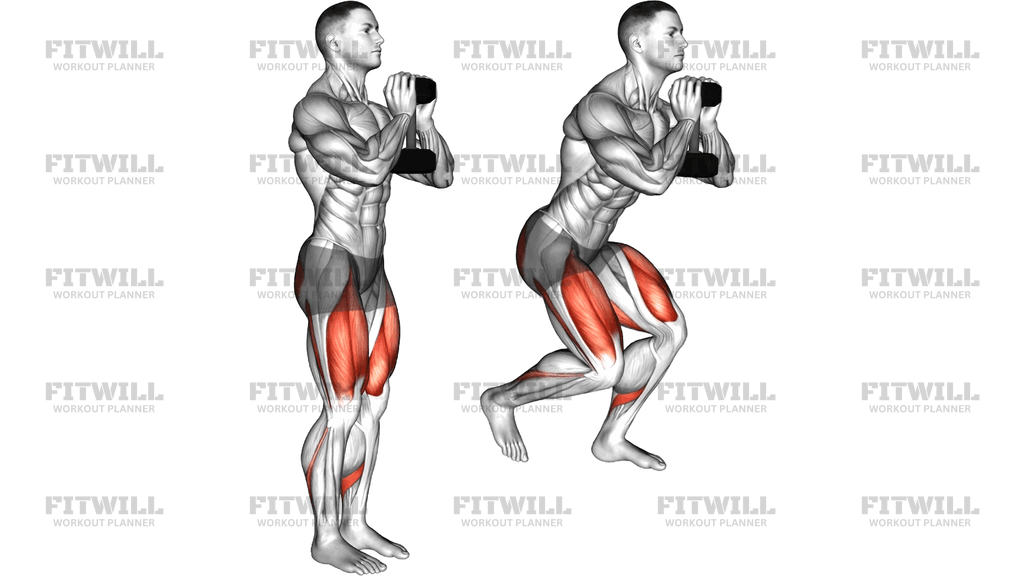
Instructions
- Stand tall with your feet roughly hip-width apart or slightly narrower, holding one dumbbell vertically by the top head with both hands cupped underneath it.
- Press the dumbbell firmly against your sternum, tuck your elbows down toward your ribs, and pull your shoulders back so your chest stays open.
- Brace your core as if bracing for a light punch, and set your gaze on a fixed point straight ahead at eye level.
- Step one foot straight back into a split stance, keeping the split narrow so both feet stay roughly in line with your hips, and keep about seventy percent of your weight over the front leg.
- Inhale, then lower your body straight down by bending the front knee, letting the rear knee travel down toward the floor until it is a few centimeters off the ground or lightly touches it.
- Check your positions at the bottom: front shin near vertical or knee tracking over the middle of the foot, front heel flat, rear knee under or slightly behind the rear hip, torso upright.
- Exhale and drive through the entire front foot, emphasizing the heel and mid-foot, to push yourself back up until the front leg is fully straight and your hips are standing tall.
- Either bring the rear foot forward to the start stance and reset, or immediately perform the next rep with the same working leg before switching sides.
- Complete all planned reps on one leg, then switch and match the rep count on the other leg, resting as needed between sets.
Tips & Tricks
- If your front heel lifts as you descend, your split stance is probably too long for your mobility, so shorten the step slightly until the heel stays planted.
- The most frequent mistake is stepping the rear foot too far out to the side or too wide forward, which turns this into a generic lunge; keep the split narrow to preserve the quad-focused feel.
- Do not let the dumbbell slide away from your chest mid-set. If it drifts forward, your elbows have flared and your torso will pitch; reset the grip between reps if needed.
- Move the rear knee down, not the chest forward. If your upper body leans toward the front thigh, slow the descent and think about staying tall through the crown of your head.
- Keep the front knee tracking in line with the second toe. If it dives inward, consciously spread the floor with your front foot or reduce the load.
- Do not rush the return. Pushing explosively out of the bottom before you own the position usually means the back leg is helping more than it should.
- If balance is the limiting factor, lighten the dumbbell before switching to hands-free, since the chest-held weight actually acts as a counterbalance.
- Start every set with your weaker leg and stop that set when form quality drops, then match the reps on the stronger side rather than exceeding them.
- A soft mat under the rear knee is worth using if you train on hard flooring, especially at the point where the knee lightly kisses the ground each rep.
Frequently Asked Questions
What muscles does the Dumbbell Narrow Squat Lunge work?
The front leg's quadriceps do most of the work, since the narrow split and upright torso keep the load on the front thigh. The glutes and hamstrings of the front leg assist strongly, the adductors stabilize the stance, and your core works to hold the dumbbell steady against your chest.
Why hold the dumbbell at my chest instead of at my sides?
The chest-held goblet position acts as a counterbalance that keeps your torso upright and makes balancing easier, while shifting more demand onto the quadriceps. Weights held at the sides tend to pull you forward and make an upright torso harder to maintain.
Is the Dumbbell Narrow Squat Lunge good for beginners?
Yes, and the goblet grip is a big part of why. Start with a very light dumbbell or even body weight, focus on the narrow split position and a controlled descent, and only add load once every rep looks identical on both legs.
How narrow should my stance actually be?
Keep both feet roughly in line with your hips as you step back, so the split is narrow front to back but not crossing over the body's midline. If the rear foot drifts far to the side or the front foot wanders off-line, you lose the quad-focused character of the exercise.
Should my rear knee touch the floor?
A light tap is fine if you control it, and many lifters use the touch as a consistent depth marker. If you cannot lower that far without your front heel lifting or your torso falling forward, stop a few centimeters higher and build range over time.
How does this differ from a regular reverse lunge?
A regular reverse lunge usually uses a longer split and returns the rear foot to standing each rep, distributing work more toward the glutes. The Dumbbell Narrow Squat Lunge keeps a narrow split, sinks the rear knee more vertically, and keeps tension on the front quad throughout.
Can I do this exercise if my knees are sensitive?
Often yes, with adjustments: shorten the range so the descent stays pain-free, keep the front shin more vertical, and use a lighter dumbbell. If you feel sharp pain rather than muscular effort, stop and get the knee assessed before continuing.
What should I do if I keep losing my balance?
Slow the descent, fix your eyes on a stationary point ahead, and make sure the dumbbell stays pressed to your sternum, since a wandering load is the most common balance disruptor. Reducing the weight temporarily will also help while your stabilizers adapt.
How many sets and reps should I use?
For strength and muscle, two to four sets of eight to twelve reps per leg works well with a moderate dumbbell. For a conditioning finisher, lighter weight for fifteen to twenty controlled reps per leg is effective.