Table Top Bridge Jack
The Table Top Bridge Jack is a body weight movement that combines a reverse tabletop bridge with a controlled leg extension, similar in rhythm to a jumping jack but performed from a crab-style position. You sit on the floor, place your hands behind your hips, drive up into a bridge so your torso and thighs form a straight, elevated line, and then extend one leg out long while keeping the hips high. The extended leg returns and the other side takes over, creating a steady alternating pattern.
This exercise earns its place in a routine because it demands two things at once: the glutes and hamstrings must hold the bridge position without sagging, while the core braces hard to stop the hips from dropping or rotating every time a foot leaves the floor. The moving leg also works through the hip flexors and quads as it extends and returns, so you get active hip mobility and trunk stability in the same rep.
Setup matters more here than in most floor exercises. Your hand position behind the shoulders determines whether your wrists stay comfortable and whether you can actually press the hips to full height. Feet planted about hip-width apart with knees stacked over ankles give you a stable base, and if your hips start low, the leg extensions turn into a grind on the lower back instead of a clean glute and core drill.
To execute it well, press the floor away with the whole hand, squeeze the glutes to lift the hips until your body reads as one straight line from shoulders to knees, and only then start the leg action. Extend the leg with control rather than swinging it, pause briefly at the long position, and place the foot back down deliberately before switching sides. Breathing stays steady: exhale as the leg extends, inhale as it returns.
You will see this movement in general strength circuits, warm-ups for glute-focused lower body days, and home workouts where no equipment is available. It also works well as a finisher after squats or hip thrusts when the goal is to keep the glutes and core under tension with a light load. Because it loads the shoulders in extension, people who spend long hours sitting often find it a useful counter-position for the front of the shoulders and hips.
The main safety points are simple. Keep the weight spread across the whole palm rather than dumped into the wrist, and stop at a hip height you can hold without the lower back arching to compensate. If you feel the bridge collapse as the leg extends, shorten the range or slow the tempo instead of pushing through a sloppy position.
[ Workout Log & Planner ]
Put your next workout in Fitwill
Keep your plan and training log ready when you are.


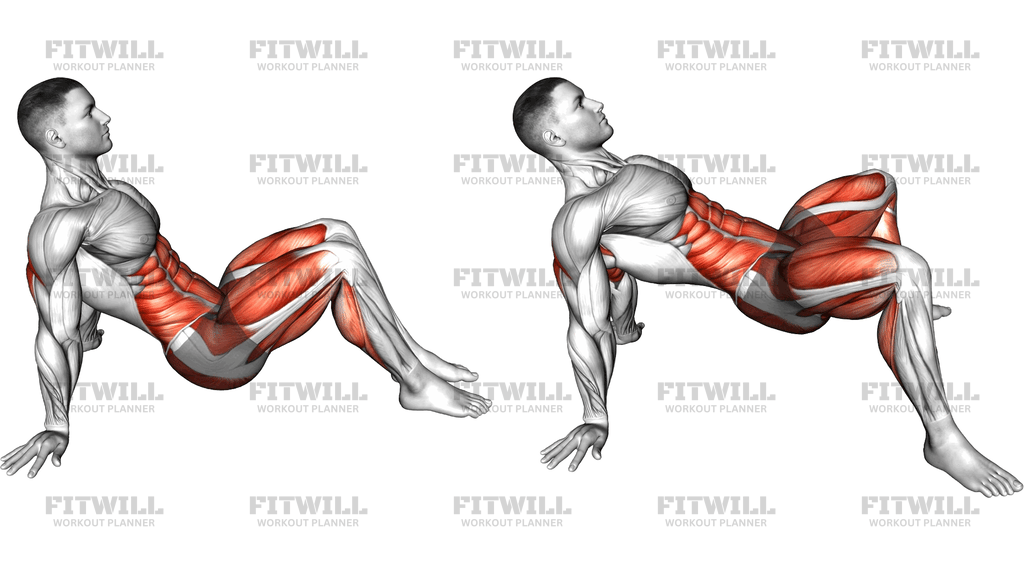
Instructions
- Sit on an exercise mat with your knees bent and feet flat on the floor, roughly hip-width apart and about a foot in front of your hips.
- Place your palms on the floor just behind your hips, fingers pointing toward your feet or turned slightly outward, with the whole palm in contact with the ground.
- Press through your palms and heels to lift your hips until your shoulders, hips, and knees form a straight tabletop line, and squeeze your glutes to hold that height.
- Brace your abdominal muscles as if bracing for a light punch, and keep your neck relaxed with your gaze angled slightly upward rather than craned back.
- Extend one leg straight out in front of you so the knee straightens and the foot hovers just above the floor, keeping both hips level the entire time.
- Pause for a beat in the extended position, then bend the knee and place the foot back flat in its original spot without letting the hips drop.
- Repeat the extension with the opposite leg and continue alternating in a steady, jack-like rhythm.
- Exhale as each leg extends, inhale as it returns, and keep the breath flowing rather than holding it through the set.
- Finish the set by lowering your hips back to the mat with control, then shake out your wrists and reset your hand position before the next set.
Tips & Tricks
- If your wrists complain, turn your fingers slightly outward and spread the weight across the whole palm instead of loading the heel of the hand.
- The most common fault is the hips sagging the moment a foot lifts. Fix it by squeezing the glutes harder before extending the leg, not by arching the lower back to fake the height.
- Watch for the working hip dropping or rotating as the leg extends. Imagine a glass of water balanced on your pelvis and keep it level throughout.
- Do not let the extended leg swing up and down with momentum. Lift it to a controlled hover and return it under muscular control for the core and hip flexor benefit.
- If a full tabletop bridge is too demanding at first, keep the hips lower and extend the legs with a smaller range, then progress the hip height over a few weeks.
- Push the floor away on the support side rather than merely resting on the arm. Active pressing keeps the shoulder stable and the torso tall.
- Slowing the tempo is the easiest way to make this harder without adding load. Try a two-second extension and a two-second return per rep.
- Warm up the wrists and shoulders with a few shoulder circles or gentle wrist rocks before your first set, since both areas take sustained load in this position.
- Place your feet slightly wider than hip-width if you feel wobbly; a wider base makes the alternating leg action much easier to control.
Frequently Asked Questions
Which muscles does the Table Top Bridge Jack work the most?
The glutes and hamstrings hold the bridge position while the abs brace to keep the trunk level. The hip flexors and quads of the moving leg do the extending, and the shoulders and triceps support the upper body throughout.
Is the Table Top Bridge Jack suitable for beginners?
Yes, provided the beginner can hold a basic crab or tabletop bridge for a few seconds. Start by extending each leg only halfway and keep the hip height modest, then build toward the full position.
How high should my hips be during the Table Top Bridge Jack?
Aim for a straight line from your shoulders through your hips to your knees. If you cannot keep that line when a leg extends, lower your hips slightly rather than arching your lower back to appear higher.
Why do my wrists hurt during this exercise?
The wrists sit in extension while bearing part of your body weight, which is uncomfortable if they are unprepared. Turn the fingers slightly outward, spread the load across the whole palm, and build up your time in the position gradually.
Can I keep both legs extended at the same time?
That turns the drill into a different and considerably harder variation. Master the alternating jack pattern first, because extending both legs together removes your base of support and challenges the core far more aggressively.
What is the most common mistake in the Table Top Bridge Jack?
Letting the hips drop or tilt the instant a foot leaves the floor. The fix is pressing actively through the support hand and heel and squeezing the glutes before the leg moves, not after.
What can I substitute if I cannot get into the crab position?
A standard glute bridge with alternating leg extensions or a front plank with slow leg lifts trains a similar combination of hip extension and anti-rotation core control without loading the wrists and shoulders in the same way.
How many reps and sets should I do?
Two to three sets of 10 to 16 alternating extensions per side is a solid working range. If your hips sag before you finish a set, cut the reps rather than continuing with a collapsed bridge.
Is the Table Top Bridge Jack safe for the lower back?
It is generally well tolerated when the glutes, not the lumbar spine, hold the hip height. If you feel the movement in your lower back instead of your hips and core, reduce the range and rebuild the bridge position before progressing.
Should the extended leg touch the floor?
Keep the extended leg hovering just above the floor with the knee fully straight. Touching down momentarily is fine between reps, but resting the leg on the ground removes the tension that makes the exercise effective.