Squat Side Walk
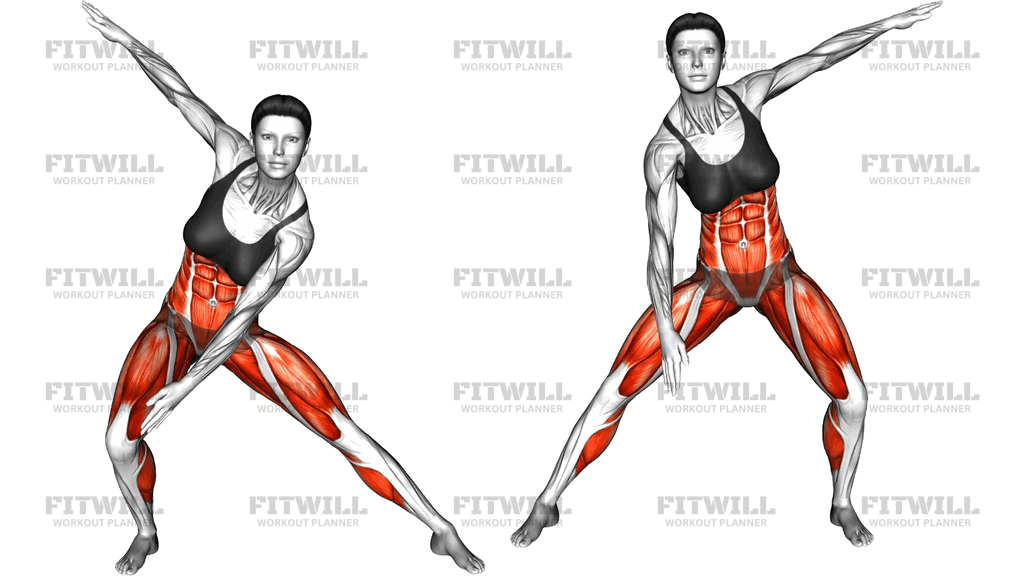
The Squat Side Walk is a lateral walking drill performed while holding a partial squat position. Instead of standing up between steps, you stay low with your hips shifted back, knees bent, and arms raised in front of you for balance, then take controlled side steps in one direction and back in the other. It looks simple, but holding that low position while moving sideways puts constant tension on the thighs and hips in a way that regular forward walking never does.
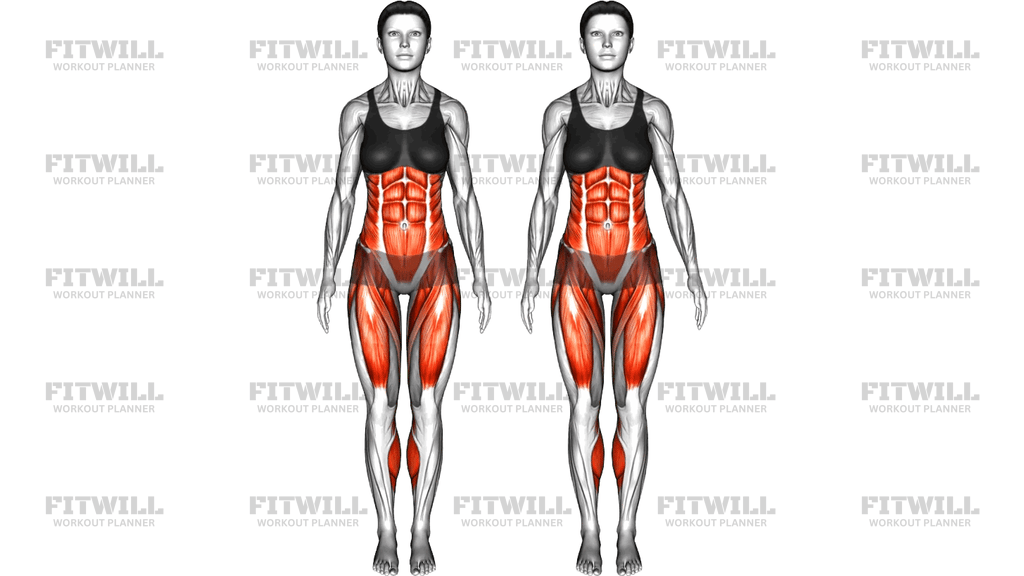
This movement is best known for targeting the gluteus medius, the smaller glute muscle on the side of your hip that stabilizes your pelvis with every step you take. Because you walk laterally from a bent-knee position, the leading leg has to abduct against your body weight while the trailing leg pushes the floor away. The quads hold the squat isometrically the whole time, the adductors control the width of your stance, and your core works to keep your torso upright as you shift from side to side.
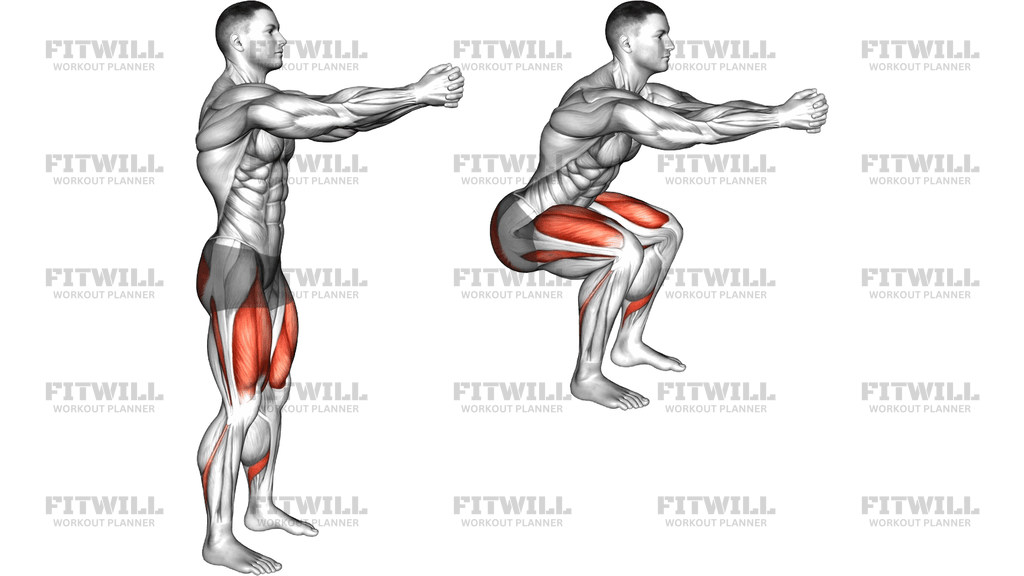
The setup matters more than most people expect. Your squat depth determines everything: too shallow and the move becomes a lazy side shuffle, too deep and your thighs will burn out before your hips get the work. Aim for a depth where your thighs are roughly parallel to the floor or slightly above, with your weight in your heels and mid-foot, knees tracking over your toes. Raising your arms in front of your body, as shown in the standard form for this exercise, counterbalances your hips and helps you sit back rather than lean forward.
To execute it well, think of your feet as staying at least hip-width apart the entire time. Step sideways with the lead foot, follow with the trail foot, and resist the urge to bob up and down as you move. The height of your squat should stay constant from the first step to the last. Most sets travel a fixed distance, such as 8 to 15 steps one way, then the same number back to the starting point.
The Squat Side Walk is a staple in warm-ups for squats and deadlifts, in lower-body strength circuits, and in rehab-style programming where coaches want hip stability without load. It requires no equipment and very little space, which makes it easy to do at home or in a hotel room. Because there is no external resistance, the challenge comes from time under tension, so slower steps with a consistent squat height will always beat fast, sloppy shuffling.
The main safety point is protecting your knees and lower back. If your knees cave inward as you step, shorten your stance or reduce your squat depth until you can keep them aligned over your toes. Stop the set when your squat height starts to creep up or your torso starts rounding forward, since those are the first signs your legs have given you everything they have for that round.
[ Workout Log & Planner ]
Put your next workout in Fitwill
Keep your plan and training log ready when you are.


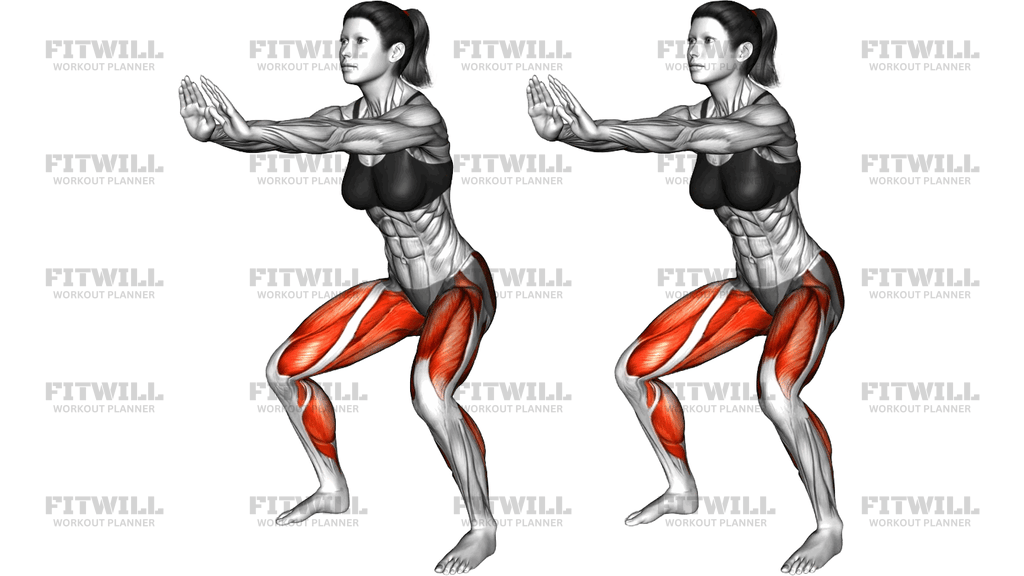
Instructions
- Stand with your feet about hip-width apart, toes pointing forward or turned out slightly, and let your arms hang relaxed at your sides.
- Hinge at the hips and bend your knees to lower into a partial squat with your thighs roughly parallel to the floor or slightly above, keeping your chest tall and your weight spread across your heels and mid-foot.
- Raise both arms straight out in front of your chest at shoulder height with palms facing forward or inward, using them as a counterbalance for your hips.
- Brace your core as if bracing for a light push, and keep your back flat from your hips to your shoulders.
- Take a controlled side step with your right foot, widening your stance, then follow with your left foot so your feet return to their original hip-width spacing.
- Keep your squat height constant as you step, and avoid letting your knees collapse inward; press them slightly outward over your toes.
- Continue stepping sideways for 8 to 15 steps, breathing steadily and exhaling on each lead step.
- Once you reach the end of your lane, reverse the direction, now stepping with your left foot first, and travel back to your starting point.
- After completing the final return step, drive through your heels, straighten your hips and knees, and lower your arms to stand fully upright before resting or beginning the next set.
Tips & Tricks
- The most common mistake is rising out of the squat with every step, which turns the drill into a standing side shuffle. Pick a reference point, like a mirror line or wall mark, and keep your hip height pinned to it for the whole set.
- If your knees cave inward as the lead foot steps out, actively think about spreading the floor with your feet. A slight outward knee pressure before you start stepping usually fixes this immediately.
- Do not let your arms drop. When the arms fall, the torso usually pitches forward and your lower back takes over positioning work. If your shoulders tire before your legs, lower your arms slightly but keep them in front of your body.
- Take small steps first. Oversized steps force your adductors into a wide stretch and pull your torso sideways, while short, quick, controlled steps keep your pelvis level and your glutes engaged.
- Keep your whole foot on the floor. Rolling onto the outer edge of the trailing foot is common when the hip tires and shifts stress away from the glutes.
- Slow the follow step down rather than letting it snap in. Resisting the trailing leg as it comes in keeps tension on the inner thighs and glutes through the entire rep.
- If you want more challenge without equipment, pause for one to two seconds with each follow step instead of adding speed.
- Do this exercise before heavy squats or deadlifts as an activation drill rather than to exhaustion; two or three sets of 10 to 15 steps per direction is plenty.
Frequently Asked Questions
What muscles does the Squat Side Walk work?
It primarily targets the gluteus medius on the side of the hip, with strong support from the gluteus maximus and quads, which hold the squat position. The inner thighs and calves assist during each step, and the core stabilizes your torso throughout.
How deep should my squat be during the Squat Side Walk?
Aim for thighs roughly parallel to the floor or slightly above it. The key is choosing a depth you can hold without your hips rising as you step, since a constant squat height is what makes the exercise effective.
Is the Squat Side Walk good for beginners?
Yes, it is one of the most accessible lower-body exercises because it needs no equipment and the difficulty scales with depth and step count. Beginners should start with a shallower squat and about 8 steps per direction before going deeper or longer.
Why do my knees hurt or feel strained during the Squat Side Walk?
Knee discomfort usually comes from the knees caving inward as you step or from sitting into a squat depth your legs are not ready for. Keep your knees tracking over your toes, reduce the depth, and shorten your steps until the movement feels smooth.
Should my arms stay up the whole time?
Yes, holding your arms extended in front of your chest counterbalances your hips and helps you sit back into the squat instead of leaning forward. Dropping the arms is one of the first signs of fatigue and usually leads to a rounded torso.
How does the Squat Side Walk differ from a regular lateral band walk?
A band walk is usually done from a higher, more upright stance with external resistance around the legs, while the Squat Side Walk holds a deep bent-knee position using only your body weight. The squat hold adds constant quad and glute tension, making it demanding even without a band.
How many steps and sets should I do?
A typical dose is 2 to 3 sets of 8 to 15 steps in each direction. Focus on keeping your squat height and step quality consistent rather than chasing distance.
Where should I place this exercise in my workout?
It works well as an early warm-up drill before squats, deadlifts, or running, or as a high-rep finisher in a lower-body circuit. As a warm-up, keep the effort moderate so your legs are activated, not fatigued.
Can I add resistance to the Squat Side Walk?
Once you can hold a parallel squat for 15 controlled steps per direction, you can loop a resistance band above your knees or around your ankles to increase the sideways demand on your glutes. Master the body-weight version first, since form tends to break down quickly under load.