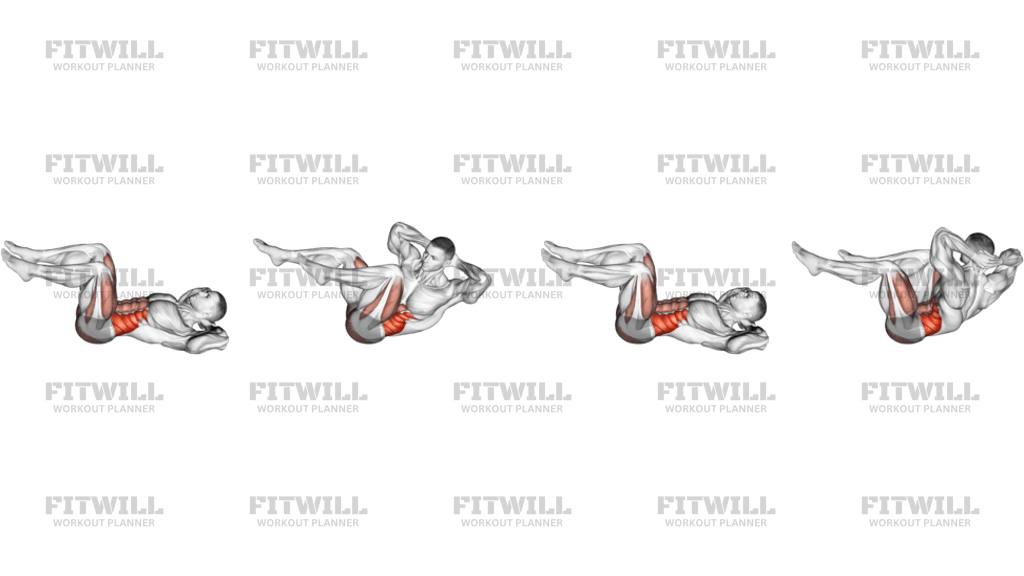
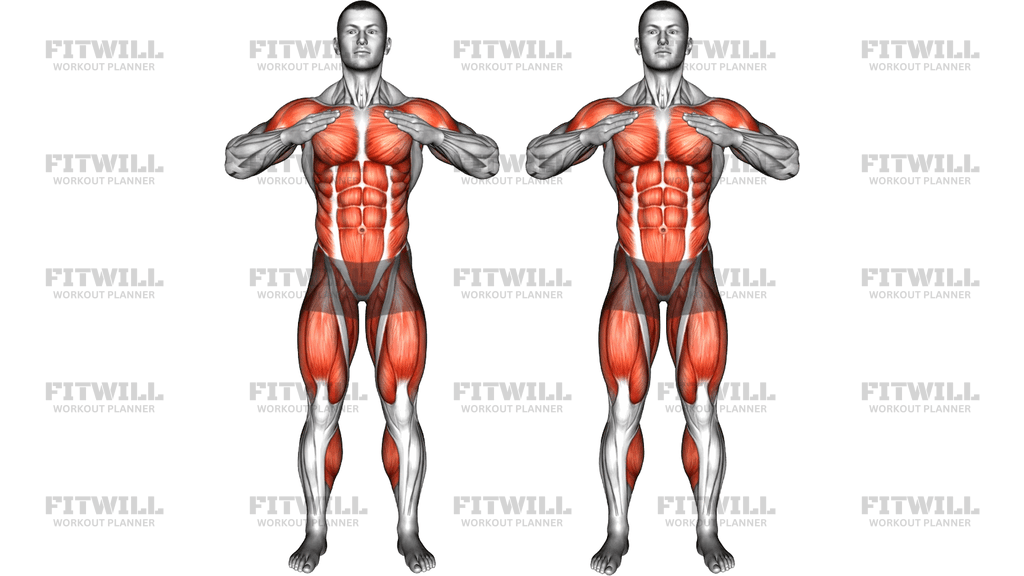
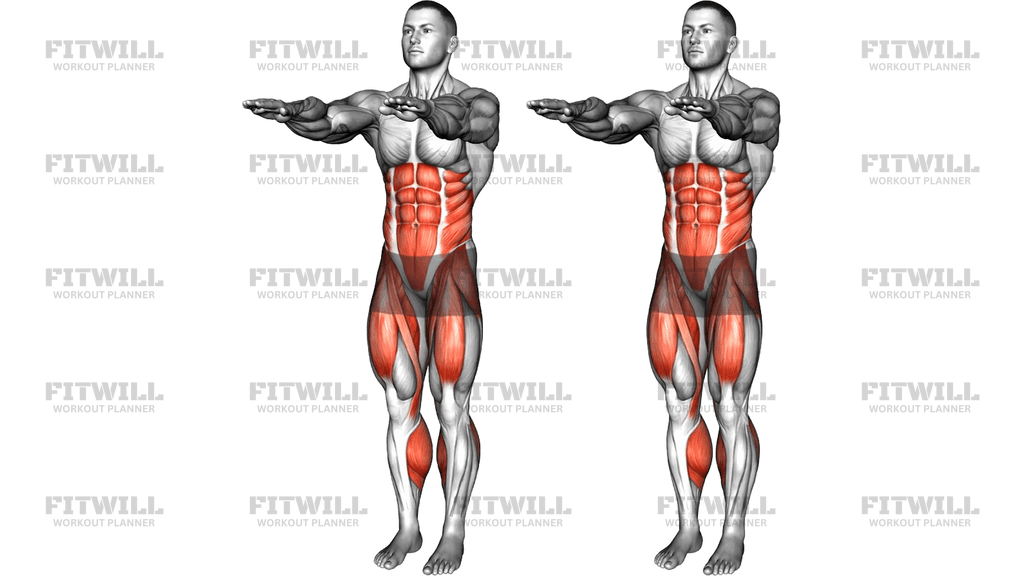
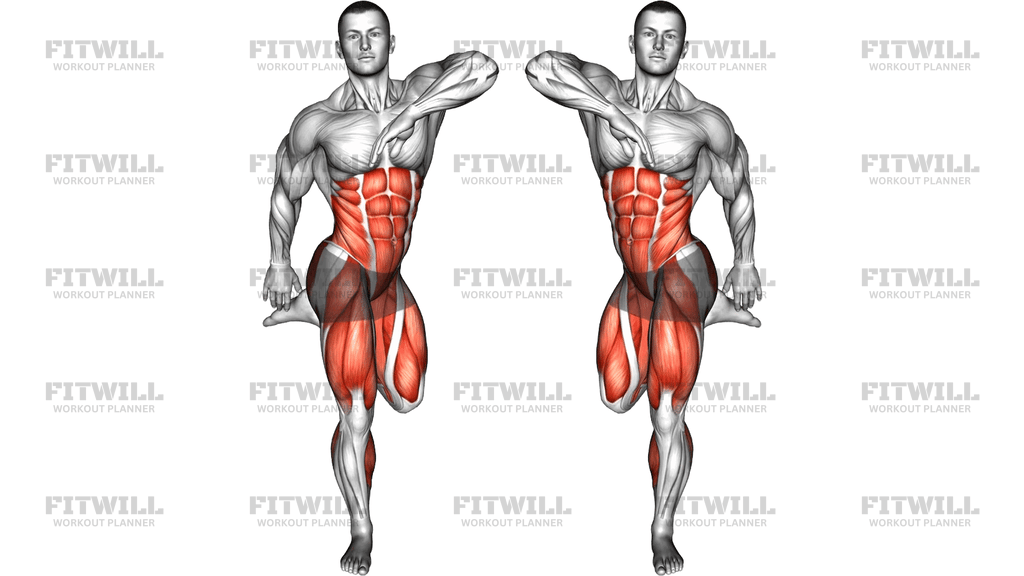
Side Plank Lift Against Wall
The Side Plank Lift Against Wall is a lateral core exercise where you hold a side plank with your feet braced against a wall, supporting yourself on one hand, and repeatedly lift and lower your hips through a controlled arc. The wall gives your feet a stable vertical surface to press into, which makes the movement easier to control and keeps your body in a clean side-facing line while the obliques do the work of moving and holding the pelvis.
The main muscles at work are the obliques on the underside of your torso, along with the quadratus lumborum and deep core muscles that stabilize the spine and pelvis. Your bottom shoulder and arm handle a significant portion of your body weight, the glutes help drive the hip lift, and the adductors and inner thighs work to keep your legs stacked and pressed toward the wall. Because one side works at a time, it also exposes and helps correct left-to-right strength differences.
This version suits people who find a free-standing side plank hip lift a bit unstable or who want to focus on feeling the side of the waist without wobbling everywhere. It is commonly used in core circuits, rehab-informed lateral trunk work, and programs for sports that demand side-to-side control, such as tennis, boxing, or running. The wall contact is genuinely useful: it anchors the feet, prevents them from sliding forward, and lets you concentrate on the hip path rather than balance.
To get the most from it, press your feet firmly into the wall and keep your elbow nearly straight with your hand stacked under your shoulder. The lift comes from pushing your bottom hip up toward the ceiling and pulling your ribs down toward your hip, not from shrugging or cranking your neck. Lower with control until your hip hovers just off the floor, then drive back up. Two or three sets of 8 to 15 controlled reps per side is a solid working range.
Keep your head neutral, look forward rather than down, and place your free hand on your hip or the side of your head as shown. If your supporting wrist or shoulder complains, drop to a forearm-supported version or shorten the range. Stop the set as soon as your hips sag or your body starts twisting toward the floor, because that is when the exercise stops training the obliques and starts loading the lower back.
[ Workout Log & Planner ]
Put your next workout in Fitwill
Keep your plan and training log ready when you are.


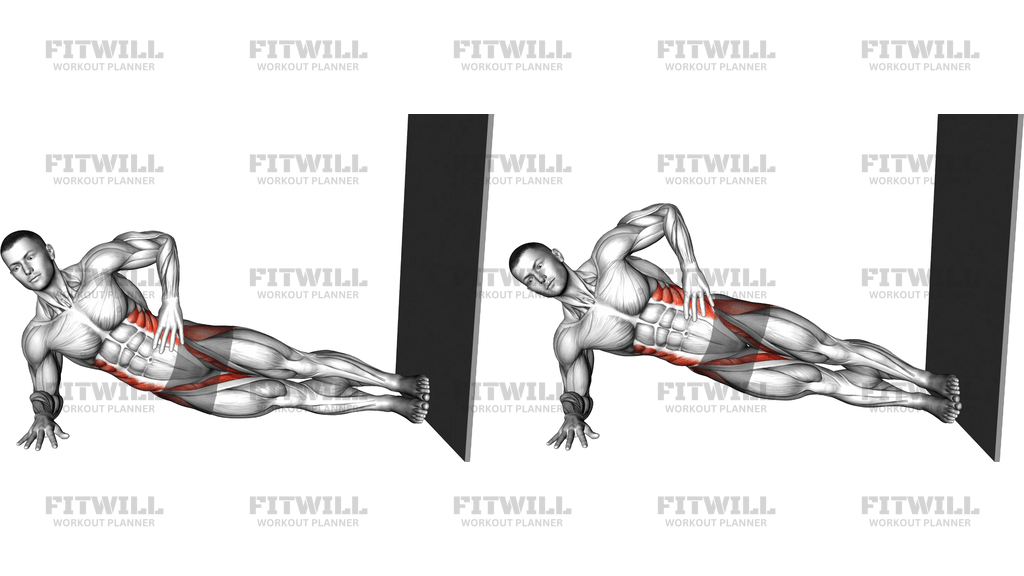
Instructions
- Find a clear stretch of wall and set an exercise mat alongside it so your body will rest on the mat, not bare floor.
- Lie on your side with your legs fully extended and the outer edge of your bottom foot, then the top foot, pressed flat against the wall. Stack your feet one on top of the other and point your toes forward so your laces do not drag the wall.
- Place your bottom hand on the mat directly under your shoulder with the arm nearly straight, fingers spread wide for a stable base. Rest your top hand on your hip with the elbow raised.
- Lift your hips off the floor until your body forms one straight line from head to heels, and press both feet firmly into the wall.
- Brace your abs and squeeze your glutes before you start moving, and keep your bottom shoulder actively pushed away from the floor rather than sunk into the joint.
- Inhale and lower your hips down toward the floor in a straight sideways path until they hover an inch or two off the mat.
- Exhale and drive your bottom hip up toward the ceiling, pulling your ribs toward your hip, until you are slightly above the straight side plank line.
- Pause briefly at the top of the lift, then lower back down with the same control — no dropping or bouncing at the bottom.
- Complete your target reps on one side, lower your hips to the mat, roll to the other side, and repeat with the opposite arm and shoulder supporting you.
- Rest between sides and reset your foot position against the wall each time so your line from head to heels stays perpendicular to the wall.
Tips & Tricks
- If your top hip drifts backward or forward during the lift, check that both feet are actually flat against the wall — losing that contact is the most common reason the line collapses in this setup.
- A sinking bottom shoulder turns this into a shoulder exercise. Think about pushing the floor away throughout the set to keep the space between your ear and shoulder open.
- Do not let your head hang or crane upward. Looking straight ahead at a fixed point on the wall keeps your neck neutral as your hips travel up and down.
- Cut the range short if your hip touches the floor between reps. Hovering just above the mat keeps tension on the obliques and protects the hip bone.
- Slow the lowering phase to two or three seconds. Most people get a better side-waist stimulus from a controlled descent than from adding more reps.
- If your wrist hurts, turn your supporting hand so the fingers angle slightly outward, or hold a light handle or dumbbell to keep the wrist straight.
- Breathe out on the lift, not while holding your breath. Exhaling as you drive the hip up also helps the deep core brace properly.
- Doing the weaker side first and matching its reps on the stronger side is a simple way to even out a left-right imbalance over time.
- Progress by pausing two to three seconds at the top of each lift or elevating your feet slightly higher up the wall once the standard version feels easy.
Frequently Asked Questions
What muscles does the Side Plank Lift Against Wall work?
The obliques on your supporting side are the primary movers, assisted by the quadratus lumborum and deep core muscles. Your glutes, inner thighs, and supporting shoulder also work hard to hold the side plank line.
Why are the feet placed against the wall in this exercise?
Pressing the feet into the wall anchors them so they cannot slide forward or lose alignment, which stabilizes the whole body. It lets you focus on moving the hips smoothly instead of fighting for balance.
Is the Side Plank Lift Against Wall suitable for beginners?
Yes, the wall support actually makes it friendlier for beginners than a free-standing version. Start with a small range of motion and fewer reps, or support yourself on your forearm instead of a straight arm if the full version is too demanding.
Should I support myself on my hand or my forearm?
The straight-arm version shown here places more demand on the shoulder and wrist, while a forearm support shortens the lever and spares those joints. Choose the hand version if your wrists and shoulders are healthy, and the forearm version if they are not.
How far should I lower my hips during the lift?
Lower until your hip is roughly an inch or two off the floor and still under tension. Letting the hip touch down between reps releases the obliques and can bruise the hip bone over repeated sets.
Why do my shoulders burn more than my waist?
That usually means your bottom shoulder is sinking toward your ear or your hips are dropping below the straight line. Push the floor away, lift slightly higher, and if it persists, switch to the forearm version so the obliques remain the limiting factor.
How many reps and sets should I do?
Two to three sets of 8 to 15 controlled lifts per side works well for most people. When that feels easy, add a two-to-three-second pause at the top of each lift rather than chasing much higher rep counts.
What can I use instead of a wall?
A standard free-standing Side Plank Hip Lift is the closest substitute, and a forearm side plank hip dip on a mat also trains the same muscles. The wall mainly adds stability, so the free-standing versions require more balance and control.
Is it safe for my lower back?
When performed with a braced core and a straight side-to-side hip path, it is a well-tolerated lateral core exercise. Avoid twisting the torso, jerking the hips upward, or continuing once your form sags, and stop if you feel sharp pain anywhere.