Medicine Ball 45 Degree Side Bend
The Medicine Ball 45 Degree Side Bend is a lateral core exercise performed on a Roman chair or adjustable hyperextension bench set to roughly 45 degrees. You position yourself sideways on the bench with your feet anchored under the roller pads, hips supported by the pad, and your trunk hanging down toward the floor. Holding a medicine ball against your chest with both hands, you raise your torso sideways until your body forms a straight line, then lower back down under control. The angled setup extends the range of motion beyond what a standing side bend allows, which is exactly why this version is worth doing.
This movement targets the obliques on the side of your torso that is working to lift your trunk, along with the quadratus lumborum and deep stabilizers that control sideways bending. The medicine ball held at the chest adds load close to your center of mass, making the obliques work harder on both the lifting and the lowering phase without putting a long lever over your head like some standing variations do.
The setup matters more here than in most ab exercises. Because your body is turned sideways on the bench, your hip bone needs to rest on the pad while your lower trunk and torso hang free. If your hips are too far forward or back, you end up flexing at the hip or twisting instead of bending sideways, and the obliques stop doing the work. Feet locked firmly under the rollers give you a stable base so the effort stays in your waist rather than in your legs or grip.
To execute it well, keep your shoulders and hips square to the side throughout the rep. Think of folding sideways like a closing book rather than rolling or twisting forward. The ball stays glued to your chest, your neck stays in line with your spine, and the lift should come from the side of your waist, not from pulling with your arms or pushing off your feet.
This exercise fits well for anyone building rotational and lateral trunk strength: combat athletes, throwers, golfers, and tennis players all benefit from stronger side-bending and anti-rotation capacity. It is also a solid choice for general lifters who have plateaued on planks and crunches and need loaded lateral work. Start with a light ball, keep the reps deliberate, and progress the weight only when you can control the lowering phase on every rep. Stop short of the point where your form twists forward, because that is when the lower back starts taking over.
[ Workout Log & Planner ]
Put your next workout in Fitwill
Keep your plan and training log ready when you are.


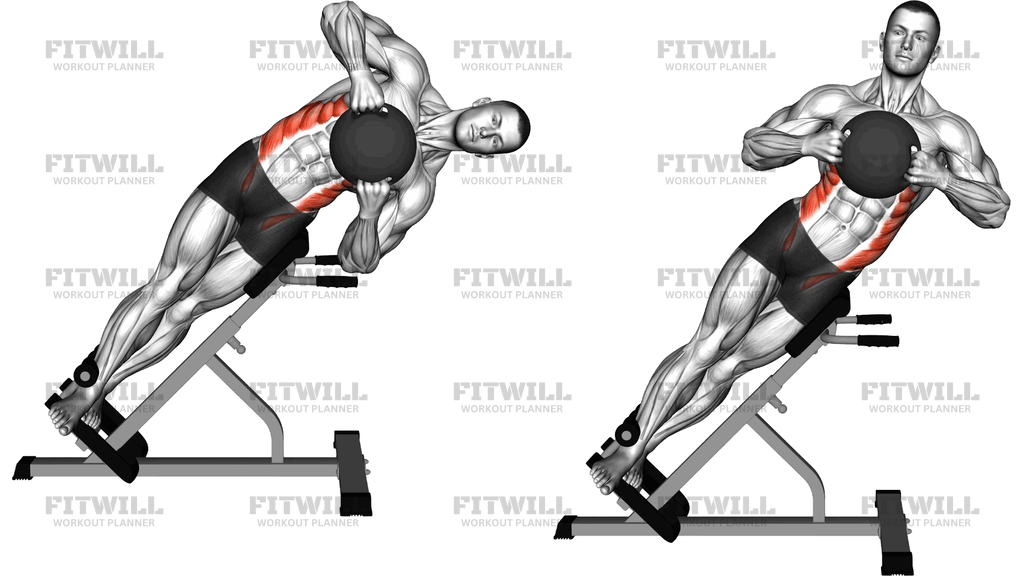
Instructions
- Set a Roman chair or hyperextension bench to about 45 degrees and anchor your feet under the roller pads with the outside leg pressed firmly on top.
- Lie sideways across the bench so your hip rests on the pad and your lower trunk hangs freely toward the floor, with your legs stacked and knees straight.
- Hold a medicine ball at your chest with both hands, elbows tucked in, and keep the ball pressed against your upper abdomen for the entire set.
- Brace your core lightly and make sure your shoulders and hips are square to the side, not rolled forward or back.
- Bend sideways up toward the ceiling by contracting the oblique on the working side until your head, shoulders, and hips form one straight line.
- Pause briefly at the top and squeeze the side of your waist rather than pulling the ball up with your arms.
- Lower your torso slowly back down toward the floor, controlling the descent for two to three seconds instead of dropping into the stretch.
- Exhale as you bend up and inhale as you lower down, keeping the breath steady throughout the set.
- Complete all reps on one side, then reposition yourself carefully on the other side of the bench and repeat for the same number of reps.
Tips & Tricks
- The most common mistake is twisting forward as you lift, which turns this into a crunch and offloads the obliques. Keep your chest facing sideways and imagine bending around an invisible pole behind you.
- Check your hip placement before the first rep. If your hip bone is not on the pad, you will bend from the hip joint instead of the waist, and the medicine ball will feel heavier than it should.
- Do not let the ball drift away from your chest. The further it moves from your torso, the more it pulls on your shoulders and the less load reaches your obliques.
- Lowering too fast is the usual reason people stall on this exercise. The stretch phase under the bench is where much of the oblique work happens, so take two to three seconds on the way down.
- Choose a ball you can control for the full set. A heavy ball at the bottom position can yank you deeper into side flexion than your quadratus lumborum is ready for.
- If your bottom foot slips out of the rollers mid-set, re-secure it immediately. Losing your anchor changes the lever arm and forces your legs to compensate.
- Keep your neck neutral by looking forward rather than craning upward. Looking up encourages you to roll the torso instead of bending purely sideways.
- If 45 degrees feels too demanding at first, reduce the bench angle so your trunk hangs less steeply, then work toward the steeper position as your strength improves.
Frequently Asked Questions
What muscles does the Medicine Ball 45 Degree Side Bend work?
The external and internal obliques on the working side do most of the lifting, supported by the quadratus lumborum and deep core stabilizers. The lower back musculature works to control the descent.
Is the Medicine Ball 45 Degree Side Bend suitable for beginners?
Yes, if you start with a very light ball or no ball at all and a shallower bench angle. Beginners should first learn to bend purely sideways without twisting before adding load.
Why hold the medicine ball at the chest instead of extended overhead?
Holding the ball at the chest keeps the load close to your center of mass, which challenges the obliques without straining the shoulders or lower back. An extended-arm position would lengthen the lever and make the exercise much harder to control.
How high should I bend up on each rep?
Bend sideways until your head, shoulders, and hips form a straight line with your legs. Going past that line requires twisting or using momentum, neither of which helps the obliques.
What should I do if I feel this exercise in my lower back?
Reduce the ball weight, slow down the lowering phase, and double-check that your hips are square and on the pad. If discomfort continues, shorten the range so you do not descend as far into the stretch.
How does this differ from a standing side bend with a dumbbell?
The angled Roman chair position puts you below horizontal, so gravity pulls your trunk into a deeper stretch and the obliques work through a longer range. A standing side bend only works the top portion of the movement and often loads one side of the lower back unevenly.
How many reps and sets should I do?
Two to four sets of 8 to 15 controlled reps per side works well for most people. Because the lowering phase is demanding, choose a weight you can lower slowly on every rep.
Can I substitute the medicine ball with another piece of equipment?
A dumbbell or weight plate held at the chest works if you do not have a medicine ball. A kettlebell held close to the torso is another option, as long as the load stays tight against your chest.
Should I do both sides in the same set or one side at a time?
Finish all reps on one side, then reposition and match the rep count on the other side. Climbing off and back on between sides takes a moment but keeps each set focused and controlled.