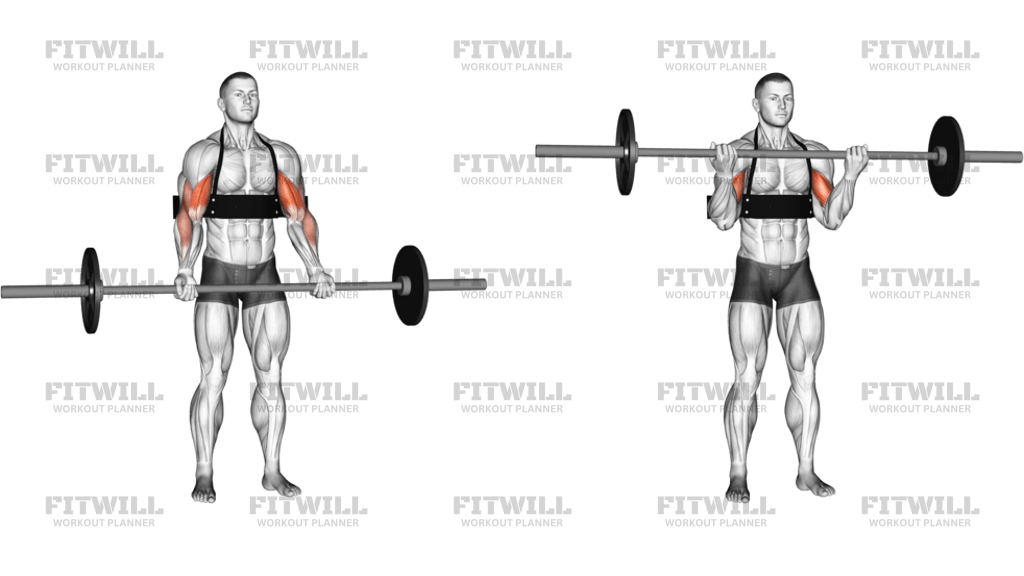
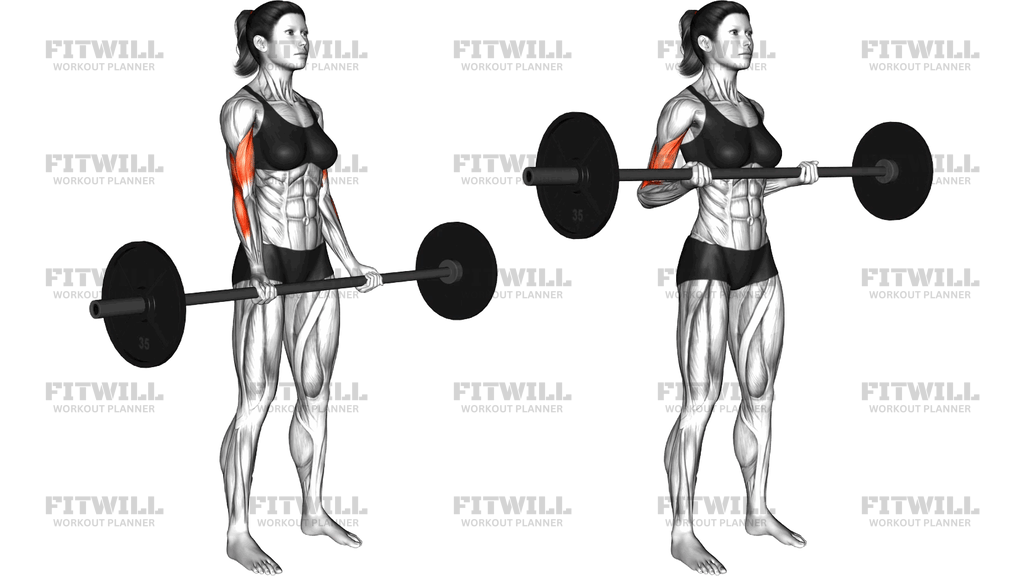
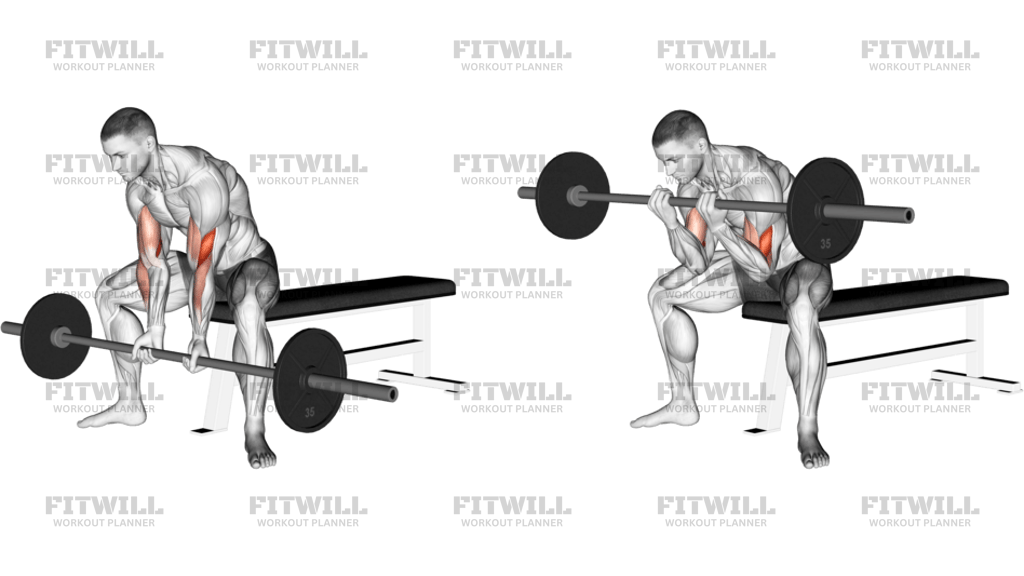
Barbell Lying Biceps Curl
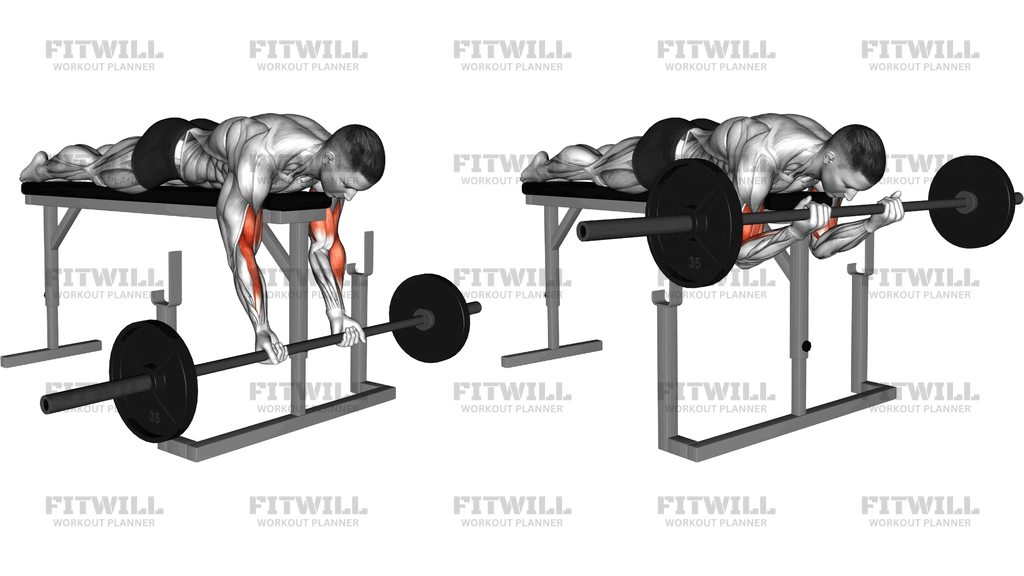
The Barbell Lying Biceps Curl is a strict isolation movement performed face down on a flat bench, with your arms hanging straight toward the floor and a barbell curled up from that hanging position. Because your torso is supported and your upper arms are fixed against your sides, there is nowhere to hide: no leaning back, no hip drive, no shoulder swing. Every rep has to come purely from the elbows bending, which is exactly why this variation is valued by lifters who want honest biceps work.
The prone position changes the stimulus in a meaningful way. With your arms hanging behind the line of your torso, the biceps works from a lengthened position through the bottom half of each rep, which many lifters find harder to load safely with standing curls. The bench also pins your shoulders in place, so the front delts can't take over the way they often do when a standing barbell curl gets heavy.
This exercise suits intermediate lifters who already own solid curl technique and want a variation that removes momentum, as well as anyone whose standing curls have drifted into upright rows. It is also useful in a hypertrophy block as a second or third biceps movement, placed after a heavier seated or standing curl. Because both arms work on a fixed bar, it exposes left-to-right strength differences quickly.
Setup is the part that makes or breaks this lift. Your upper arms need to stay vertical and tucked beside your torso for the whole set; the moment they drift forward or flare outward, the elbow angle changes and tension leaks out of the biceps. Keep your chest and hips in contact with the bench, your neck neutral, and your wrists straight rather than cocked back under the bar.
Execution should be slow and deliberate. Curl the bar up until your forearms are roughly level or slightly above, squeeze hard at the top, and lower under control until your arms are fully extended toward the floor. That bottom stretch, taken with control, is one of the main reasons to choose this variation. Because the bar hangs below you, use collars and start lighter than your standing curl; a missed rep here has fewer ways to be saved than one performed standing.
[ Workout Log & Planner ]
Put your next workout in Fitwill
Keep your plan and training log ready when you are.


Instructions
- Set a flat bench to a height that lets your arms hang fully extended toward the floor without the bar plates touching the ground.
- Lie face down on the bench with your chest and hips supported, legs relaxed behind you, and your head in line with your spine.
- Grip the barbell with an underhand, shoulder-width grip and let your arms hang straight down beside the bench, upper arms vertical and close to your torso.
- Brace your core lightly and press your upper arms against your sides to lock the shoulder position before the first rep.
- Keeping your upper arms completely still, bend your elbows and curl the bar up in a smooth arc toward your shoulders.
- Pause briefly at the top with your forearms just above parallel to the floor and squeeze your biceps.
- Lower the bar slowly along the same arc until your elbows are fully extended and you feel a stretch at the bottom.
- Exhale as you curl up and inhale as you lower the bar down.
- Complete all reps in one continuous, controlled rhythm, then set the bar down on the floor safely before sitting up.
Tips & Tricks
- The most common fault is letting the elbows drift behind or in front of the torso as the set gets hard; if you cannot keep your upper arms vertical, the weight is too heavy.
- Do not turn this into a partial rep by bouncing out of the bottom stretch — extend fully each rep, but decelerate the bar before the elbow reaches lockout.
- Keep your wrists stacked over your elbows; cocking the wrists back under the bar shifts tension to the forearms and strains the wrist joints.
- Choose a bench height that leaves clearance between the plates and the floor at full extension, otherwise your range gets cut short without you noticing.
- If your lower back feels loaded, check that your hips have not lifted off the bench — the prone position should remove your lower back from the lift entirely.
- Use collars on both sleeves every time; with the bar hanging at your sides, an uneven plate slide is much harder to correct mid-set.
- An EZ bar is a sensible swap if a straight barbell bothers your wrists in the fully supinated hanging grip.
- Chalk or a secure grip matters more here than in standing curls, since the bar hangs with nothing underneath it for most of the set.
- Film yourself from the side once in a while — from your own viewpoint it is hard to see whether your upper arms have started swinging.
Frequently Asked Questions
Which muscles does the Barbell Lying Biceps Curl work?
The biceps brachii is the prime mover, with the brachialis and brachioradialis assisting and the forearm flexors working to hold the grip. Because your shoulders are pinned by the bench, very little else contributes to the lift.
Why do this instead of a standing Barbell Biceps Curl?
Lying face down removes your ability to swing your torso or swing your upper arms, so the biceps does all the work from a stretched hanging position. Most lifters have to drop the weight noticeably, which is the point.
Is the Barbell Lying Biceps Curl suitable for beginners?
It can be, but most beginners progress faster starting with seated or standing curls where the position is easier to feel. If you try it early, use a very light bar and focus entirely on keeping your upper arms vertical.
How high should I curl the bar at the top?
Curl until your forearms are roughly level with the floor or just above, while your upper arms stay pressed to your sides. Curling higher than that usually means the elbows have drifted backward and tension has dropped off.
My wrists ache with the straight bar — what should I change?
Switch to an EZ bar so your hands sit at a slightly less than fully supinated angle, and check that you are not cocking your wrists backward under the load. Keep the bar resting in your palms with wrists stacked over elbows.
Can I do the Barbell Lying Biceps Curl with dumbbells instead?
Yes, the same prone setup works with a dumbbell in each hand and allows a slightly freer wrist path. You lose the fixed-bar feedback on left-to-right balance, but gain joint-friendly wrist angles.
Why do I feel a strong stretch at the bottom of each rep?
With your arms hanging behind your torso, the biceps works from a longer muscle length than in a standing curl. That stretch is a feature of the exercise, but take it under control rather than letting the bar drop into it.
How heavy should I go on this exercise?
Start well below your standing curl weight, since the prone position removes all momentum assistance. A weight you can lower slowly for 8 to 12 strict reps is a better choice than one you can only heave up.
Is it safe to lie face down with a barbell hanging at my sides?
It is safe with sensible precautions: always use collars, set the bar down on the floor before sitting up, and never train this to failure alone if a dropped bar could roll or you cannot safely exit the bench. Check plate clearance before your first rep.
Where should this exercise sit in my arm workout?
Use it after a heavier primary curl, since the strict setup and stretched position work best with moderate loads and higher reps. It pairs well as a finishing movement for 2 to 3 sets of 10 to 15 controlled reps.