Kettlebell Unilateral Clean Grip Farmers Carry
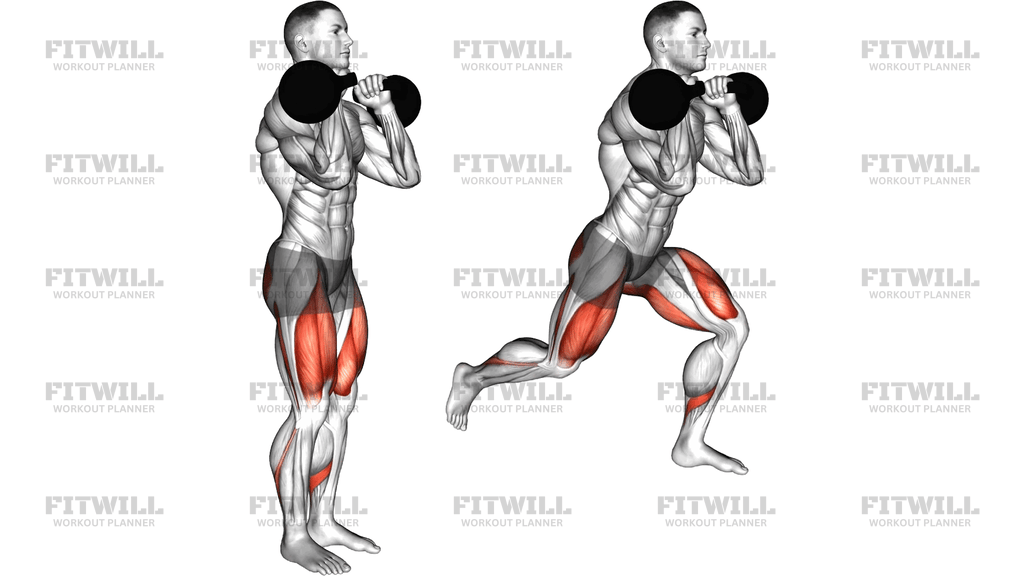
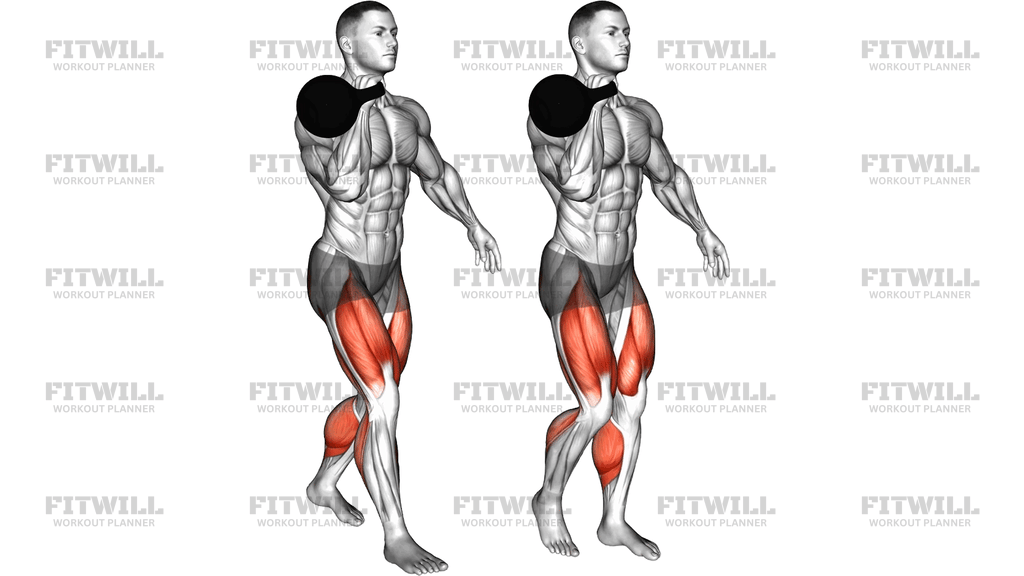
The Kettlebell Unilateral Clean Grip Farmers Carry is a loaded carry performed with a single kettlebell resting in the rack position at one shoulder, held in the same grip you finish a kettlebell clean with. Instead of hanging at your side like a traditional farmer's carry, the bell sits on the front of your shoulder with your elbow tucked down by your ribs, and you walk with that offset load. The result is a moving challenge for your legs and trunk at the same time: your quads and calves drive each step while the obliques and deep core work overtime to keep your torso from tipping toward or away from the weighted side.
Because only one side is loaded, this variation does something a two-bell carry cannot. The asymmetry forces the muscles on the unloaded side of your waist to resist lateral flexion, and it exposes side-to-side differences in how you stand, brace, and walk. The highlighted work in the thighs and lower legs is real—every step under load asks the quads to absorb and the calves to push off—but the quiet battle happening at your ribcage and hips is where most people feel it first.
This carry suits a wide range of lifters. Beginners can use it to learn how to own the kettlebell rack position without rushing into cleans or presses. Intermediate and advanced trainees use it as core training that doesn't look like core training, as conditioning with a strength bias, or as a shoulder-friendly way to load the trunk when hanging exercises or heavy bilateral carries aren't available. It also pairs naturally with kettlebell sport and general strength sessions because the rack position itself—wrist neutral, elbow close, bell settled—is a skill worth practicing under fatigue.
Setup matters more here than in most carries. If the bell rests out on the forearm instead of against the shoulder, or if the elbow drifts out to the side, the shoulder takes unnecessary strain and the trunk loses its leverage. A good rack lets you stay tall, breathe shallowly into your belly, and walk for distance or time without the bell rolling or the wrist collapsing.
To execute it well, clean the bell to your shoulder, settle it into the rack, brace your midsection, and walk with deliberate, even steps. Keep your ribs stacked over your pelvis rather than arching backward to counterbalance the weight, and keep your free arm relaxed at your side. Complete your distance or time on one side, set the bell down with control, then switch sides and match the work.
Practically, this movement slots in at the end of a lower-body day, as a finisher, or as a standalone carry circuit alongside other loaded walks. Start with a kettlebell you could comfortably front squat for several reps, walk 20 to 40 meters per side, and progress by adding distance or time before adding weight. If your torso starts leaning hard to one side or the bell begins sliding off the forearm, that is your cue to end the set rather than grind through it.
[ Workout Log & Planner ]
Put your next workout in Fitwill
Keep your plan and training log ready when you are.


Instructions
- Place one kettlebell on the floor in front of your feet, stand with your feet about hip-width apart, and hinge down to grip the handle with one hand.
- Hike the bell back between your legs and clean it up to your shoulder so it rests on the front of your deltoid, with your wrist straight, knuckles facing outward, and elbow tucked down close to your ribs.
- Stand tall and settle the bell into the rack: the handle should sit diagonally across your palm, the body of the bell resting against your shoulder and forearm rather than hanging off the wrist.
- Take a breath into your belly, brace your abs as if bracing for a light punch, and gently pull your ribs down so your lower back isn't arching to counterbalance the weight.
- Let your free arm hang relaxed at your side with your shoulders level and your gaze forward.
- Begin walking with controlled, even steps, keeping your torso upright and vertical—do not lean sideways away from the bell or backward underneath it.
- Continue for a set distance, such as 20 to 40 meters, or a set time, breathing shallowly into your belly while keeping the brace.
- Once you finish the distance, stop with both feet planted, hinge slightly, and set the kettlebell down on the floor with control rather than dropping it.
- Shake out your grip and forearm, then clean the bell to the opposite shoulder and repeat the same distance or time to keep the work even on both sides.
Tips & Tricks
- If the bell keeps rolling off your forearm, the rack is wrong: rotate your hand slightly outward so the handle sits diagonally across the palm and the bell nests against the shoulder instead of pulling the wrist backward.
- A common mistake is flaring the loaded elbow out to the side as fatigue builds; pull it down toward your ribs so the shoulder stays packed and the lat helps support the bell.
- Watch for a sideways lean away from the weight—this feels easier but robs the obliques of work. Film yourself from the front or walk toward a mirror to check that your shoulders stay level.
- Do not shrug the loaded shoulder up toward your ear; keep it pressed down and back so the traps support the load without creeping up.
- Short, choppy steps usually mean the weight is too heavy or the brace is lost. Take fuller, deliberate steps and slow the pace down before reaching for a heavier bell.
- Breathe shallowly into your belly rather than holding your breath for the whole walk; a full exhale every few steps keeps tension without spiking pressure.
- If your lower back starts arching as you tire, your ribs are flaring up to counterbalance the bell—exhale, pull the ribs down, and shorten the set if you cannot hold the position.
- Match sides by distance or time, not by how the hard side feels; let the weaker or less stable side set the working load.
- Flat, firm ground is best for this carry. Skip uneven surfaces until the rack position feels automatic, since a stumble under a racked bell is hard to recover from.
Frequently Asked Questions
Which muscles does the Kettlebell Unilateral Clean Grip Farmers Carry work?
The quads and calves drive each loaded step, while the obliques and deep core work hard to keep your torso upright under the one-sided load. Your grip, upper traps, and the shoulder stabilizers on the loaded side also stay active throughout the walk.
What makes the clean grip different from a regular farmers carry grip?
In a regular farmers carry the bell hangs at your side from a straight arm. Here the kettlebell is racked at your shoulder with a bent elbow, which shifts the load upward and forces your trunk and shoulder to support it in a compressed, front-loaded position.
Is the Kettlebell Unilateral Clean Grip Farmers Carry good for beginners?
Yes, as long as the weight is modest. It is actually one of the safest ways to learn the kettlebell rack position, since you are simply standing and walking rather than pressing or squatting. Start with a bell you could comfortably front squat and keep the walks short.
Why do I feel this more in my waist than in my legs?
The single-sided load creates a sideways pull that your obliques must constantly resist, and that anti-lean work is often fatiguing before the legs give out. This is expected; as you get stronger and heavier, the quads and calves take on a bigger share.
How far or how long should I walk?
A practical starting point is 20 to 40 meters per side, or 20 to 40 seconds if you are training in a small space. Progress by extending the distance or time first, then by increasing the kettlebell weight.
The bell keeps sliding off my forearm—what am I doing wrong?
Your wrist is likely collapsing backward or the elbow is drifting away from your ribs. Straighten the wrist, rotate your hand slightly outward so the handle lies diagonally across the palm, and tuck the elbow down so the bell rests against your shoulder and forearm.
Can I do this carry with two kettlebells instead of one?
You can, but it becomes a different exercise: a bilateral racked carry. The unilateral version is specifically valuable for the anti-lean core demand and for exposing side-to-side differences, so keep the single-bell version in your program for those reasons.
What can I use if I do not have a kettlebell?
A single dumbbell can be held at the shoulder in a similar front-racked position, though the shape makes the rest point less stable. A sandbag hugged over one shoulder is another reasonable substitute for the offset carry effect.
Is it safe to walk with the weight at my shoulder if I have shoulder discomfort?
The racked position should feel supported, not pinched. If tucking the elbow and straightening the wrist does not remove discomfort at the shoulder, choose a side-hung farmers carry instead and build up rack tolerance gradually.
Where should I put this exercise in my training session?
It works best at the end of a lower-body or full-body session as a finisher, or as part of a carry circuit. Doing it before heavy squats or presses is possible, but the trunk fatigue can take the edge off those main lifts.