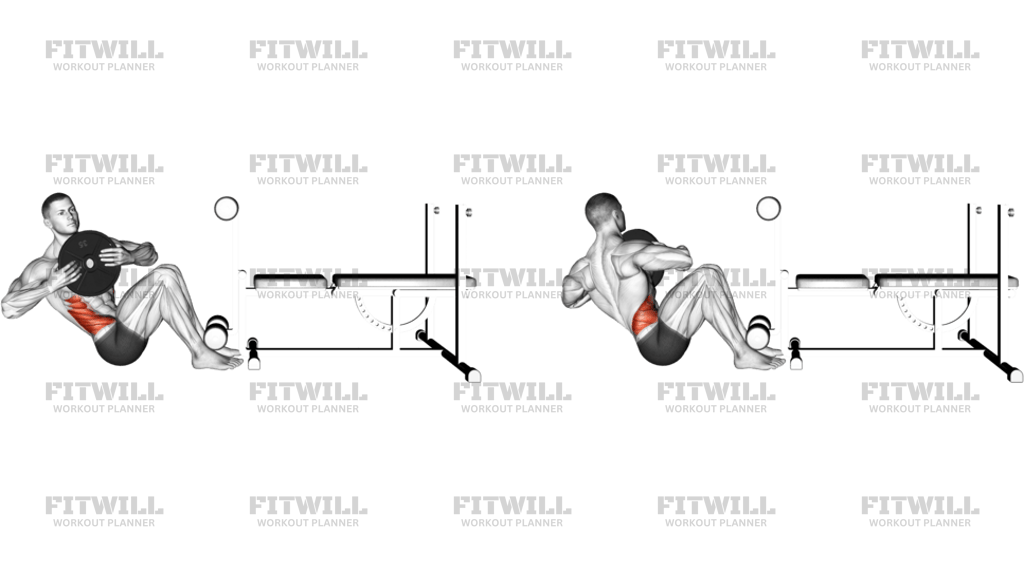
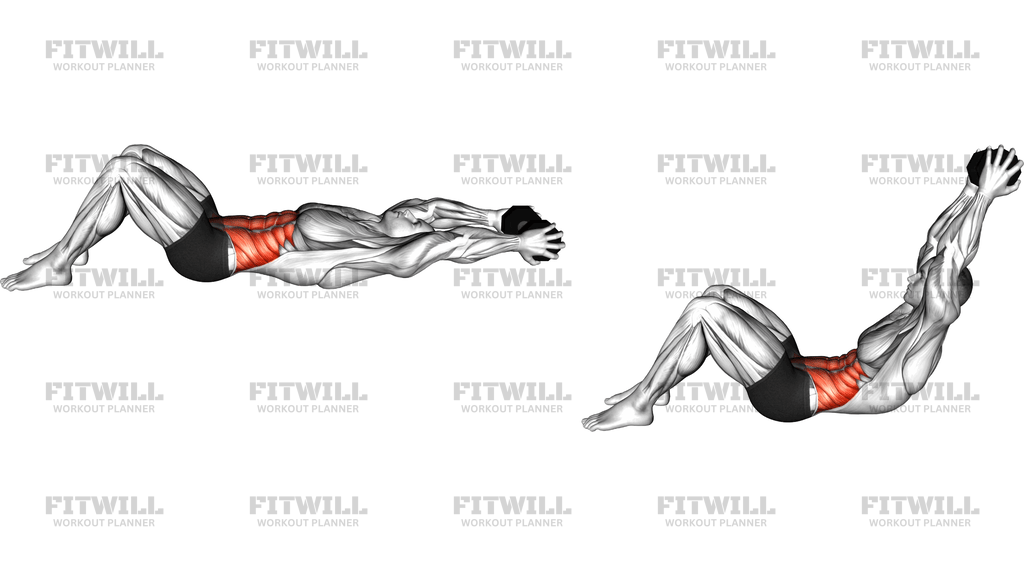
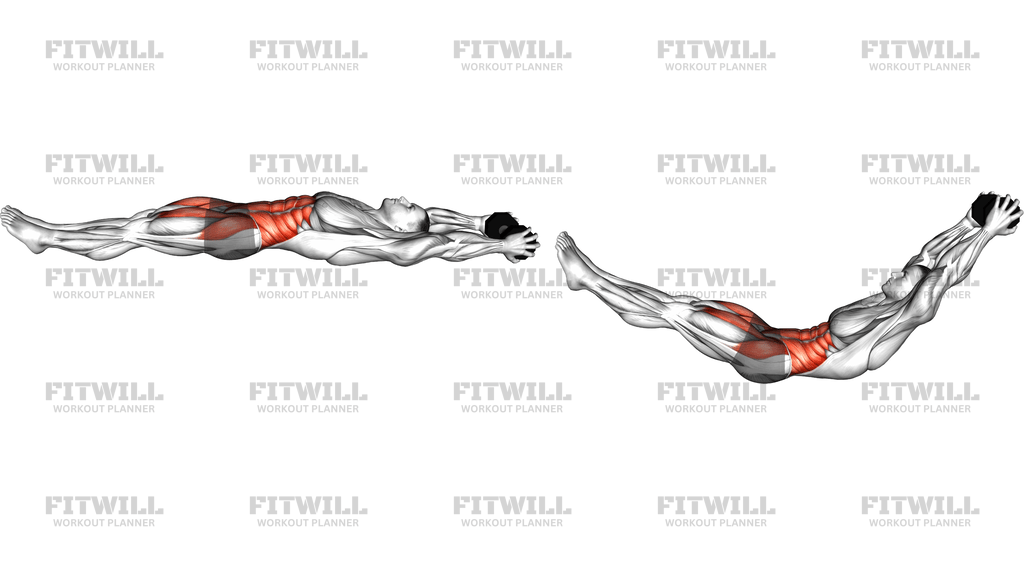
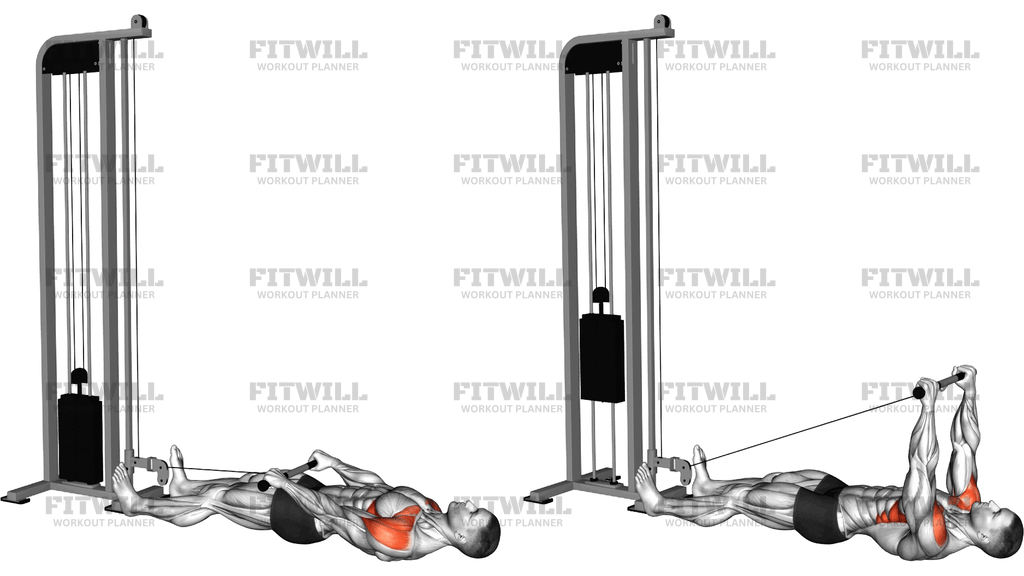
Dumbbell Twisting Crunch With Legs Supported
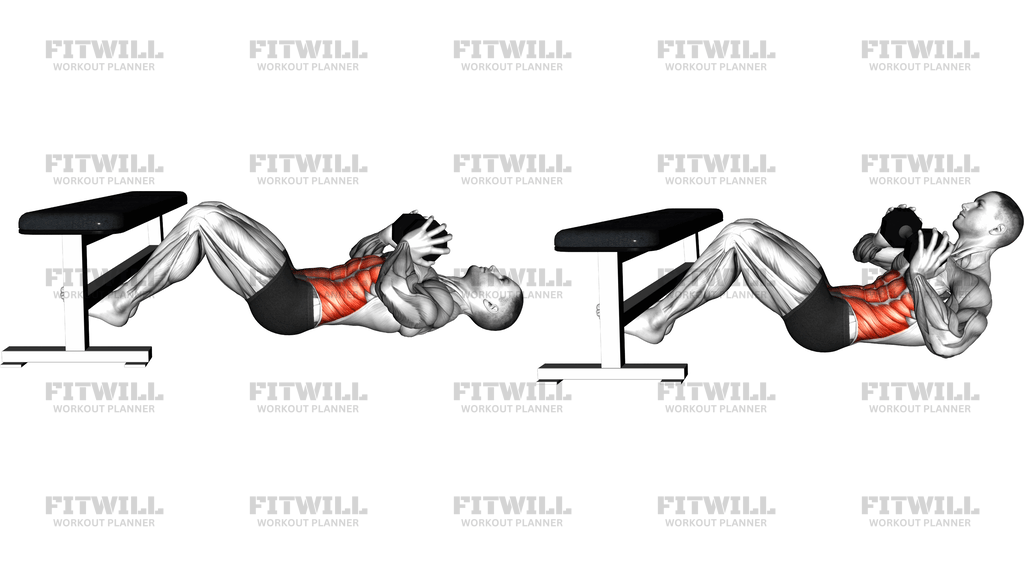
The Dumbbell Twisting Crunch With Legs Supported is a weighted abdominal exercise performed on the floor with your lower legs resting on a flat bench and a dumbbell held against your chest with both hands. From this position you crunch your upper back and shoulders off the floor while rotating your torso, so the movement combines spinal flexion with trunk rotation. The bench under your calves takes your legs out of the equation, which keeps your hips from doing the work and forces the abs and obliques to drive every rep.
This variation suits lifters who have outgrown bodyweight crunches and want to load the midsection without doing hundreds of repetitions. Holding a dumbbell turns a high-rep endurance drill into a strength-focused movement, and the added twist shifts a meaningful share of the work to the obliques, which are largely idle in a straight crunch. It fits well at the end of a push, pull, or leg day as a focused core finisher, or as the main abdominal movement in a shorter home session since all you need is a bench, a mat, and one dumbbell.
The legs-supported setup is what separates this from a floor crunch. Resting your calves on a bench places your hips and knees near 90 degrees and reduces the tendency for the hip flexors and quads to pull on your pelvis. It also gives you a stable base so you can concentrate on curling your ribcage toward your pelvis rather than worrying about your legs drifting around. With the weight held tight to your chest, your hands act as a sled for the load rather than pressing it away from you.
Execution depends on rotation coming from your trunk, not your arms or neck. As you crunch up, steer one elbow toward the opposite knee or hip, letting your shoulder blade lift and your torso wind slightly. Your lower back stays on the floor the whole time; only the upper and mid-back rise. Exhale hard as you twist up, pause briefly at the top where the contraction is strongest, then lower with control until your shoulders touch the floor before starting the next rep.
Keep the load honest. A weight that lets you twist smoothly for 10 to 15 controlled reps builds the trunk far better than a heavy dumbbell that turns the set into jerky half-reps. If your neck strains or your feet slip off the bench, that is the signal to reset your position or reduce the weight rather than push through.
Common use cases include building visible midsection strength, supporting big lifts like squats and deadlifts with a more stable trunk, and adding rotational work for sports that involve swinging, throwing, or changing direction. Because the floor supports your spine throughout, the movement is generally joint-friendly and easy to scale by adjusting dumbbell size, rep range, or how far you rotate each rep.
[ Workout Log & Planner ]
Put your next workout in Fitwill
Keep your plan and training log ready when you are.


Instructions
- Place a flat bench beside an open area of floor and set a dumbbell nearby, choosing a weight you can hold against your chest for 10 to 15 controlled reps.
- Lie on your back with your head a foot or two away from the bench, then lift your legs and rest your lower calves on the bench pad so your knees and hips are bent close to 90 degrees.
- Pick up the dumbbell and hold it vertically against your upper chest with both hands cupped around the top head, elbows tucked in toward your ribs.
- Draw your belly button in slightly and press your lower back gently toward the floor to brace your core before moving.
- Exhale and crunch your upper back and shoulders off the floor while rotating your torso, driving one elbow across your body toward the opposite knee or hip.
- Keep the dumbbell pressed to your chest throughout the rep so the rotation comes from your trunk, not from swinging your arms.
- Pause for a beat at the top of the twist and squeeze your abs and the oblique on the working side.
- Inhale as you slowly un-twist and lower your torso until your shoulders and upper back touch the floor again.
- Complete all reps on one side or alternate sides each rep, re-bracing before every crunch.
- When finished, sit up carefully before lowering your legs off the bench, and set the dumbbell down away from your body.
Tips & Tricks
- Do not let the dumbbell drift forward away from your chest as you crunch; the moment the weight leads the movement, your arms and shoulders start doing the work your abs should be doing.
- If your lower back peels off the floor or your hips rock, you are twisting too far or too fast — shorten the rotation and keep the pelvis planted.
- Pull your knees a little tighter toward the bench if your heels slide off during the set; unstable legs steal tension from the trunk.
- Avoid yanking your head forward with your hands. Your fingers support the dumbbell, your neck stays neutral, and your eyes track toward the ceiling rather than your knees.
- Choose a lighter dumbbell than you expect. The twisting crunch loads the abs and obliques through two directions at once, so even a modest weight feels challenging by the tenth rep.
- Exhale forcefully as you twist up. Holding your breath is the most common reason people lose their brace halfway through a set of weighted crunches.
- If one side twists more smoothly than the other, start your sets on the stiffer side to keep the work balanced.
- Keep your elbows squeezed in rather than flared wide; tucked elbows make it easier to hold the dumbbell steady as your torso rotates.
Frequently Asked Questions
What muscles does the Dumbbell Twisting Crunch With Legs Supported work?
The rectus abdominis does most of the crunching work, while the obliques on both sides rotate and control the trunk. The deep core muscles stabilize throughout, and the hip flexors assist lightly even with the legs supported.
Why rest my legs on a bench instead of keeping my feet on the floor?
Resting your calves on the bench fixes your hip and knee angles and gives your lower body a stable base, which stops your legs and hip flexors from dominating the movement. That keeps the tension on your abs and obliques where you want it.
How heavy should the dumbbell be for this exercise?
Pick a weight that lets you complete 10 to 15 reps with a full crunch and a controlled twist on every rep. If your rotation gets shorter, your lower back lifts, or the dumbbell drifts off your chest, the weight is too heavy.
Should I alternate sides each rep or finish one side first?
Both work. Alternating sides each rep keeps the effort even, while completing all reps on one side first makes it easier to feel the oblique working and then match the burn on the other side. Just do the same total work per side.
Is it normal for my neck to feel strained?
No. Neck strain usually means you are pulling your head forward or leading the crunch with your chin instead of your ribcage. Support the dumbbell with your hands, keep your neck in line with your spine, and imagine curling your sternum toward your opposite hip.
Can beginners do the Dumbbell Twisting Crunch With Legs Supported?
Yes, but it is easier to learn the pattern with a very light dumbbell or no weight first. Once you can perform smooth, controlled twisting crunches with your calves on the bench, add load in small increments.
How is this different from a regular dumbbell crunch?
The twist adds trunk rotation, which recruits the obliques alongside the rectus abdominis and changes the muscle demand rep to rep. The crunch and the rotation happen together, so the top position emphasizes one side of your waist more than the other.
What can I use if I do not have a bench to rest my legs on?
A sturdy chair, an ottoman, or a stability ball placed under your calves can reproduce the same legs-supported setup. The key detail is that your hips and knees stay bent near 90 degrees and your feet do not press into the floor.
How many sets and reps should I do?
Two to four sets of 10 to 15 reps per side works well as a core finisher. Because the movement is weighted, treat it more like a strength exercise and stop the set when your twist shortens rather than grinding out extra sloppy reps.
Is the Dumbbell Twisting Crunch With Legs Supported safe for my lower back?
For most healthy trainees, yes, because the floor supports your spine and your lower back stays in contact with it throughout. Keep the pelvis still, avoid forcing extra rotation at the top, and stop if you feel sharp or radiating discomfort rather than muscle effort.