Weighted Plate Lu Raise
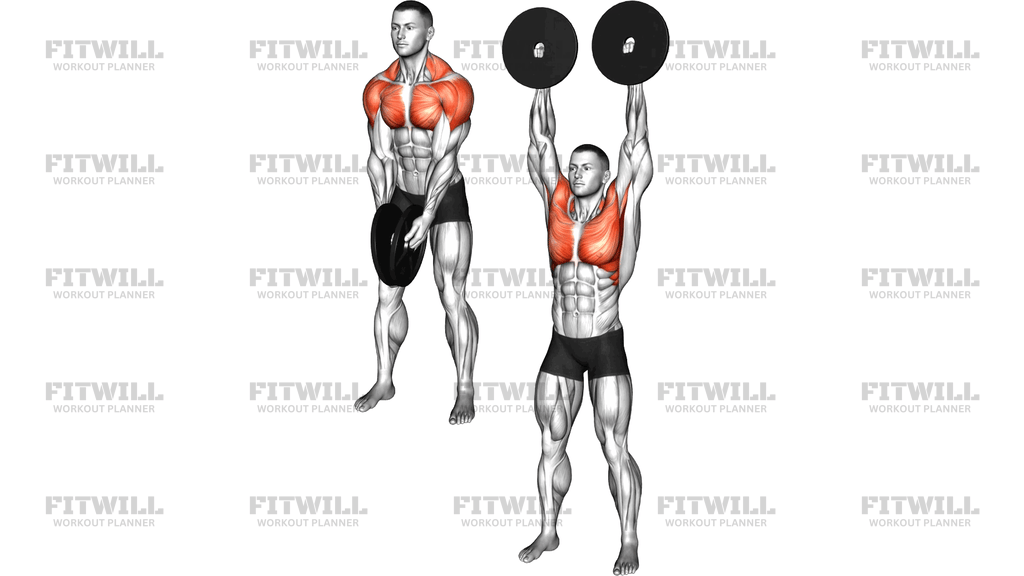
The Weighted Plate Lu Raise is a straight-arm front raise performed with a weight plate held between both hands, moving from in front of your thighs all the way to a locked-out overhead position. The name comes from the weightlifting community, where this style of straight-arm raise was popularized by Chinese weightlifters as a shoulder and scapular strength builder. Unlike a standard front raise that stops at shoulder height, the Lu Raise continues through the full arc until the plate is directly over your head, which forces your shoulders and upper back to work through a much longer range.
This movement is especially useful for lifters who want stronger overhead positioning: Olympic weightlifters, CrossFit athletes, and anyone who presses, snatches, or jerks will feel the carryover quickly. It also suits general strength trainees who want to develop the front delts and upper traps without loading a barbell. Because your arms stay straight the entire time, you cannot cheat with elbow drive or momentum from a curling motion — the shoulders and traps have to do the work.
The main muscles trained are the front shoulders, with strong involvement from the upper traps as the plate travels above head height and the shoulder blades rotate upward. The side shoulders, upper chest, and serratus anterior assist as stabilizers, and your grip and forearms work to keep the plate pinched securely between your palms. Your core stays engaged throughout to keep your ribs down and your torso from leaning back as the weight passes overhead.
Setup matters a lot here. Because you are holding a smooth-sided plate rather than a handle, your grip security depends on how well you sandwich the plate between your palms and fingers. Stand tall with feet about hip-width apart, hold the plate at arm's length in front of your thighs, and set your shoulders down and back before the first rep. A plate that slips mid-rep is the main safety risk, so start with a lighter plate than you think you need until your grip and timing are solid.
Execution is simple but demanding: raise the plate forward and up in a smooth arc with completely straight arms until it sits directly over your shoulders and hips, pause briefly, then lower it back along the same path under control. Avoid swinging, leaning back, or letting the plate drift away from your midline. Two to four sets of eight to fifteen reps works well, either as a shoulder finisher or as a warm-up activation drill before pressing work with a lighter plate.
If you have limited shoulder mobility or any history of shoulder impingement, work within a range that stays pain-free and stop short of full overhead if needed. The movement should feel like a steady, even pull through the shoulders — never a jerk, a heave, or a strain at the top.
[ Workout Log & Planner ]
Put your next workout in Fitwill
Keep your plan and training log ready when you are.


Instructions
- Stand upright with your feet about hip-width apart and a weight plate held vertically between both palms, fingers spread wide on each side of the plate.
- Let your arms hang straight down in front of your thighs, plate resting lightly against them, and pull your shoulders back and down to set a tall posture.
- Brace your core and squeeze your glutes slightly so your ribs stay down and your lower back does not arch.
- Inhale, then raise the plate forward and upward in a smooth arc, keeping your elbows completely locked and straight the entire way.
- Continue lifting until your arms are fully overhead and the plate is stacked directly over your shoulders and hips, with your biceps beside your ears.
- Pause for a beat at the top and actively reach the plate toward the ceiling to finish the shoulder blade rotation.
- Exhale as you lower the plate back down along the same arc in front of your body, resisting the weight on the way down.
- Stop when the plate touches or nearly touches your thighs, reset your posture, and begin the next rep without swinging.
Tips & Tricks
- The most common mistake is bending the elbows as the plate passes chest height — this turns the drill into a partial press and unloads the shoulders. If you cannot keep your arms locked, the plate is too heavy.
- Do not lean your torso back as the plate goes overhead. If you catch yourself leaning, brace your abs harder or reduce the weight; the lean is your body stealing range from your shoulders.
- Keep the plate close to your body on the way up. Letting it drift forward in a wide arc multiplies the leverage against your shoulders and strains the front of the joint.
- Grip the plate with your fingers spread as far around the edge as your hands allow. A fingertip-only pinch fails first, usually at the worst moment — at the top of the lift.
- Use a bumper plate or a rubber-coated plate if available. Steel or chrome plates are slippery, especially if your hands sweat.
- Your upper traps should feel heavily worked at the top. If you only feel it at the front of the shoulders below head height, you are probably stopping short of the full overhead finish.
- Chalk your hands or dry them before gripping the plate — the Lu Raise is as much a grip challenge as a shoulder one once the weight gets meaningful.
- Move slowly on the descent. The lowering half builds just as much strength and control as the raise, and dropping the plate quickly is where most slips happen.
- Start with a 5 kg plate or lighter even if your pressing numbers are strong. The straight-arm leverage makes the effective load much heavier than the plate's number suggests.
Frequently Asked Questions
Which muscles does the Weighted Plate Lu Raise work?
The front shoulders are the primary movers, with the upper traps taking over heavily as the plate travels overhead. The side shoulders, upper chest, serratus anterior, and forearms assist throughout the arc.
Why does the Weighted Plate Lu Raise use straight arms instead of a normal front raise?
Straight arms remove the elbows from the equation, so the shoulders and shoulder blades must move the load through the entire range with no help from pressing. This also makes the overhead portion, which a standard front raise never reaches, a large part of the work.
How heavy should the plate be for the Weighted Plate Lu Raise?
Choose a plate you can raise with completely locked elbows and no backward lean for all your reps. For most lifters this starts far below their pressing weight — a 5 kg or 10 kg plate is plenty to begin with.
Is the Weighted Plate Lu Raise safe for beginners?
Yes, provided you start light and keep your arms close to your body on the way up. The main risks are a slipping plate and overloading the shoulder at the top, both of which a conservative weight choice prevents.
Where should the plate start and finish on each rep?
Start with the plate held vertically in front of your thighs at arm's length, and finish with it locked out directly over your head, arms beside your ears. Lower it back to the thighs along the same path.
Why do my hands give out before my shoulders during the Weighted Plate Lu Raise?
Holding a smooth plate between your palms is a demanding pinch grip, and the forearms often fatigue first. Chalk your hands, spread your fingers wider around the plate edge, or drop to a lighter plate while your grip catches up.
Can I substitute a dumbbell or barbell for the plate in the Weighted Plate Lu Raise?
You can perform the same straight-arm arc with a light barbell or a single dumbbell held horizontally in both hands. The plate is unique because the smooth rim demands extra grip and control, which some lifters specifically want to keep.
What is the most common mistake in the Weighted Plate Lu Raise?
Bending the elbows or swinging the plate up with body English as it gets heavy. Both turn a precise shoulder exercise into a sloppy partial press — fix it by lowering the weight and rehearsing the strict, straight-arm path.
How should I program the Weighted Plate Lu Raise?
It works well as a finisher after pressing or pulling sessions, or as a pre-press activation drill with a light plate. Two to four sets of eight to fifteen controlled reps covers most goals.
Should I stop at shoulder height if the overhead position hurts?
Yes — work in a range that stays comfortable and pain-free, even if that means stopping short of full overhead for now. If discomfort persists at a given height, reduce the weight or consult a qualified professional before pushing deeper into the range.