Dumbbell Stiff Leg Deadlift
Dumbbell Stiff Leg Deadlift is a standing hip-hinge exercise built around a controlled stretch through the back of the legs. With the dumbbells held at your sides and the knees only slightly unlocked, the hips travel back while the torso inclines forward, making this a very direct way to train the hamstrings, glutes, and the muscles that keep the spine steady under load.
What makes Dumbbell Stiff Leg Deadlift useful is the way it teaches you to load the posterior chain without turning the movement into a squat or a rounded-back lift. The dumbbells stay close to the thighs and shins, the ribs stay stacked over the pelvis, and the spine stays long from the first inch of the descent to the last inch of the rise. That combination builds hinge strength, positional control, and a strong stretch position that carries over to deadlift variations, athletic acceleration, and general lower-body strength work.
The setup matters because the exercise is easy to turn into a back-bending motion if the feet, knees, and dumbbells are not organized. Stand about hip-width apart, keep a soft knee bend, and let the weight shift toward the midfoot and heels before you hinge. As you lower, push the hips straight back and let the dumbbells slide down the front of the legs instead of drifting forward away from the body.
At the bottom, only go as far as you can keep the hamstrings lengthening and the lower back neutral. For some lifters that means stopping below the knees; for others it will be closer to mid-shin. On the way up, drive the feet into the floor, bring the hips forward, and finish tall without leaning back or shrugging the shoulders.
Dumbbell Stiff Leg Deadlift works well as a strength accessory, a hamstring-focused builder, or a technique drill for learning clean hinging mechanics. It is also a smart choice for lifters who want posterior-chain work without the barbell setup. Keep the reps deliberate, lower under control, and use a load that lets every rep look the same rather than chasing range at the expense of position.
Fitwill
Log Workouts, Track Progress & Build Strength.
Achieve more with Fitwill: explore over 9600 exercises with images and videos, access built-in and custom workouts, perfect for both gym and home sessions, and see real results.
Start your journey. Download today!




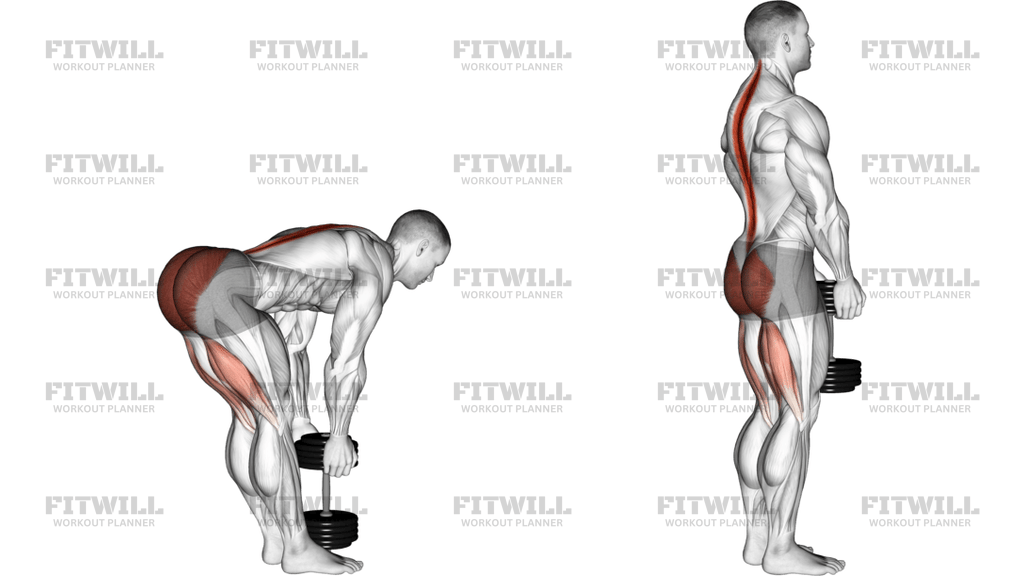
Instructions
- Stand with your feet about hip-width apart and hold a dumbbell in each hand at the front of your thighs, palms facing your body.
- Keep a slight bend in your knees, soften your shoulders, and brace your torso so your ribs stay stacked over your pelvis.
- Shift your weight into your midfoot and heels before you start the hinge.
- Push your hips straight back and let the dumbbells slide down the front of your thighs.
- Keep your shins almost vertical and your back long as your torso tips forward.
- Lower until you feel a strong stretch in the hamstrings without losing a neutral spine.
- Drive your feet into the floor, bring your hips forward, and stand up tall by squeezing your glutes.
- Finish with the dumbbells back at your thighs, then repeat for the planned reps with steady breathing.
Tips & Tricks
- Keep the dumbbells brushing your thighs and shins; if they drift forward, the lower back usually starts doing the work.
- Think "hips back" instead of "weights down" so the hinge stays loaded in the hamstrings.
- Do not turn the movement into a squat by letting the knees bend more as you descend.
- Stop the rep where your pelvis starts to tuck under or your low back begins to round.
- A slower lowering phase makes it easier to keep tension on the hamstrings and avoid bouncing out of the bottom.
- Keep your neck long and your gaze a few feet in front of you instead of cranking the head up.
- If your grip gives out before your hinge does, lighten the dumbbells or use straps for longer sets.
- Exhale as you stand and finish the rep by squeezing the glutes, not by leaning back.
Frequently Asked Questions
What muscle does Dumbbell Stiff Leg Deadlift target most?
It mainly trains the hamstrings and glutes, with the lower back, lats, and upper back working to keep the hinge stable.
Can beginners perform this exercise?
Yes. Beginners should start light and practice the hip hinge pattern first so they can keep the dumbbells close and the spine neutral.
How low should the dumbbells go in Dumbbell Stiff Leg Deadlift?
Lower only until you still feel the hamstrings lengthen and your back stays flat. For many people that is just below the knees or around mid-shin.
What is the biggest mistake to avoid in Dumbbell Stiff Leg Deadlift?
Letting the dumbbells drift away from the legs. That usually shifts stress into the lower back and makes the hinge harder to control.
Should my knees stay straight during Dumbbell Stiff Leg Deadlift?
Keep them softly unlocked, not locked out. A small knee bend protects the joints and helps you load the hamstrings without turning it into a squat.
Why do I feel Dumbbell Stiff Leg Deadlift in my lower back?
Usually the hips are not traveling back far enough or the dumbbells are getting too far in front of the body. Reset the hinge and keep the bells closer to your thighs and shins.
Is Dumbbell Stiff Leg Deadlift the same as a Romanian deadlift?
They are very close, but Dumbbell Stiff Leg Deadlift usually uses a straighter knee angle and a slightly deeper hamstring stretch. The key cue for both is a pure hip hinge.
Can I touch the dumbbells to the floor on this exercise?
Only if your hamstring mobility lets you do it without rounding your back. Stopping higher is better than chasing floor contact with a sloppy hinge.