Medicine Ball Overhead Slam Circle
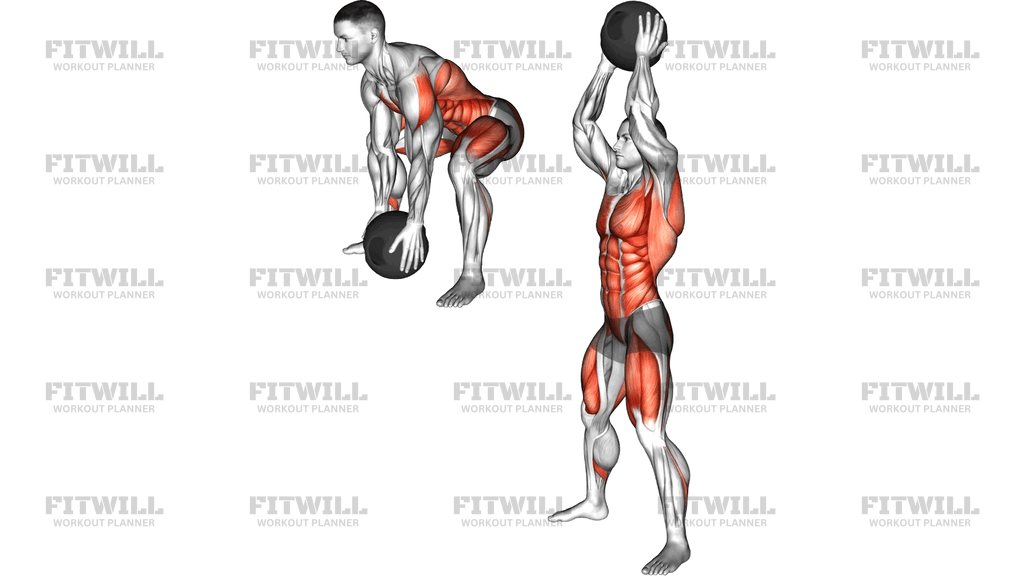
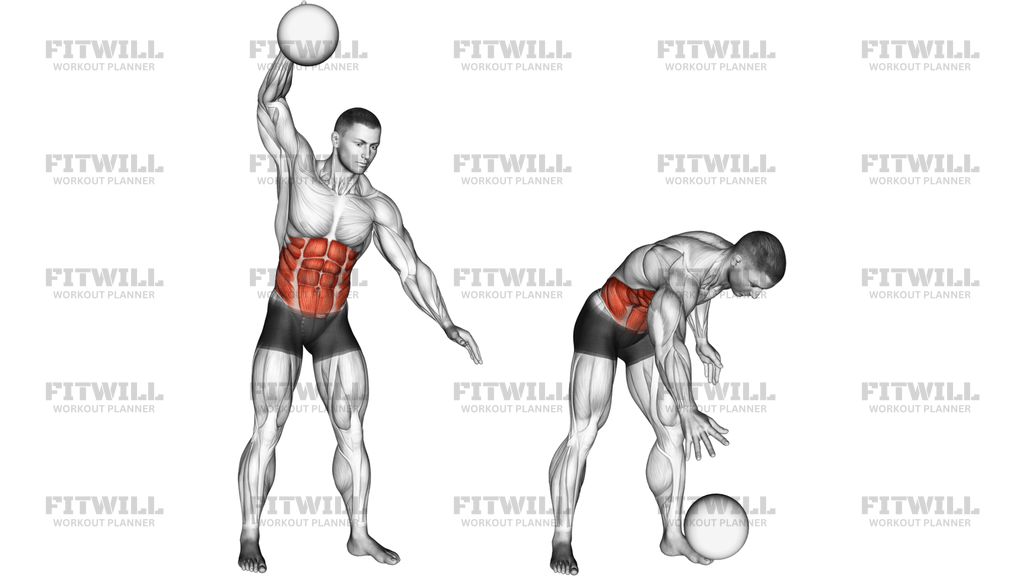
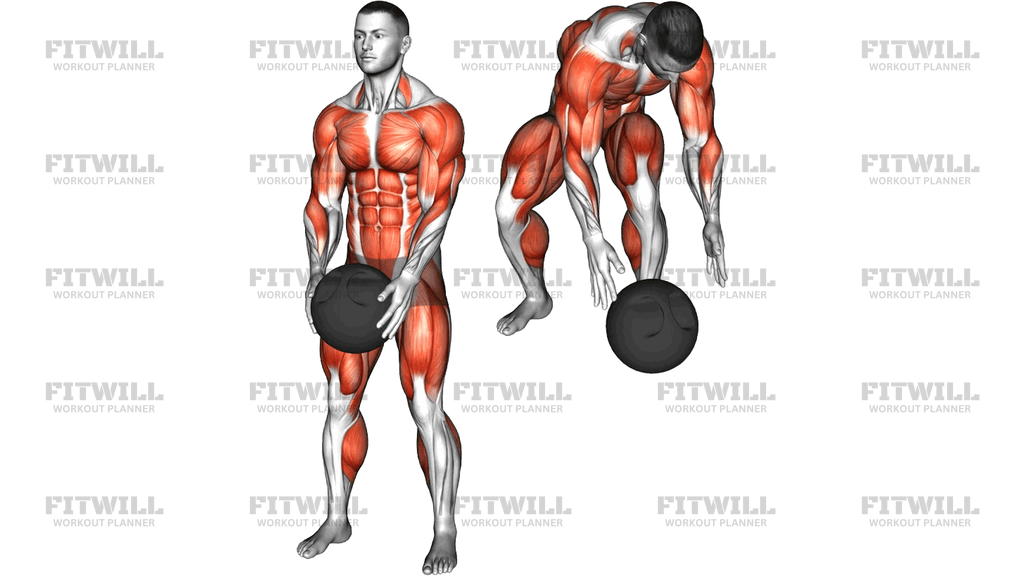
The Medicine Ball Overhead Slam Circle is an explosive, full-body power exercise where you raise a medicine ball overhead, slam it down in front of you with force, then guide the bounce or roll in a circular path before bringing the ball back overhead for the next repetition. Unlike a standard slam, the circular element keeps you moving and repositioning, which adds rotation, coordination, and footwork to an already demanding movement. The highlighted musculature in the demonstration reflects exactly where the work happens: the abdominals and obliques drive the flexion and force transfer, while the shoulders, lats, glutes, and quads all contribute to lifting, slamming, and absorbing the return.
This exercise is particularly useful for athletes and trainees who need to express power quickly through the trunk — think throwing, swinging, sprinting, or any sport that rewards fast hip and torso action. Because the slam terminates with impact rather than requiring deceleration of a heavy load, it lets you train at high intent with comparatively low joint stress, making it a smart addition to conditioning circuits, warm-up power blocks, or sport-specific training days.
Setup matters more than people expect. You need clear space around you in every direction, since the ball travels outward in a circle after impact, and the ball itself should be a non-bouncy slam ball style medicine ball or one that bounces predictably. A ball that rebounds wildly turns a controlled drill into a chase. Choose a weight you can accelerate hard without your lower back rounding — for most people that means something light enough to move fast, not heavy.
Execution comes from the whole chain, not the arms alone. You raise the ball overhead with tall posture, then slam it by hinging at the hips and snapping the ball downward with your entire trunk, letting your abs and lats pull the movement through. After the slam, steer the ball in a smooth circular path around your body, reset your stance, and lift it back overhead for the next rep. The return should be controlled rather than rushed, since that is when sloppy backs and lazy posture creep in.
Common use cases include metabolic conditioning circuits, power development before heavier lifting, and team sport training where rotational force and quick direction changes matter. It also works well as a low-skill finisher that spikes the heart rate without needing much equipment or space beyond a clear floor area.
For safety, keep the hinge pattern clean: the movement comes from the hips, not from rounding through the lower back. Brace your trunk before each slam, keep your neck neutral, and never slam a ball that could rebound into your face. If you feel the work shifting into your lower back instead of your abs, the ball is likely too heavy or your hip hinge has collapsed.
[ Workout Log & Planner ]
Put your next workout in Fitwill
Keep your plan and training log ready when you are.


Instructions
- Stand with your feet about hip-width apart, holding a medicine ball with both hands at chest height in an open area with several feet of clearance on all sides.
- Raise the ball straight overhead, extending your arms fully and standing tall with your ribs stacked over your hips and your shoulders down away from your ears.
- Brace your abdominal wall and take a breath in before the descent, setting your trunk to handle the impact.
- Hinge sharply at the hips and slam the ball down into the floor in front of your feet, driving the movement from your abs, lats, and shoulders rather than your arms alone.
- Let your torso follow the ball into a bent-over position as your arms extend down and through the slam.
- Guide the rebounding or rolling ball in a controlled circular path around your body, keeping your hands connected to it and your back flat as you reposition.
- Retrieve the ball and stand back up by driving through your heels and extending your hips, keeping your chest up as you rise.
- Exhale forcefully during the slam, then inhale as you recover the ball and return to standing.
- Bring the ball back overhead to the tall starting position, reset your brace, and begin the next repetition.
Tips & Tricks
- Choose a slam-appropriate ball — a heavily bouncy medicine ball will rocket back up and can hit you in the face after a hard slam.
- If your lower back rounds during the slam, hinge your hips back further and slow the descent slightly; the snap should come from the hips and trunk, not a collapsed spine.
- Aim to slam the ball slightly in front of your toes, not straight down at them, so the bounce travels forward and the circular path stays natural.
- Keep the circle tight and deliberate rather than letting the ball scatter — controlling the rebound is where much of the core and grip work happens.
- Exhale hard at the moment of impact; holding your breath through the slam commonly causes people to lose their brace mid-rep.
- If your shoulders fatigue before your abs, the ball is too heavy for overhead work — reduce the weight and prioritize speed of the slam.
- Stay on the balls of your feet through the slam and rise, but keep your heels available for balance rather than bouncing on your toes.
- Alternate the direction of the circle between sets so the rotational demand stays balanced across both sides of your trunk.
- Quality over tempo: three or four hard, well-braced slams per set beat ten fast, sloppy ones when the goal is power.
Frequently Asked Questions
Which muscles does the Medicine Ball Overhead Slam Circle work the most?
The abdominals, especially the rectus abdominis and obliques, do the bulk of the force production during the slam. The lats, shoulders, triceps, glutes, and quads all contribute to the overhead lift, the downward drive, and controlling the circular return.
Is the Medicine Ball Overhead Slam Circle suitable for beginners?
Yes, provided a light ball is used and the hip hinge is practiced first. Beginners should focus on a clean hinge and slam before adding the circular recovery, since controlling the bounce takes some coordination.
How heavy should the medicine ball be for overhead slams?
Pick a weight you can accelerate hard and control on the rebound, typically between 4 and 10 pounds for most people. If the ball slows your slam down or forces your lower back to round, it is too heavy.
What is the most common mistake in the Medicine Ball Overhead Slam Circle?
Rounding the lower back during the slam instead of hinging at the hips. This shifts stress away from the abs and onto the spine, so keep your chest long and let your hips drive the movement.
Why does the exercise include a circular path after the slam?
The circle forces you to reposition, control the rebound, and reintegrate rotation and footwork before the next slam. It turns a simple slam into a more dynamic, sport-like drill that also trains grip and trunk control.
Can I substitute the Medicine Ball Overhead Slam Circle if I don't have a medicine ball?
A dedicated slam ball, a sand-filled ball, or a dead ball all work well. Avoid firm, highly elastic basketballs, since their unpredictable rebound makes the overhead slam and circular recovery unsafe.
How should I breathe during this exercise?
Inhale as you raise the ball and brace, then exhale forcefully at the moment of impact. Inhale again while you control the ball through the circle and stand back up.
How many repetitions and sets should I perform?
For power, do 3 to 5 sets of 4 to 6 hard slams with full recovery between sets. For conditioning, use a lighter ball and 20 to 30 seconds of continuous work, keeping the slam quality high throughout.
Do I need a partner or special flooring for the Medicine Ball Overhead Slam Circle?
No partner is needed, but a forgiving surface such as rubber gym flooring or grass is preferable to concrete, both for the ball's lifespan and to reduce noise. Make sure you have clear space in every direction for the circular path.
Is it safe to slam the ball overhead if I have shoulder discomfort?
If the overhead reach or the deceleration of the slam provokes discomfort, reduce the weight and range, or substitute a chest-height rotational slam until overhead motion feels comfortable. Persistent shoulder pain should be assessed before continuing.