Dumbbell Front Hand To Hand Single Leg Balance
Dumbbell Front Hand To Hand Single Leg Balance is a standing balance drill that combines a single-leg stance with a simple hand-off of a dumbbell from one hand to the other in front of your body. It looks almost too simple on paper: stand on one leg, hold a dumbbell in one hand, pass it across to the other hand in front of your hips, and keep standing tall without wobbling, touching the free foot down, or letting the weight pull you around. In practice, that small weight transfer creates a constant, shifting load that forces your trunk and the standing leg to correct and re-correct in real time.
The main demand falls on your deep core and abdominal wall, which have to resist rotation and side-bending every time the dumbbell changes hands. Because you are on one foot, your ankle stabilizers, calves, glute of the standing leg, and the small muscles of the foot all work to keep your base quiet and level. The forearm and grip muscles also stay busy simply holding and controlling the weight as it crosses the midline.
Setup matters more than it seems. A light to moderate dumbbell is usually enough, because the goal is not load but instability. Standing on a flat, non-slip surface with the free foot tucked behind the ankle or lifted in front, and holding the dumbbell at thigh height near the midline, puts you in a position where the hand-off challenges your balance without throwing you off. Holding the weight too far from your body multiplies the leverage against your core, which is exactly where the drill earns its difficulty.
To execute it well, brace your abs, fix your gaze on a still point at eye level, and pass the dumbbell smoothly from hand to hand in front of your thighs and hips. Keep your shoulders down, chest up, and hips square to the front. Each hand-off should be deliberate, with a brief pause to re-settle before the next one. Moving the weight slowly and close to the body makes the drill cleaner and harder to cheat; swinging it fast or wide just turns it into a hip-hinging wobble.
This movement fits well as a core finisher, a warm-up activation drill, or part of a balance and stability block for older adults, runners, and field-sport athletes who need single-leg control. It is also a practical way to train balance under load without a dedicated balance tool.
For safety, start lighter than you think you need, keep a wall or rack within reach if you are new to single-leg work, and switch legs before your standing foot starts to cramp or your ankle fatigues. If your form breaks down into hopping or hip-dropping, set the dumbbell down, reset, and continue with body weight only.
[ Workout Log & Planner ]
Put your next workout in Fitwill
Keep your plan and training log ready when you are.


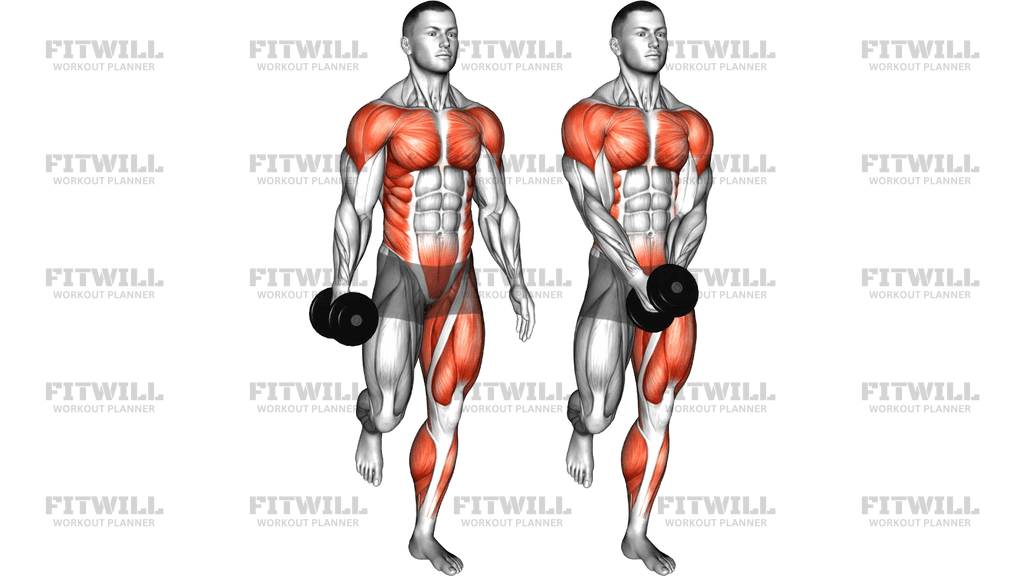
Instructions
- Stand tall with a dumbbell held in one hand at your side, arm extended down in front of your thigh, and your feet hip-width apart.
- Shift your weight onto one leg, lift the opposite foot off the floor, and either tuck it behind your standing ankle or raise the knee slightly in front of you.
- Find a fixed point at eye level to stare at, then brace your abdominal wall and squeeze the glute of the standing leg.
- Keep your hips square to the front and your shoulders level; do not let the loaded side of your body lean or drop.
- Draw the dumbbell across the front of your body toward the midline, staying close to your thighs and hips.
- At the midline, transfer the dumbbell from the working hand to the free hand with a smooth, controlled grip change.
- Carry the weight back out to the other side of your body, pausing briefly each time the hand-off completes.
- Continue passing the dumbbell hand to hand for the desired number of repetitions while keeping the free foot off the floor.
- Breathe steadily throughout, exhaling softly on each hand-off rather than holding your breath.
- Finish the set, lower the free foot to the floor, reset your stance, and repeat on the other leg.
Tips & Tricks
- Start with a light dumbbell, around 2 to 5 kg, because the shifting load in front of the midline is far more destabilizing than the number on the dumbbell suggests.
- If you lean your torso away from the weight during the hand-off, that is a sign the load is too heavy or you are moving it too far from your body; pull the arc closer to your thighs.
- Watch for the standing foot rolling to the outside edge, a common escape pattern; press through the big toe, heel, and ball of the foot evenly.
- Do not let the free foot hover near the floor as a backup plan. Lift the knee slightly or tuck the foot behind the ankle so you commit to the single-leg stance.
- Keep your gaze on a fixed point instead of following the dumbbell with your eyes; tracking the weight across the midline tends to increase wobbling.
- Slow hand-offs with a one-second pause at the midline build more control than rapid passes, which mostly train momentum.
- If your standing calf or ankle burns out before your core does, switch legs sooner and build ankle endurance gradually across weeks.
- Practice near a wall or squat rack at first so a light fingertip touch is available if you genuinely lose balance, rather than stumbling to catch yourself.
- Swap the direction of the pass occasionally, from outside to inside versus inside to outside, so both sides of the trunk work evenly.
Frequently Asked Questions
What muscles does Dumbbell Front Hand To Hand Single Leg Balance work?
The primary work comes from the deep core and abdominal wall, which resist rotation as the dumbbell crosses the midline. The ankle stabilizers, calves, and glute of the standing leg handle balance, while the forearms and grip hold and transfer the weight.
How heavy should the dumbbell be for this exercise?
Start with a light dumbbell, roughly 2 to 5 kg, since the challenge comes from the shifting load rather than the resistance. If you wobble heavily or lean away on each hand-off, the weight is too heavy.
Can beginners do Dumbbell Front Hand To Hand Single Leg Balance?
Yes, beginners can do it, but it is smart to master the single-leg stance without weight first. Once you can hold a quiet one-legged stand for 30 seconds, add a very light dumbbell and keep the hand-off path close to your body.
Why do I lose balance every time I pass the dumbbell to the other hand?
The weight crossing the midline shifts your center of mass sideways, and your core has to counter that pull instantly. Slow the pass down, keep it tight to your thighs, brace your abs harder, and pick a fixed point at eye level to stare at.
Should my free leg be in front or behind me?
Either position works; tucking the free foot behind the standing ankle makes the drill slightly easier, while raising the knee in front increases the demand. Choose the version that lets you keep your hips square and your standing foot flat.
Can I substitute another piece of equipment for the dumbbell?
A small kettlebell, a medicine ball, or even a water bottle works as a substitute as long as the object has enough weight to create a noticeable load shift. Avoid anything bulky that forces the weight far from your body during the pass.
How many hand-offs should I do per set?
Aim for 8 to 12 controlled hand-offs per leg, which usually takes 20 to 40 seconds. Stop the set when your standing foot starts rolling or hopping, not when your grip fails.
Is it normal for my standing ankle to feel tired during this exercise?
Yes, mild fatigue in the ankle and calf is expected because those structures stabilize your base the whole time. Sharp pain, repeated ankle rolling, or cramping means you should stop, come off one leg, and progress more gradually.
Where does this exercise fit into a workout?
It works well as a warm-up drill to wake up the core and single-leg stabilizers, or as a core finisher after heavier strength work. Because the load is light, it should not replace your main resistance training movements.
Can I do Dumbbell Front Hand To Hand Single Leg Balance on an unstable surface?
You can progress to a balance pad or soft surface once the floor version feels easy, but do it without the dumbbell first. Adding a hand-off on an unstable surface at the same time usually creates more wobble than control, which reduces the training quality.