Dumbbell Plank Jack
The Dumbbell Plank Jack is a dynamic core exercise performed from a high plank position with your hands gripping a pair of dumbbells on the floor. From that anchored position, you hop your feet out wide and back together again, like a jumping jack with your lower body while your upper body stays fixed. The dumbbells serve two purposes: they raise your hands slightly off the floor, which gives your wrists a more neutral position, and they add a small stability demand because the handles can shift if your plank isn't solid.
This movement trains the deep core and abs in an anti-extension role, meaning your main job is to keep your trunk rigid while your legs move quickly. Your shoulders, chest, and triceps work isometrically to hold the plank, and your glutes and hip stabilizers fire every time your feet land wide and pull back in. Compared with a standard bodyweight plank jack, the dumbbell version asks a little more from your shoulder girdle and grip, which is why it tends to show up in intermediate conditioning circuits rather than beginner ab routines.
Setup matters more here than in most core work. Because your hands are loaded onto dumbbells, a poorly chosen pair will roll or slide, and a plank with sagging hips becomes a lower back problem the moment you start jumping. Place the dumbbells roughly shoulder-width apart on a non-slip surface, keep them stable and parallel, and build your plank on top of them before any foot movement starts. A straight line from head through hips to heels is the position you protect for every rep.
To execute well, think of your torso as one solid piece. Brace your abs, squeeze your glutes lightly, and push the dumbbells into the floor so your upper back stays active rather than collapsed. The hop should come from your legs and hips, not from a bouncing torso, and your hips should rise and fall as little as possible. Land softly with feet wide, then jump them back to the narrow starting position at the same controlled pace.
The Dumbbell Plank Jack fits well as a finisher after strength work, as a station in a metabolic circuit, or as a progression once bodyweight plank jacks feel easy. Start with short sets of ten to twenty jumps, and stop the set the moment your hips drop or your lower back starts to arch. Quality of the plank matters far more than the number of hops, and a slower, quieter landing always beats a fast, noisy one.
[ Workout Log & Planner ]
Put your next workout in Fitwill
Keep your plan and training log ready when you are.


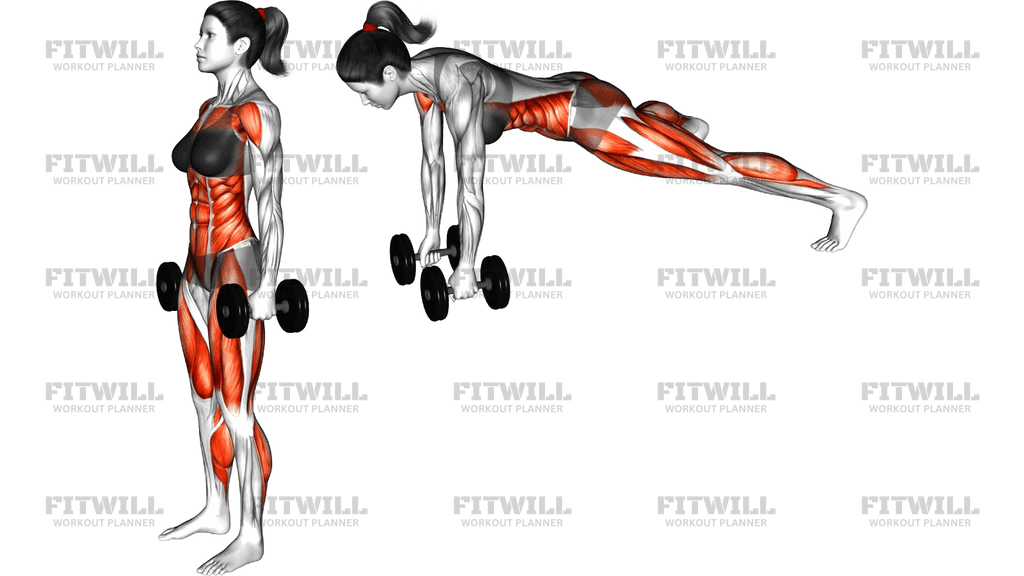
Instructions
- Place a pair of hex dumbbells on the floor about shoulder-width apart, parallel to each other, on a non-slip mat or surface.
- Grip the dumbbell handles with a firm neutral grip and walk your feet back until your body forms a high plank, shoulders stacked directly over the dumbbells.
- Set your feet together and check your line: head neutral, flat back, hips level with your shoulders and heels, not sagging or piked.
- Brace your abs as if bracing for a light punch, squeeze your glutes, and push the dumbbells down into the floor to engage your upper back.
- With a small, controlled hop, jump both feet out wide to the sides at the same time, landing softly on the balls of your feet.
- Immediately jump your feet back together to return to the narrow plank position, keeping your hips at the same height throughout.
- Breathe in a steady rhythm, exhaling sharply on each jump out and inhaling as the feet come back in, without letting the brace loosen.
- Continue for your target number of reps or time, keeping the movement quiet and the torso still.
- To finish, stop with feet together, then carefully step or walk your feet toward your hands and stand up, or lower your knees to rest.
Tips & Tricks
- Use hex-shaped dumbbells rather than round ones; round heads can roll under your weight and slip your hand off mid-set.
- If your hips start dropping toward the floor, that is the first sign of fatigue in this exercise, not something to push through, because the jump then loads your lower back.
- Keep the hop small. Feet only need to clear enough to land wide; big jumps make your hips bounce and turn a core drill into a sloppy cardio move.
- Spread your fingers around the dumbbell handles and press down hard, which stabilizes your shoulders and stops the handles from tipping inward.
- If the wide landing causes your hips to rotate or one foot to land ahead of the other, slow the tempo down and jump half-speed until both feet move symmetrically.
- Watch that your shoulders stay over the dumbbells, not behind them; drift back into a downward-sloping push-up position makes the plank much harder on the shoulders and shorter on the abs.
- Do this exercise on a mat or rubber floor. Hard tile makes the dumbbells slide and turns every landing into a joint-rattling affair.
- If your wrists ache on the handles, try a slightly thicker dumbbell or wrap the handles, since a fat grip spreads pressure over more of the palm.
- Your breath should match the hops, not the other way around. If you find yourself holding your breath for five or six jumps, drop the pace and re-establish the rhythm.
Frequently Asked Questions
What muscles does the Dumbbell Plank Jack work?
It primarily targets the deep core and abs, which brace to stop your hips from sagging while your legs jump. Your shoulders, chest, and triceps hold the plank, and your glutes and hip stabilizers control each wide landing.
Why use dumbbells for Plank Jacks instead of doing them on flat hands?
The dumbbells put your wrists in a straighter, more neutral position, which many people find more comfortable than a flat palm on the floor. They also add a light stability challenge because the handles can tip if your plank gets loose.
Are Dumbbell Plank Jacks suitable for beginners?
They are better saved for after you can hold a solid high plank for 30 to 45 seconds and perform quiet bodyweight plank jacks. Beginners should master the static plank first, then add the jump, then add the dumbbells.
How heavy should the dumbbells be?
Weight is not the point here; stability is. Choose light dumbbells with flat hexagonal heads, usually in the 5 to 15 pound range, so your focus stays on the plank rather than on wrestling the handles.
My hips sag and my lower back aches after a few jumps. What should I fix?
That is a brace and fatigue issue. Squeeze your glutes before the first jump, shorten the set, and slow the tempo. If the sag continues even at a slow pace, drop back to bodyweight plank jacks or a static plank until your endurance improves.
Can I substitute Dumbbell Plank Jacks if jumping is uncomfortable?
Yes. Step your feet out wide one at a time and step them back, keeping everything else identical. This step-out version keeps the core and shoulder demand while removing the landing impact.
Should my shoulders stay directly over the dumbbells during the movement?
Yes, your shoulders should remain stacked over your hands for the entire set. If your hips rise or your shoulders drift back, the plank angle changes and the exercise shifts away from the abs.
How many reps should I do?
Start with sets of 10 to 20 hops or 20 to 30 seconds, resting until your plank form is back to full quality. Because it is often used as a conditioner, work by time or clean reps rather than chasing a maximum set.
Is it safe to do this exercise on a hard floor?
A hard, slippery floor is a poor choice because the dumbbells can slide and every landing sends more shock through your wrists and knees. Use a rubber mat or carpeted area, and check that the dumbbells cannot roll before you start.
Where does the Dumbbell Plank Jack fit into a workout?
It works best as a mid-circuit core station or a finisher after your main lifts, when you want a short, intense core and conditioning block. Placing it before heavy pressing is not ideal, since it pre-fatigues the shoulders you need for stability.