Dumbbell Kneeling Around Head Rotation
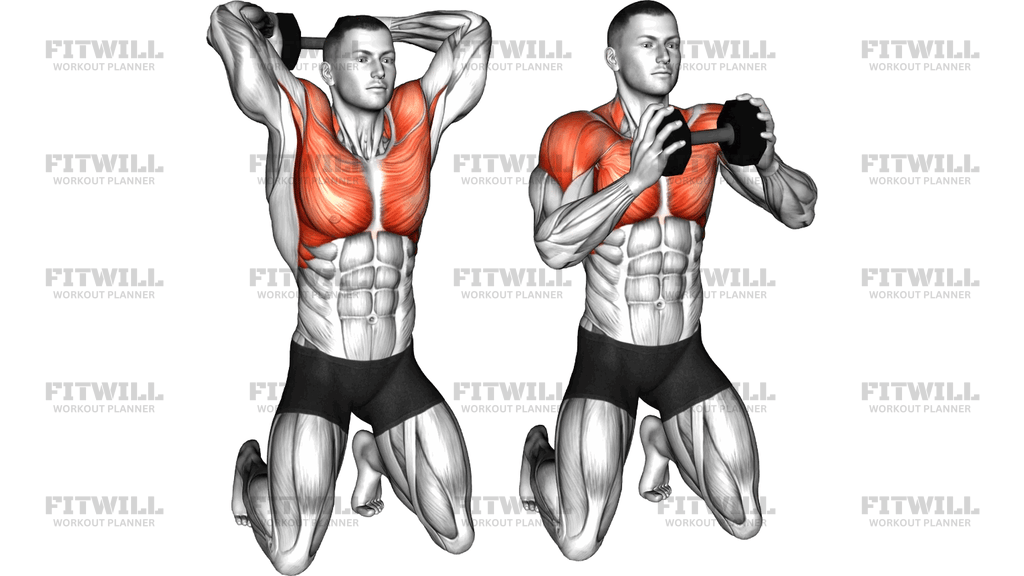
The Dumbbell Kneeling Around Head Rotation is a controlled mobility and stability drill in which you kneel upright, hold a single dumbbell with both hands at chest height, and trace a smooth circular path around your head, passing the weight behind the skull and over the top before bringing it back down to the front. It is closely related to the classic halo, but the added load of the dumbbell and the kneeling base change the demands: your shoulders have to move the weight through a full overhead arc while your trunk works to stay tall and still.
This movement is especially useful for people who press overhead, throw, swim, or spend long hours at a desk with rounded shoulders. The circular path takes the shoulder through external rotation, flexion, and extension in one continuous motion, which makes it a practical warm-up before pressing days and a useful accessory for maintaining comfortable overhead range of motion. Because you are kneeling rather than standing, there is no help from hip drive or leg swing, so the shoulders and upper back do the actual work.
The kneeling position is not just there to make it harder. With your knees on the floor and your torso stacked over your hips, it becomes obvious the moment you start leaning, arching, or twisting to cheat the weight around your head. That feedback is one of the main coaching benefits of the exercise: the weight can only travel around the head cleanly if the shoulder actually moves through its range instead of the spine substituting for it.
The muscles doing most of the visible work are the deltoids of each shoulder, supported by the rotator cuff as it steers the humerus through the arc. The chest assists as the arms travel in front of the face, the triceps help lock the elbows out on the upper portion, and the upper traps and upper back stabilize the shoulder blades throughout. Meanwhile, the deep core and obliques hold the kneeling torso square, which is why many people feel this drill in their midsection more than expected.
Choose a light dumbbell to start, often somewhere between 2.5 and 7.5 kilograms depending on your training history, and prioritize a smooth, unhurried circle over weight. The drill loses its point the moment the load forces you to shrug, lean, or shorten the arc. Treat it as quality of motion work: a couple of circles in each direction per set, controlled from start to finish, will do more for your shoulders than rushing through heavy reps.
As with any loaded movement around the head and neck, keep the path close but never touching, and stop if you feel pinching at the shoulder or strain in the neck. If overhead positions are uncomfortable, reduce the range by keeping the circle slightly lower and wider until your mobility improves.
[ Workout Log & Planner ]
Put your next workout in Fitwill
Keep your plan and training log ready when you are.


Instructions
- Kneel on the floor with your knees about hip-width apart, the tops of your feet on the ground, and your torso upright so your shoulders sit directly over your hips.
- Hold one dumbbell horizontally with both hands, palms wrapping the handle from opposite sides, and bring it to the center of your chest with your elbows bent and tucked near your ribs.
- Brace your abdominal muscles and squeeze your glutes slightly to lock your pelvis and ribcage into a tall, neutral position before you start moving.
- Begin the circle by raising the dumbbell up and across the front of your face, keeping both elbows bending and extending as the weight travels.
- Guide the dumbbell around the side of your head, past your ear, and behind the back of your skull with your arms extended, letting the elbows flare outward naturally.
- Continue the arc over the top and down the opposite side of your head until the dumbbell returns to the starting point at your chest, completing one full circle.
- Reverse direction and rotate the dumbbell back around the head the other way if your set calls for circles in both directions, keeping the same controlled tempo.
- Exhale steadily as the weight travels overhead behind the head, and inhale as it comes back down toward your chest.
- Keep your head still and eyes forward the entire time; the dumbbell moves around the head, not the head around the dumbbell.
- Finish the set by lowering the dumbbell to the floor beside your knee before you stand or rest, resetting your brace before the next set.
Tips & Tricks
- The most common mistake is craning the chin forward or tilting the head to help the dumbbell clear behind the skull. Keep your gaze fixed on a point ahead of you and let the elbows widen instead.
- If the weight drifts away from your head mid-circle, the dumbbell is probably too heavy. A lighter bell lets you keep the path tight, which is what actually trains the shoulder through its full range.
- Watch for the ribcage flaring and lower back arching as the dumbbell passes overhead. Squeeze your glutes and exhale on the way back to keep your torso stacked over your hips.
- Do not let one arm do more work than the other. Both hands should share the load evenly through the whole circle; an uneven grip or lopsided path usually shows up as the weight swinging to one side.
- Kneeling on a mat or padded surface makes it much easier to focus on your shoulders instead of uncomfortable knees, especially on hard floors.
- Speed is the enemy here. If the dumbbell is moving fast enough to build momentum, your shoulders stop steering it and the exercise turns into a swing.
- Keep the elbows from dropping as the weight goes behind the head. Collapsed elbows shorten the arc and turn the movement into a small, low circle that skips the overhead range.
- Start with two or three circles in each direction rather than one direction only, so both shoulders get balanced work through the rotation.
- If you feel a pinch at the front of the shoulder as the weight passes ear height, make the circle slightly wider and lower for a few sessions before trying to tighten the path again.
Frequently Asked Questions
What muscles does the Dumbbell Kneeling Around Head Rotation work?
The deltoids of the shoulders do most of the work, with the rotator cuff guiding the joint through the circular path. The chest, triceps, and traps assist, and the core stabilizes your upright kneeling torso.
Why is this done kneeling instead of standing?
Kneeling removes the ability to lean or swing from the hips, so any cheating shows up immediately as torso movement. It also lowers the base of support slightly, making the shoulders and trunk work harder to stay controlled.
How heavy should the dumbbell be for this exercise?
Start light, roughly 2.5 to 7.5 kilograms, and only increase when you can complete full circles without leaning, shrugging, or dropping the arc. This is a control exercise, not a strength-maxing lift.
Should I rotate in both directions during a set?
Yes, doing equal circles clockwise and counterclockwise keeps both shoulders working symmetrically through the same path. Many people alternate direction each rep or complete equal sets each way.
Is the Dumbbell Kneeling Around Head Rotation safe for the shoulder?
For healthy shoulders with a light weight and a smooth tempo, it is generally a low-risk drill. If you have a current shoulder injury or feel pinching during the arc, reduce the range or clear the movement with a professional first.
Can beginners do this movement?
Yes, it is actually a good beginner drill because the light load and slow path teach shoulder control right away. Beginners should focus purely on keeping the torso tall and the circle smooth rather than adding weight.
What is the most common mistake with this exercise?
Moving the head and neck to help the dumbbell clear behind the skull. The head should stay still and forward-facing while the arms and shoulders carry the weight around it.
What can I use if I do not have a dumbbell?
A small kettlebell held by the horns, a light plate gripped on both sides, or even just body weight with the same circling arm path all work. The key is keeping the load light enough to control through the full arc.
When should I include this in my workout?
It works well as a warm-up before overhead pressing, benching, or pulling sessions, or as a light finisher for shoulder control. Avoid going heavy with it right before a max-effort press.