Burpee Single Leg Jump
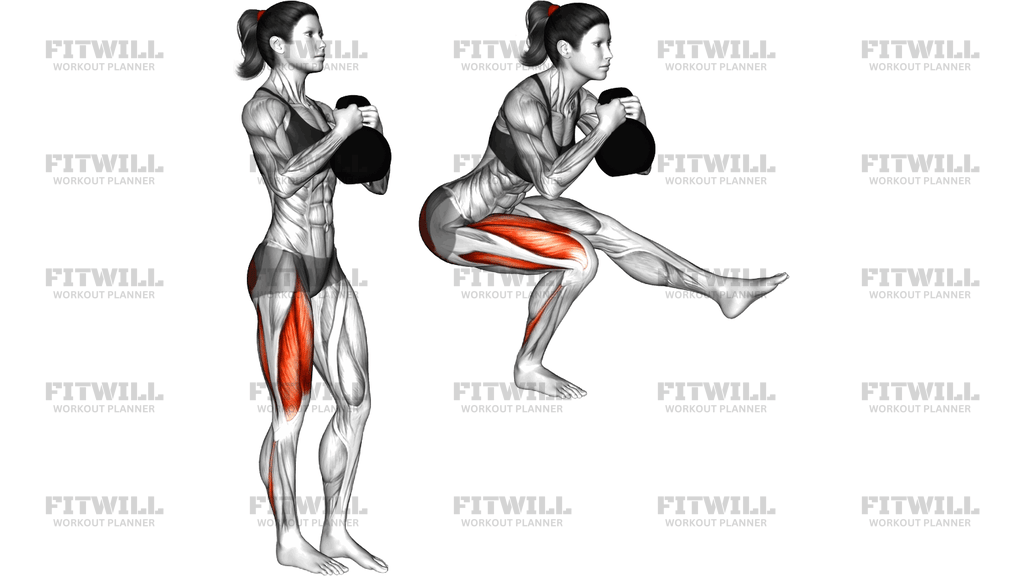
The Burpee Single Leg Jump is a demanding full-body conditioning movement that combines the standard burpee pattern with a one-legged vertical jump at the top. You flow from standing on one foot, down to the floor, through a plank position, and back up to an explosive jump on the same leg. Removing one leg from the jump makes every phase harder: the single-leg squat down, the stability work in the plank, and the balance and drive needed to leave the ground on one foot.
This exercise is best suited to people who already own the regular burpee and can perform a controlled bodyweight single-leg squat. It shows up in conditioning circuits, martial arts and combat sport preparation, and athletic training programs where unilateral power and repeated deceleration matter. Because one leg does all the absorbing and all the driving, it doubles as a tool for exposing and fixing left-right strength differences.
The main work comes from the quads, glutes, and hamstrings, which handle the descent and the jump, while the calves fire hard at takeoff and landing. The chest, shoulders, and triceps support you through the plank and push-up portion, and the core has to work overtime to keep your hips from twisting while one leg bears the load. Your heart rate climbs faster than in a standard burpee because the single-leg jump demands more force in less time.
Setup matters more here than in a normal burpee. Your hands need to land far enough forward that you can step or hop back into a full plank without piking your hips, and your standing foot needs to stay planted close to your hands so the return to standing doesn't turn into a scramble. Practice the transition on both sides at a slow tempo before adding the jump.
To execute it well, keep your weight mid-foot on the working leg, hinge and squat down with control, and place your hands shoulder-width on the floor. Shift your weight onto your hands, extend the working leg back to the plank, hold a solid push-up position, then reverse the path, gather your balance, and jump straight up off one leg, landing softly on the same foot.
The most common error is rushing the landing from the jump. Single-leg landings place a large load on the knee and ankle, so aim to land quietly with the knee tracking over the toes and the hip pushed slightly back. Alternate legs between reps or complete all reps on one side first — both work, but alternating usually keeps balance more consistent as fatigue builds.
[ Workout Log & Planner ]
Put your next workout in Fitwill
Keep your plan and training log ready when you are.


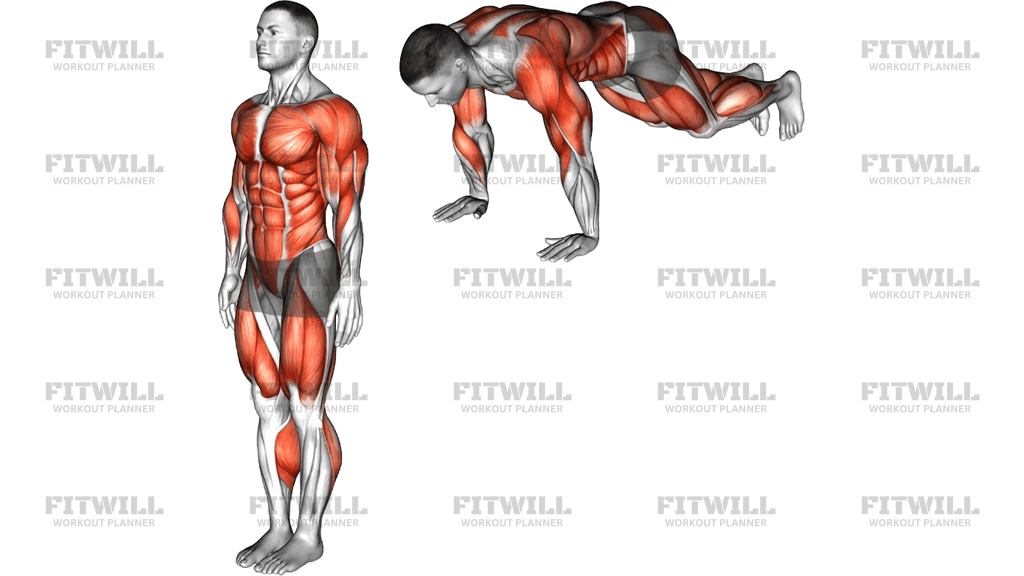
Instructions
- Stand tall on your right foot with your left leg bent slightly behind you and held off the floor, arms relaxed at your sides.
- Shift your weight into your right foot, then hinge at the hips and squat down, reaching both hands to the floor about shoulder-width apart in front of your foot.
- Shift your weight onto your hands, then extend your right leg back so you land in a plank position with your body in one straight line from head to heel.
- Keep your left leg hovering off the floor and your hips level with your shoulders so you don't twist or sag toward one side.
- Optionally perform one push-up here, lowering your chest to just above the floor with your elbows at about 45 degrees to your torso.
- Drive your right knee forward toward your chest and place your foot flat on the floor just behind your hands.
- Rise into a quarter squat on the right leg, swinging your arms back, then jump vertically off the right foot, driving the arms overhead.
- Land on the right foot with a soft knee and hip, absorbing the landing quietly, then reset your balance before the next rep.
- Exhale as you jump, inhale on the way down to the floor, and breathe steadily through the plank and push-up.
- Complete your reps on the right leg, then switch to standing on the left foot and repeat the same pattern.
Tips & Tricks
- Place your hands slightly wider than you would in a regular burpee — the wider base helps counterbalance the wobble of standing and jumping on one leg.
- If you lose your balance during the jump, cut the height in half before cutting reps; a low, controlled hop on one leg builds the landing skill you need.
- Watch that the hip on your lifted leg doesn't rotate upward in the plank — keep both hips square to the floor so the core does the stabilizing work.
- A common mistake is letting the knee cave inward on the single-leg landing. Cue yourself to push the knee out over your second toe every time you land.
- Keep your standing foot flat and fully loaded before descending to the floor — tipping onto the ball of the foot on the way down is what causes stumbles.
- If the full version is too hard, keep a hand or fingertip on the floor as you jump, or perform the burpee on one leg but jump off both feet until your balance catches up.
- On soft surfaces like grass or a gym mat, the landings are quieter and kinder to your joints than on concrete, especially at higher rep counts.
- Rest enough between sets to keep your form sharp — sloppy single-leg landings late in a set are where most form breakdowns happen.
- Alternate which leg you start with each session so one side doesn't always get the freshest, highest-quality reps.
Frequently Asked Questions
Which muscles does the Burpee Single Leg Jump work the most?
The quads, glutes, and hamstrings do the heavy lifting during the descent and the single-leg jump, with the calves driving takeoff. The chest, shoulders, and triceps support the plank and push-up phase, and the core stabilizes throughout.
Is the Burpee Single Leg Jump suitable for beginners?
It's best treated as a progression. Beginners should first be comfortable with standard burpees and controlled single-leg squats, then try the single-leg version with a small hop or no jump before attempting full-height jumps.
Should I do all reps on one leg or alternate legs?
Both approaches work. Alternating each rep keeps balance and fatigue more even, while completing a set on one side first highlights and challenges any left-right strength difference.
Why do I keep losing my balance on the single-leg jump?
The usual culprits are jumping before you've fully gathered your balance, letting the knee collapse inward, and landing stiffly. Pause for a beat in the quarter squat before jumping and focus on a quiet, bent-knee landing.
Do I need to include a push-up in the Burpee Single Leg Jump?
The defining feature is the single-leg jump, so the push-up is optional. Including it increases upper-body involvement, while leaving it out lets you focus on leg power and conditioning.
What can I substitute if the single-leg jump is too hard on my knees?
Perform the burpee on one leg but jump off both feet, or replace the jump with a strong single-leg calf rise to a full stand. Both keep the unilateral pattern while reducing landing force.
How does the Burpee Single Leg Jump differ from a regular burpee?
One leg stays off the floor through the entire movement, so the squat down, the plank, and especially the final jump all happen unilaterally. This raises the balance and single-leg strength demands considerably.
How many reps should I aim for?
Start with 5-8 reps per leg for 2-3 rounds and adjust from there. Because the landing quality drops quickly with fatigue, it's better to stop a set while your landings are still controlled.
Is the Burpee Single Leg Jump safe for daily training?
The repeated single-leg landings are demanding on the knees and ankles, so most people benefit from a recovery day between high-volume sessions. Listen for persistent soreness and reduce volume or jump height if it lingers.