Bodyweight Step Down
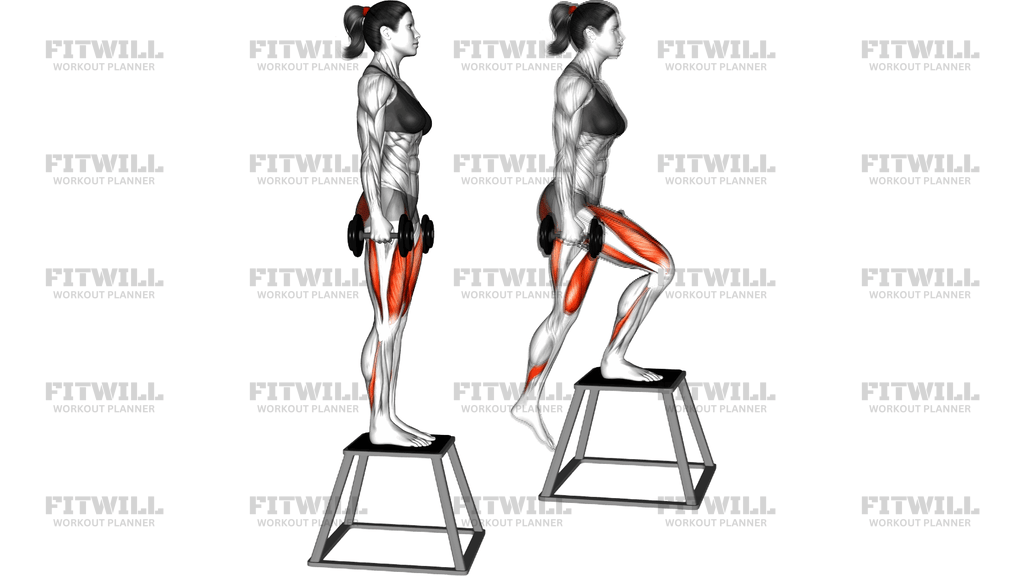
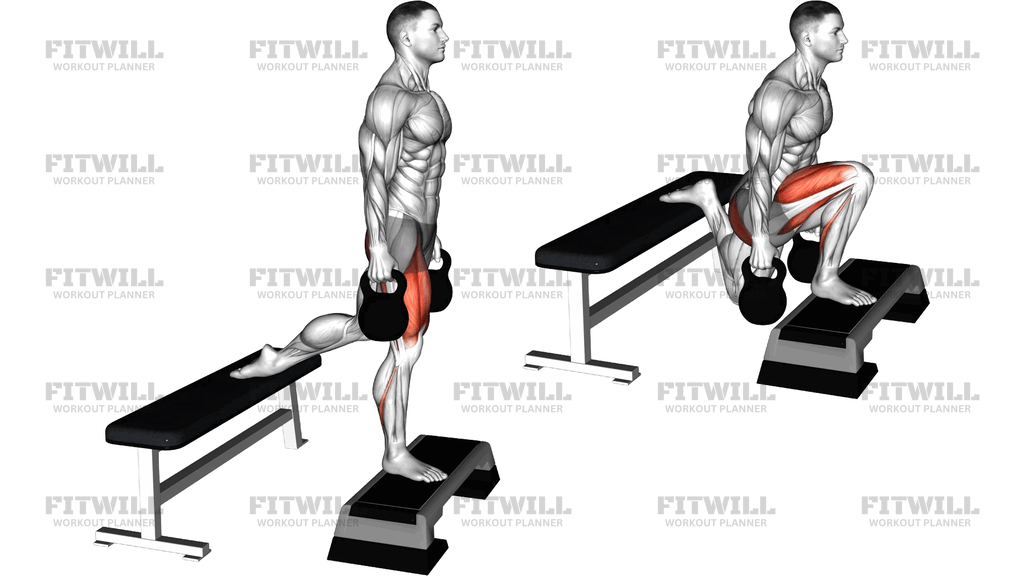
The Bodyweight Step Down is a single-leg exercise where you stand on a sturdy box or step platform, balance on one leg, and slowly lower your free foot toward the floor before driving back up to full standing height. Unlike a step-up, where the emphasis often lands on the pushing leg during the climb, the step down puts the workload on the leg staying on the box as it lowers you under control. That makes it one of the best ways to build eccentric strength in the quads and glutes using nothing but your body weight and a stable platform.
This movement is especially useful for runners, hikers, and anyone who wants knees and hips that handle stairs, descents, and uneven ground without complaint. Because each rep demands that one leg absorb and control your full body weight, it exposes and corrects side-to-side imbalances that bilateral squats can hide. It is also a common rehabilitation and prehabilitation tool, frequently used to build tolerance in the knee after irritation or to strengthen the hips for better patellar tracking.
The muscles doing most of the work are the quadriceps of the stance leg, which control your descent as the knee bends. The glutes, particularly the gluteus medius, keep your pelvis level so your hip does not drop or drift outward, while the hamstrings and calves assist with stability at the hip and ankle. Your core works quietly the whole time to keep your torso upright and balanced over a narrow base of support.
Setup matters more than it looks. Choose a step height that lets your working leg lower with the knee tracking over the midfoot and the heel staying down on the platform. A box around knee height or slightly lower suits most people, and the surface must not wobble. Place your entire foot on the platform, keep your hands on your hips or at your sides, and pick a fixed point ahead of you to help with balance.
Execution comes down to tempo and control. Shift your weight fully over the stance leg, let the free foot reach toward the floor by bending the knee and hinging slightly at the hip, and take two to three full seconds to descend. Lightly tap the floor with the heel or toes of the reaching foot, then push through the whole foot on the platform to stand back tall. The tap should be a touch, not a weight shift; if you find yourself resting on the floor each rep, use a lower step.
In practice, the Bodyweight Step Down fits well as a warm-up activation drill, a main strength movement for beginners, or a high-rep finisher for experienced lifters. Start with two to three sets of five to eight slow reps per leg and progress by adding reps, slowing the tempo, or raising the step height. Stop and lower the difficulty if your knee collapses inward, your hip drops, or you lose balance repeatedly, since those are signs the current height or volume exceeds what you can control today.
[ Workout Log & Planner ]
Put your next workout in Fitwill
Keep your plan and training log ready when you are.


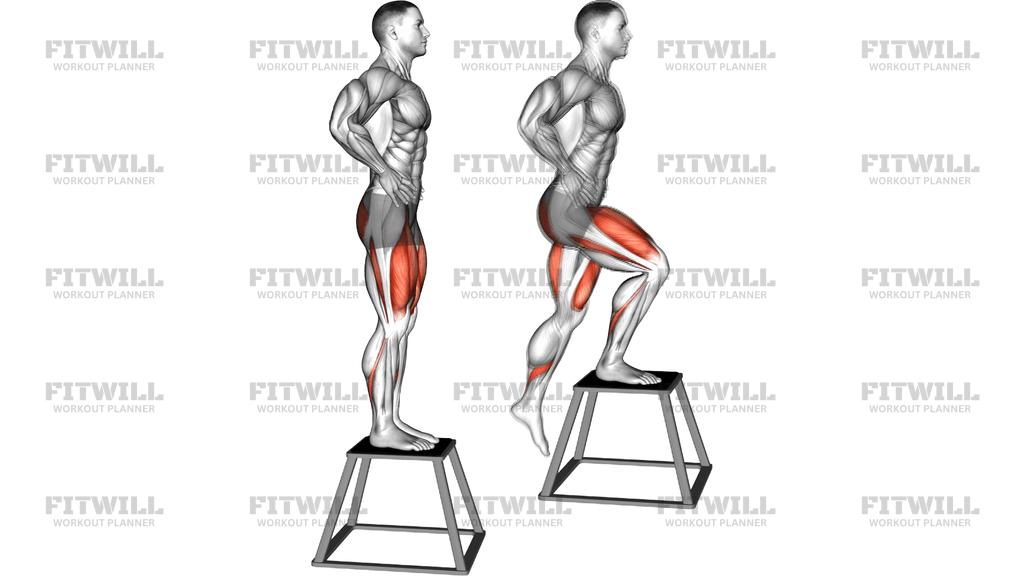
Instructions
- Stand sideways or facing forward on a sturdy step platform or box, with your entire working foot flat on the surface and your other foot hanging just off the edge.
- Place your hands on your hips or let them hang at your sides, and set your feet about hip-width apart in your stance.
- Brace your core lightly and lift the free foot so your full body weight is supported by the stance leg on the box.
- Keep your chest tall, hips level, and your gaze fixed on a point in front of you rather than down at your foot.
- Begin lowering by bending the stance knee and sitting the hips back slightly, allowing the free foot to reach toward the floor in front of the box.
- Descend slowly over two to three seconds until the heel or toes of the free foot lightly tap the floor, keeping the knee of the working leg tracked over your midfoot and the stance heel flat on the platform.
- Without resting or shifting weight onto the lowered foot, press through the whole foot on the box and extend the knee and hip to return to a tall standing position.
- Exhale as you push back up, and inhale slowly on the way down.
- Complete all reps on one leg, then step off carefully and switch to the other side.
- Reset your balance and posture between reps if you wobble rather than rushing into the next descent.
Tips & Tricks
- If your knee dives inward as you lower, think about spreading the floor with your stance foot and driving the knee out over your little toe.
- A common mistake is dropping the hip on the side of the free leg, which turns the exercise into a balance struggle; keep both hips level as if balancing a glass of water on each hip bone.
- Tap the floor with the reaching foot like it is an egg, not a landing. If you can rest between reps, the step is too high or the tempo too fast.
- Keep the heel of your working foot planted on the box for the whole rep. Rising onto the ball of the foot shifts stress forward and away from the quads and glutes.
- Hold a counterbalance, such as lightly touching a wall or rack with one hand, only if balance is the limiting factor; wean off it as your stability improves.
- Slow the descent to four or five seconds before adding step height. Tempo is the safest way to make the Bodyweight Step Down harder.
- Breathe steadily instead of holding your breath; exhale on the push up to help keep your trunk braced without tension spilling into your shoulders.
- If your lower back rounds or arches during the descent, hinge slightly at the hips and think of your torso and shin staying roughly parallel.
- Start with a step that reaches mid-shin to knee height. Full knee-height or higher boxes are a progression, not a starting point for most people.
Frequently Asked Questions
What muscles does the Bodyweight Step Down work?
The quadriceps of the stance leg do the main work controlling the descent, supported strongly by the glutes. The hamstrings, calves, ankle stabilizers, and core contribute to balance and control throughout the rep.
How is the Bodyweight Step Down different from a step-up?
A step-up emphasizes concentric strength as you climb onto the box, while the step down emphasizes the eccentric phase as the working leg lowers you. The step down is generally more demanding on knee control and single-leg balance.
How high should the box be for the Bodyweight Step Down?
Start with a step around mid-shin to knee height, high enough that your knee bends to roughly 60 to 90 degrees at the bottom without pain. Progress the height only when you can lower slowly without your knee caving in or your hip dropping.
Is the Bodyweight Step Down good for beginners?
Yes, as long as the step height is modest and the tempo is slow. Beginners often find balance is the limiting factor at first, so lightly holding a wall or using a lower step is a perfectly valid starting point.
Why does my knee drift inward during step downs?
Inward knee drift usually points to weak or under-active gluteus medius muscles and poor control at the hip. Cue yourself to push the knee out over your second toe and consider adding dedicated hip abduction work alongside this exercise.
How many reps and sets should I do?
Two to three sets of five to eight slow, controlled reps per leg is a solid starting dose. Because it is an eccentric-dominant movement, expect some next-day muscle soreness when you first add it in.
Can I do the Bodyweight Step Down if I have knee discomfort?
Many people use gentle step downs to build knee tolerance, but you should reduce the height and depth to a pain-free range first. If discomfort persists or sharpens during the movement, stop and consult a qualified professional before continuing.
What can I use if I don't have a step platform?
A stable bench, a low stair with a railing, or any firm, non-slip surface of the right height works. Avoid anything that wobbles, since a shifting platform turns the exercise into a balance hazard rather than a strength drill.
Should the free foot rest on the floor at the bottom?
No, the free foot should only lightly tap the floor before you drive back up. If you load that foot between reps, the stance leg loses tension and the eccentric training effect drops off sharply.
How do I make the Bodyweight Step Down harder without adding weight?
Slow the lowering phase to four or five seconds, increase the step height, pause for two seconds at the bottom, or add reps. These progressions increase time under tension while keeping the movement joint-friendly.