Kettlebell Pistol Squat
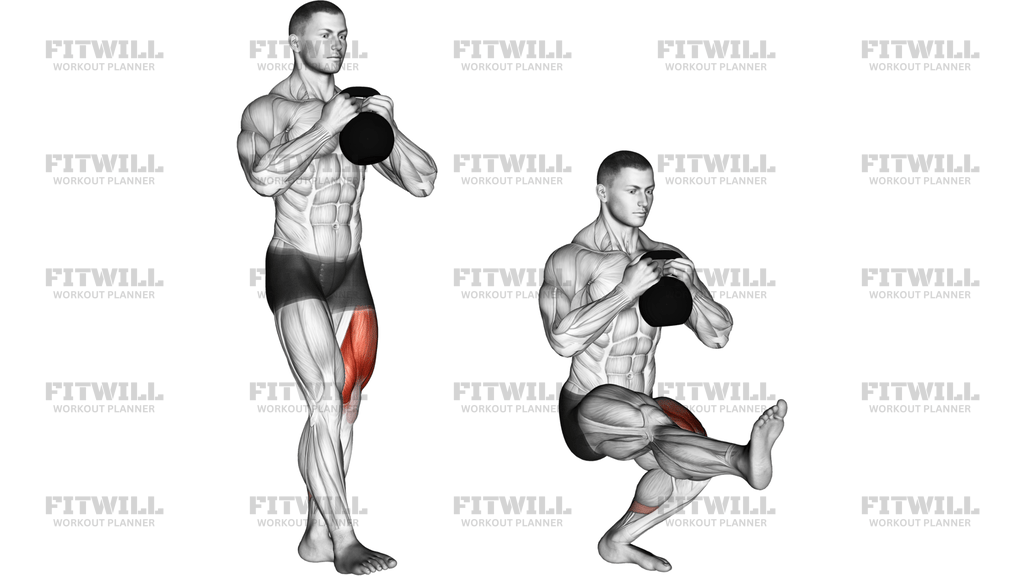
The Kettlebell Pistol Squat is a single-leg squat performed while holding a kettlebell at your chest, with the non-working leg extended straight out in front of you. The kettlebell acts as a counterbalance, letting you lean your torso slightly forward and reach your arms out as you descend, which makes the deep single-leg position far more attainable than a bodyweight pistol for most lifters. The image shows the classic setup: a two-handed grip on the bell at chest height, one foot planted, and the other leg extended forward through the entire rep.
This movement is one of the most demanding unilateral leg exercises you can do. The working leg handles your full body weight plus the load of the bell through a deep range, which builds serious strength in the quads and glutes. At the same time, the extended leg and the single-foot base force your hips, ankles, and deep core to stabilize constantly, so you are training balance and control as much as raw force.
It is especially useful for lifters who want to expose and fix side-to-side differences. Because each leg works alone, a weaker or less mobile leg cannot hide behind the stronger one the way it can in a barbell back squat. It also carries over well to running, jumping, and change-of-direction sports, where you are constantly absorbing and producing force on one leg.
Setup matters more here than in most squats. Your stance width, where you hold the bell, and how far you lean your torso all determine whether you can sit into the bottom position or whether you will tip backward or collapse the working knee inward. Start with a light kettlebell you can press comfortably, and keep the grip tight against your chest with elbows tucked.
To execute well, think about sitting straight down between your hip and your heel rather than pushing the knee forward. Let the bell travel out in front of you as you descend so it counterbalances your hips moving back. Descend until your hamstring meets your calf or as deep as you can control, then drive through the midfoot to stand, keeping the extended leg off the floor the whole time.
Common use cases include unilateral leg strength blocks, home training with minimal equipment, and progressions toward a full bodyweight or weighted pistol squat. Because the balance demand is high, treat your first few sessions as skill practice: low reps, full rest between sets, and no rush to add load. If you cannot reach depth cleanly yet, elevate your heel slightly or squat to a box before chasing the full range.
[ Workout Log & Planner ]
Put your next workout in Fitwill
Keep your plan and training log ready when you are.


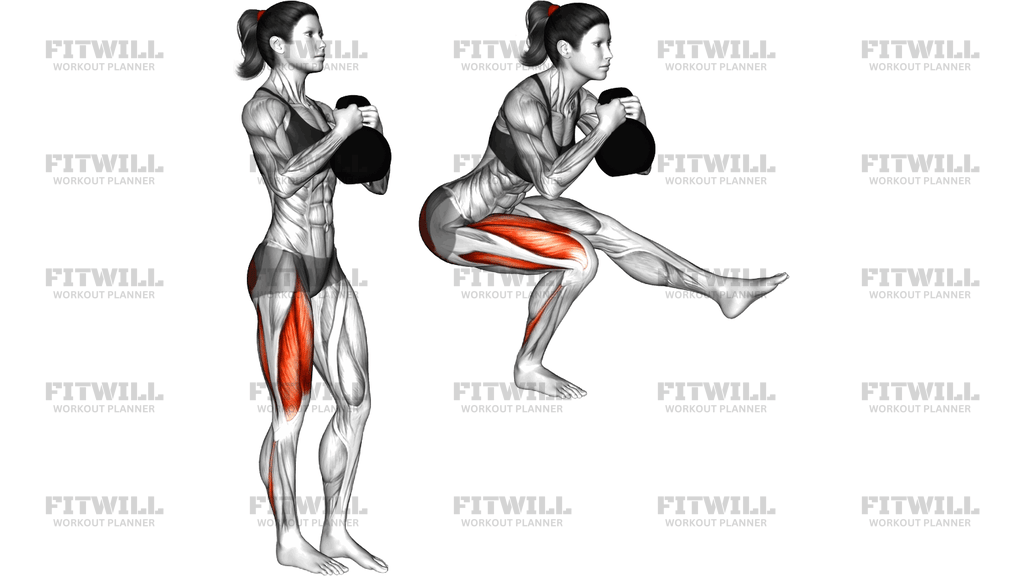
Instructions
- Stand tall with your feet roughly hip-width apart and hold a kettlebell by the horns with both hands at chest height, elbows tucked close to your ribcage.
- Shift your weight onto one foot and lift the other leg straight out in front of you, pointing the toes up and locking the knee so the leg stays elevated throughout the set.
- Squeeze your standing glute, brace your abs as if bracing for a light punch, and pull your shoulders down and back to set your torso.
- Begin the descent by pushing your hips back and bending your standing knee at the same time, letting the kettlebell travel forward with your arms as a counterweight.
- Keep your working knee tracking over your mid-foot, not caving inward, and keep your whole foot planted with the heel in contact with the floor.
- Lower until the back of your thigh rests on your calf or you reach the deepest position you can hold with tension, keeping your chest tall and the extended leg parallel to the floor.
- Pause for a beat at the bottom, then drive through your mid-foot and squeeze the standing glute to rise back to a full stand without letting the extended leg touch down.
- Exhale as you press up and inhale at the top before the next rep; avoid holding your breath through the entire descent and ascent.
- Complete all reps on one leg, lower the free foot to the floor, reset your stance, and then switch to the other leg.
- Rest fully between sets so each rep is performed with crisp balance and a controlled knee path rather than wobbling through fatigue.
Tips & Tricks
- If you keep tipping backward at the bottom, hold the kettlebell slightly farther from your chest and let your arms extend as you descend; the counterweight shifts your center of mass forward where it needs to be.
- A knee that dives inward on the standing leg is usually a glute stabilization issue, not just a cue problem, so think about spreading the floor with your foot and driving the knee out over your little toe.
- Start with a light bell even if your legs are strong; the balance demand of the pistol position is often the limiting factor, and a heavy bell at chest height changes your counterbalance angle.
- If your heel lifts as you reach depth, elevate it slightly on a small plate or thin board so your ankle can reach the range without your foot rolling inward.
- Do not rush the bottom position; a brief pause with the hamstring on the calf teaches you to own the depth instead of bouncing out of it.
- Keep the extended leg genuinely straight and lifted; letting it drift down and hover near the floor turns the rep into a partial single-leg squat and reduces the hip flexor and stability demand.
- Grip the kettlebell handles firmly and keep your wrists neutral; letting the bell drift away from your chest mid-rep pulls your torso forward and dumps tension from your core.
- Film yourself from the side for a set or two; the most common hidden fault is descending onto the ball of the foot instead of keeping the whole foot loaded.
- Master the box version first if full depth is shaky: squat to a knee-height box on one leg with the same bell position, then lower the box height over weeks rather than forcing depth on day one.
Frequently Asked Questions
What muscles does the Kettlebell Pistol Squat work?
The quads and glutes of the working leg do most of the work through the deep squat range. Your core, hip stabilizers, calves, and the hip flexors of the extended leg all work hard to keep you balanced and upright.
Is the Kettlebell Pistol Squat suitable for beginners?
True pistol squats are an advanced movement, but beginners can start with supported versions such as squatting to a box or holding a doorframe for light assistance while keeping the same kettlebell position. Build single-leg strength and ankle mobility gradually before attempting the free-standing version.
Why hold the kettlebell at the chest instead of letting the arms hang?
Holding the bell at your chest in a goblet-style grip lets you extend it forward as you descend, acting as a counterweight for your hips moving back. This is the main reason the kettlebell version is easier to balance than a bodyweight pistol.
How heavy should the kettlebell be for the Kettlebell Pistol Squat?
Choose a bell you can hold securely at your chest for the whole set without your grip or arms giving out first. For most people a lighter bell actually improves the movement at first because the balance and depth demand dominates over load.
My heel keeps rising off the floor at the bottom of the Kettlebell Pistol Squat. What should I do?
This usually points to limited ankle mobility. Elevate your heel on a small plate or thin board, and add dedicated ankle mobility work so you can eventually perform the rep with your whole foot flat.
Can I do the Kettlebell Pistol Squat if I have knee discomfort?
Deep single-leg squatting places high load on the knee, so reduce the range of motion and use a box to limit depth if discomfort appears. If the discomfort persists, stop the movement and have it assessed before continuing.
How many reps and sets should I use?
Treat it as a strength and skill movement: 3 to 5 sets of 3 to 6 reps per leg with full rest works well. Quality of the knee path and balance matters far more than chasing high reps.
What can I substitute if I cannot do a full Kettlebell Pistol Squat yet?
Box pistol squats, rear-foot-elevated split squats holding a kettlebell at the chest, and step-ups all build the single-leg strength this movement requires. Use the same bell-at-chest position so the carryover is direct.
Should I train both legs in the same set or one leg at a time?
Finish all reps on one leg before switching so you can give the working leg full focus and stable foot positioning. Rest briefly between legs so the second side is not performed with tired, sloppy balance.