Push Up Plank Jack Burpee
The Push Up Plank Jack Burpee is a three-in-one body weight conditioner that combines a full burpee, a push-up, and a plank jack into a single repetition. From standing, you drop to the floor, perform a push-up, jump both feet wide and back together while holding a plank, then return to your feet and finish with a vertical jump. Because every rep travels from standing to the floor and back, it trains pushing strength, core stability, and explosive lower body power all at once.
This movement suits people who want a high training effect in a short window of time. It is a staple in conditioning circuits, HIIT sessions, and body weight-only workouts because it drives the heart rate up quickly while still demanding upper body strength. If a standard burpee has become easy but you are not ready for weighted or loaded variations, adding the push-up and the plank jack is a natural progression.
The work is distributed across the whole body. The chest, shoulders, and triceps handle the push-up portion, the abs and hip stabilizers control the plank jack every time the feet jump wide, and the quads, glutes, and calves power the squat, the jump back in, and the final vertical jump. The lower back and deep core work hard to keep your spine from sagging during the plank phase, which is exactly where most form breakdowns happen.
Setup matters more than speed. Place your hands on the floor shoulder-width apart with fingers spread, and aim to land them in the same spot every rep so your push-up groove stays consistent. During the plank jack, keep your hips level with your shoulders; if your hips bounce up or drop, the jack loses its core challenge and starts loading your lower back instead.
A good rep looks smooth rather than frantic. Lower the chest to just above the floor, jump the feet out and in with soft, quiet landings, then stand tall before the jump. Breathe in on the way down to the floor and exhale forcefully on the push-up and the final jump. If your form deteriorates in later reps, slow down or drop the plank jack before you drop the push-up, since the core control is usually the first thing to go.
[ Workout Log & Planner ]
Put your next workout in Fitwill
Keep your plan and training log ready when you are.


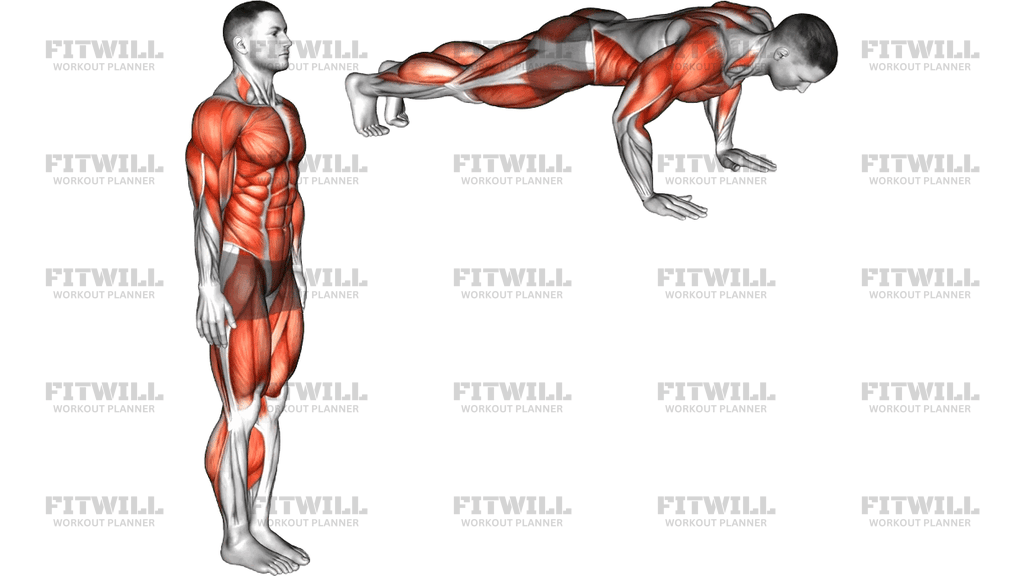
Instructions
- Stand with your feet hip-width apart and your arms relaxed at your sides, with enough clear floor space in front of you to extend into a full plank.
- Hinge at the hips and place your palms flat on the floor shoulder-width apart, fingers spread, then jump or step your feet back into a high plank with your body forming one straight line from head to heels.
- Brace your abs and squeeze your glutes so your hips sit level before you begin the rep.
- Bend your elbows to lower your chest toward the floor, keeping them at about 45 degrees to your torso, then press back up to the high plank.
- From the plank, jump both feet out wide at the same time, then jump them back together, keeping your hands planted and your hips from bouncing up or sagging down.
- Jump or step your feet in toward your hands and rise to a low squat position under control.
- Explode upward into a vertical jump, reaching full extension at the hips, knees, and ankles, and swing your arms overhead.
- Land softly on the balls of your feet with bent knees and immediately flow into the next repetition.
- Breathe in as you lower into the push-up and exhale sharply on the press-up and the final jump.
- Reset your hand position and plank line between reps if your hands have drifted or your hips have dropped.
Tips & Tricks
- Mark your hand position mentally at the start of the set; hands that creep forward rep after rep turn the push-up into a short-range press with your hips piked.
- The plank jack is where most people lose the rep. If your hips start bouncing or sagging, slow the jack down and focus on quiet feet rather than wide feet.
- If your chest never gets close to the floor on the push-up, drop to your knees for the push-up portion only, then pop back up for the jack and jump so the rest of the burpee stays intact.
- Land the final jump with your knees tracking over your feet and your weight mid-foot; stiff, loud landings beat up your knees and ankles on high-rep sets.
- Keep your elbows closer to 45 degrees than flared straight out from your shoulders during the push-up to reduce shoulder strain.
- Do not let the push-up become a hip-hinge hover; if you feel it in your lower back instead of your chest, your glutes have stopped working and your hips have dropped.
- On a hard floor, an exercise mat under your hands and the ball of your foot makes the plank jack landings far more comfortable.
- Time-box the exercise instead of chasing speed. Thirty seconds of clean reps beats forty seconds of sagging hips and half push-ups.
- If your shoulders fatigue before your conditioning does, use a slightly narrower hand position and full lockout on each press so the triceps share the load.
Frequently Asked Questions
What muscles does the Push Up Plank Jack Burpee work?
The push-up phase targets the chest, shoulders, and triceps, the plank jack loads the abs, obliques, and hip stabilizers, and the burpee and final jump use the quads, glutes, and calves. No single muscle dominates because the demand rotates through the body during each rep.
Is the Push Up Plank Jack Burpee suitable for beginners?
Yes, with modifications. Step the feet back instead of jumping, perform the push-up from the knees, and make the plank jack a slow step-out and step-in. Once you can hold a clean plank throughout, add the jumps back in.
How is the plank jack different from just jumping the feet in and out during a normal burpee?
In a standard burpee you jump the feet straight in toward your hands. In this version you first jump them out wide and back together while holding the plank, which adds an extra core-stability challenge in the exact position where most people sag.
Why do my hips sag during the plank jack portion?
The abs and glutes have stopped holding the plank position while your feet are moving. Slow the jack down, brace your stomach as if bracing for a light punch, and squeeze your glutes before each jump out.
Should my chest touch the floor on the push-up?
Your chest should lower to just above the floor or lightly touch it if you can keep a straight body line. If touching the floor forces your hips down first, shorten the range slightly rather than breaking your plank position.
What can I substitute if the full Push Up Plank Jack Burpee is too hard?
Use a step-back burpee with a knee push-up and a slow plank step-out instead of a jack. You keep the same movement pattern from standing to floor and back while reducing the impact and strength demand.
How many reps of the Push Up Plank Jack Burpee should I do?
Work in time blocks of 20 to 40 seconds or sets of 6 to 10 reps, stopping when your plank line breaks down. Quality matters more than rep count because a sagging plank jack transfers stress away from your core.
Is this exercise hard on the knees or lower back?
It can be if you land stiffly or let your hips collapse in the plank. Soft landings on the balls of your feet, level hips, and a braced midsection keep the stress on your muscles instead of your joints.
Where should my hands be placed during the Push Up Plank Jack Burpee?
Place them flat on the floor about shoulder-width apart with fingers spread, and keep them planted through the push-up and plank jack. Moving your hands mid-rep wastes energy and makes each push-up slightly different from the last.