Boxing Low Hook (With Dumbbell)
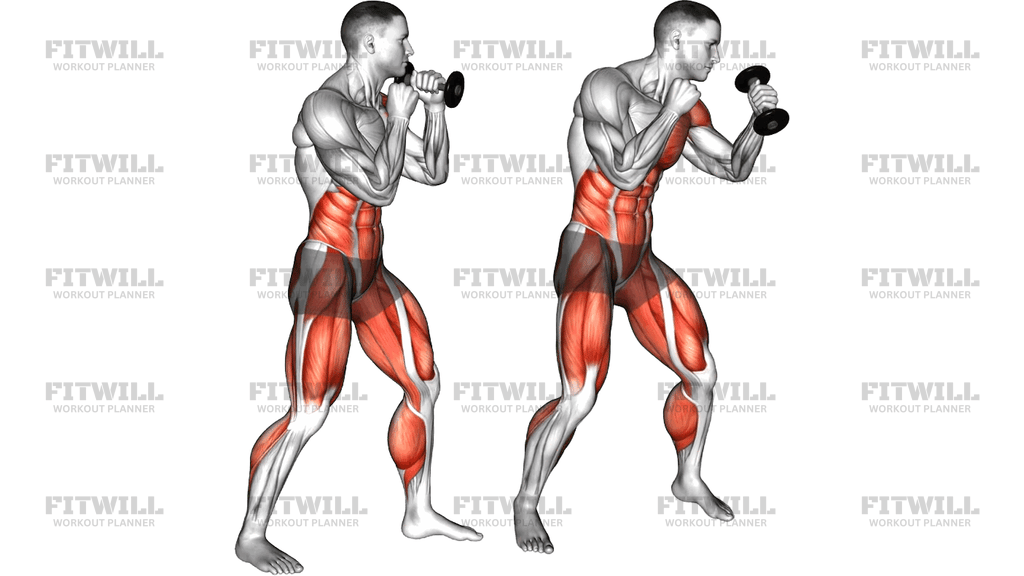
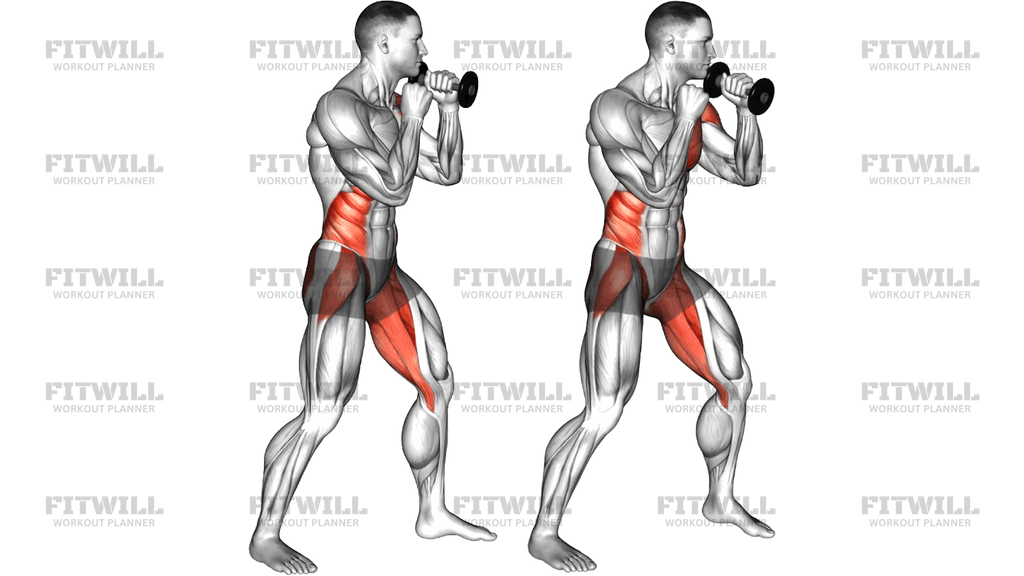
The Boxing Low Hook (With Dumbbell) takes the body hook from the ring and turns it into a loaded rotational exercise. You stand in a staggered boxing stance with a dumbbell held at chin level in each hand, then pivot your hips and drive one elbow out and across so the punch travels at waist height, as if hooking an opponent's body. The working side of your trunk rotates hard while the opposite side braces, which is why the obliques and the lead thigh do most of the visible work.
This movement suits anyone who wants rotational strength that actually transfers somewhere. Boxers and martial artists use it to groove the exact hip pivot and trunk shortening a body hook demands. General lifters benefit from it because most traditional training happens in the sagittal plane, and this exercise forces you to rotate, absorb force through a bent-knee stance, and stay balanced with weight in your hands.
The main muscles involved are the obliques on the side you are hooking with, supported by the deep core as it controls the turn. The front of the lead leg and the glutes stay active the whole time because your stance is low and slightly crouched, and the shoulder and arm guide the dumbbell through the arc. The front shoulder works to keep the elbow at punching height rather than letting it drop.
Setup matters more than people expect. Because you are holding load and rotating at speed, your feet need a stable staggered base, knees softly bent, and your torso leaning slightly forward so the hook travels to body height, not head height. If your stance is too tall or too narrow, the rotation comes from your lower back instead of your hips, which is where strain usually starts.
To perform it well, think of the punch starting from the ground. The rear or lead foot pivots, the hip whips around, and the arm simply follows the arc with the elbow bent and the dumbbell close to your body. Snap into the end position, feel the side of your waist compress, then bring the dumbbell back to your chin under control rather than letting it swing you around.
In practice, this exercise works well as a finisher on core days, as a warm-up groove drill for combat athletes, or as part of a circuit where it pairs with straight punches, footwork, or med ball rotational throws. Keep the weight modest. A dumbbell you can control through a fast arc with clean footwork will train more than a heavy one that drags your form apart.
[ Workout Log & Planner ]
Put your next workout in Fitwill
Keep your plan and training log ready when you are.


Instructions
- Grab a dumbbell in each hand and hold them at chin level in a boxing guard, palms facing inward and elbows tucked close to your ribs.
- Take a staggered stance with your lead foot forward and your rear foot back and slightly out, knees bent so your hips sit lower than in a normal standing position.
- Lean your torso a few degrees forward and brace your core so your ribs stay stacked over your hips.
- Pivot the foot on the same side as your working arm, driving the heel up and turning the knee inward as the hip begins to rotate.
- Sweep the working elbow out and across in a short arc at waist height, keeping the dumbbell near your body and the wrist straight, as if hooking a target at your opponent's ribs.
- Rotate the opposite shoulder back as you turn, letting the side of your waist compress at the end of the punch rather than leaning sideways to fake the range.
- Reverse the arc and return the dumbbell to your chin while your foot pivots back to the original stance.
- Exhale sharply as you punch and inhale as the arm returns to guard.
- Complete all reps on one side or alternate hooks with each pivot, resetting your stance and guard fully before the next punch.
Tips & Tricks
- The most common fault is throwing the arm without turning the hip. If your shoulders rotate but your rear foot stays flat, the move becomes a shoulder exercise with a lower back penalty. Exaggerate the heel pivot until it feels automatic.
- Dropping the elbow below waist level mid-punch turns the low hook into a swing. Keep the elbow at roughly rib height and shorten the arc instead of chasing range.
- Do not lean your torso sideways to make the punch travel lower. The forward lean should be constant from setup to finish; rotation happens in the hips and trunk, not in a side bend.
- Keep the non-working hand glued at your chin. It protects your jaw position if you train for boxing, and it stops your upper body from unwinding before the punch is finished.
- Choose a lighter dumbbell than you think you need. Speed plus load is what makes this drill valuable, and a heavy bell will slow your hip snap and pull your shoulder forward at the end of the arc.
- Your lead knee should track over the foot as you rotate. If the knee collapses inward during the pivot, widen your base slightly and reduce the punch speed until the stance holds.
- Keep the wrist neutral and the dumbbell handle firm but not squeezed white-knuckle tight. Excess grip tension travels up the forearm and stiffens the shoulder.
- Breathe out on every punch, even at low weight. Holding your breath during fast rotation spikes internal pressure and makes the last reps sloppy.
Frequently Asked Questions
Which muscles does the Boxing Low Hook (With Dumbbell) target most?
The obliques on the punching side do the main rotational work, with the deep core stabilizing the trunk. The quads and glutes stay loaded through the crouched stance, and the front shoulder controls the dumbbell through the arc.
How heavy should the dumbbells be for the Boxing Low Hook (With Dumbbell)?
Start light, often in the 2-6 kg range per hand, because the punch is a fast rotational movement rather than a slow strength lift. Pick a weight you can accelerate without your shoulder drifting forward or your footwork breaking down.
Should I perform the Boxing Low Hook (With Dumbbell) with a lead hook or rear hook?
Both are useful. The rear hook involves a larger hip turn and more glute involvement, while the lead hook demands faster trunk rotation over a shorter arc, so alternating them covers both patterns.
Is the Boxing Low Hook (With Dumbbell) suitable for beginners?
Yes, as long as the weight stays light and the pivot is learned slowly at first. Beginners should practice the foot and hip rotation without dumbbells before adding load to the punch.
Why does my lower back ache after the Boxing Low Hook (With Dumbbell)?
That usually means the rotation is coming from your spine instead of your hips, often because the feet are not pivoting or the stance is too narrow. Reset with a wider staggered base, exaggerate the heel turn, and slow the movement down.
How is the low hook different from a regular dumbbell punch or cross?
A low hook travels in a horizontal arc at waist height with a bent elbow, while a cross travels straight forward. The hook depends far more on hip rotation and trunk shortening, which is why the obliques dominate here.
Can I do the Boxing Low Hook (With Dumbbell) without equipment?
Yes. Shadowboxing the low hook with empty hands is a valid regression and is often used to groove the pivot before adding dumbbells, though the loaded version builds more trunk strength.
How many reps should I use for the Boxing Low Hook (With Dumbbell)?
For power and technique, work in sets of 6-10 fast, crisp hooks per side with full recovery. For conditioning, longer sets of 20-30 seconds per side work well, but only once the pivot stays clean under fatigue.
Is it safe to punch at speed while holding dumbbells?
It is generally safe with light weights, a braced trunk, and a stable staggered stance, but avoid heavy dumbbells and full-speed throwing at the end range. If your shoulder or elbow starts absorbing the deceleration instead of your core, reduce the load.